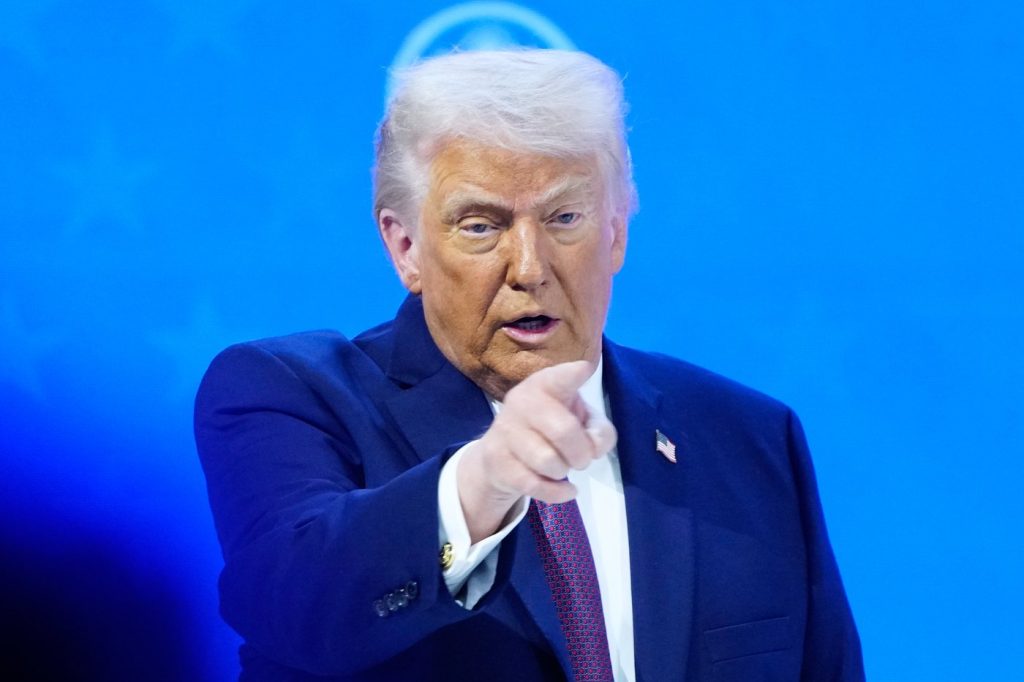
HALIFAX – International trade experts are voicing concerns over U.S. President Donald Trump’s recent threat to impose a staggering 100 percent tariffs on Canadian goods. Experts argue that such a move would inflict considerable damage not only on Canada's economy but also significantly affect U.S. consumers. According to Preetika Joshi, an assistant professor at McGill University’s Faculty of Management, Trump must be aware of this economic backfire, stating, “Yes, he’s hurting Canadian businesses, of course, but he’s hurting U.S. consumers more.”
Trump's comments came after Canadian Prime Minister Mark Carney made headlines, which included a social media post from Trump where he referred to Carney as "governor," a jab at former Prime Minister Justin Trudeau. The president explicitly warned that if Carney believes Canada can serve as a “drop-off port” for Chinese products bound for the U.S., he is “sorely mistaken.” Trump went on to assert that China would “devour” Canada if the latter made agreements with the former, threatening a 100 percent tariff on all Canadian goods entering the U.S.
Earlier this month, Carney announced a reduction of Canada’s tariff on Chinese-made electric vehicles from 100 percent to 6.1 percent, permitting an annual allotment of 49,000 such vehicles. This agreement was reached in conjunction with a reciprocal reduction in Chinese tariffs on several Canadian agricultural products, such as lobster and canola. Unifor National President Lana Payne criticized Trump’s method, stating that it reflects a consistent pattern of threats from the president. She acknowledged concerns about the impact of the China trade deal on Canadian automobile manufacturing while reiterating that the real issue lies with Trump himself.
“He thrives on chaos,” Payne said, underscoring the destructive nature of Trump’s policies on the industrial economy in Canada. She emphasized the necessity for Canada to adopt robust industrial policies, arguing that American workers and businesses would ultimately bear the costs of these adverse trade policies. She is adamant that companies wanting to sell goods in Canada should be encouraged to build their products within Canada.
Romel Mostafa, an assistant professor of international business at Western University’s Ivey Business School, observed that Trump’s recent trip to the World Economic Forum in Davos did not yield positive outcomes for him, citing a particular snub regarding Greenland. Mostafa noted that Prime Minister Carney warned that the old world order is changing, encouraging collaboration among middle powers facing pressure from larger nations through economic coercion. He expressed skepticism regarding Trump’s claims, asserting that the China trade deal does not constitute a pathway for flooding the U.S. market with cheap Chinese imports.
Matthew Holmes, executive vice-president and chief of public policy at the Canadian Chamber of Commerce, reinforced that Canada’s agreement with China is centered around the needs of consumers and businesses in both Canada and China, rather than being a scheme targeting the U.S. market. He mentioned that while Canada strengthens its trade relationships with China, it does not intend to replace its longstanding trade relationship with the U.S., which continues to be beneficial for North American competitiveness.
The Office of the United States Trade Representative reported that Canada was the top destination for American exports in 2024, with bilateral trade reaching over $909 billion. Approximately 85 percent of Canadian goods are exported to the U.S. tariff-free under a free trade agreement, while most goods not covered under the Canada-United States-Mexico Agreement (CUSMA) are subject to a 25 percent tariff. It remains uncertain whether Trump’s threatened tariffs would impact CUSMA-compliant products, as the agreement is due for review this year.
This report highlights the delicate interplay of international trade and the potential repercussions of tariff threats from the U.S. president, stressing the interconnected nature of the economies of Canada and the United States.