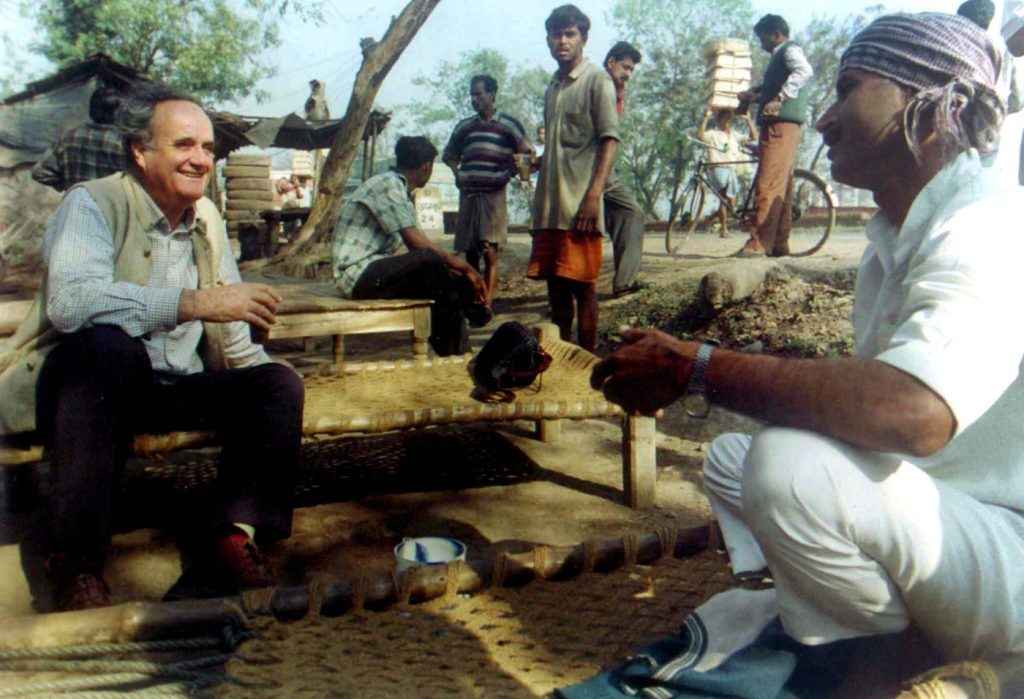
NEW DELHI (AP) — Mark Tully, a distinguished BBC correspondent renowned as the “voice of India” for his extensive coverage and reporting on the South Asian nation, has passed away at the age of 90. The broadcaster confirmed that Tully died on Sunday in a New Delhi hospital following a brief illness.
Born in Kolkata, India, in 1935, Tully made a significant impact on journalism after joining the BBC in 1965. He was appointed the BBC's New Delhi correspondent in 1971 and served more than two decades as the bureau chief for South Asia. His career was marked by in-depth reporting on numerous pivotal events in Indian history, including the 1971 India-Pakistan war that resulted in the birth of Bangladesh, the dramatic siege of the Golden Temple in 1984, the assassination of Prime Minister Rajiv Gandhi in 1991, and the 1992 demolition of the Babri mosque, which ignited widespread riots across the country.
Tully's journalistic influence extended beyond India; he reported extensively from neighboring countries such as Pakistan, Bangladesh, and Sri Lanka. His ability to weave insightful narratives from complex events earned him respect and recognition throughout the region and beyond.
In response to Tully’s death, Indian Prime Minister Narendra Modi described him as “a towering voice of journalism.” Modi highlighted the connection Tully had with the people of India, emphasizing that his work resonated deeply within public discourse. The Prime Minister also acknowledged that Tully's reporting and insights left an indelible mark on the media landscape in India.
Throughout his esteemed career, Tully received numerous accolades for his contributions to journalism. In 2002, he was knighted by Britain for his exceptional services to broadcasting, marking a significant recognition of his influence and commitment to journalism. Additionally, he was honored with two of India’s highest civilian awards: the Padma Shri and the Padma Bhushan, reflecting the high esteem in which he was held both in his home country and internationally.
This legacy of impactful journalism, shaped by Tully's thoughtful reporting and deep understanding of the Indian subcontinent, continues to inspire future generations of journalists. His extensive body of work serves not only as a historical record of India’s tumultuous transformations but also as a testament to the power of journalism in facilitating dialogue and understanding within society.
Mark Tully’s contributions to journalism and his ability to connect with the people he reported on will be remembered and celebrated by both his peers and those who followed his career. His passing is a significant loss to the field of journalism, and the void he leaves behind will be felt profoundly in both India and the global journalism community.