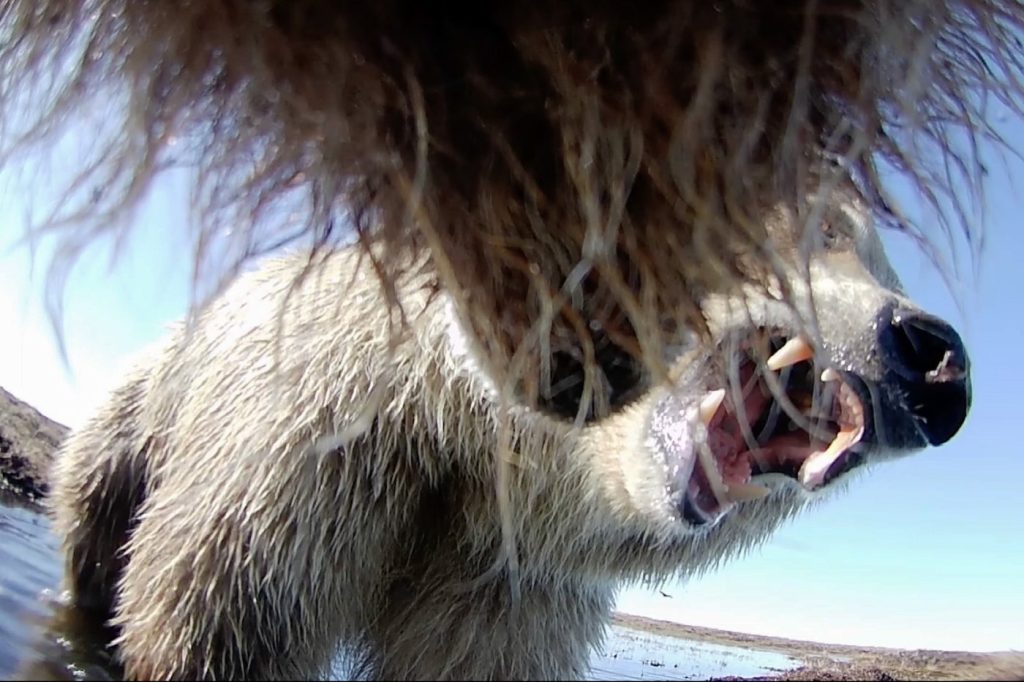
ANCHORAGE, Alaska (AP) — The life of one of the most remote populations of grizzly bears in the world is being captured by the bears themselves through the use of collar cameras. This innovative research project involves twelve grizzlies from a population of approximately 200 that roam the harsh and treeless terrain of Alaska's North Slope, an area located near the Arctic Ocean. The project is a collaboration between Washington State University and the Alaska Department of Fish and Game.
The collar cameras provide a fascinating look into the bears’ daily activities. Video footage shows the bears engaging in various behaviors, including playing or fighting with one another, gnawing on caribou, feasting on berries, napping on beaches, and swimming in search of fish. This documented behavior is critical for understanding how grizzly bears survive in one of the harshest climates on Earth.
The grizzly bears in this region hibernate for approximately eight months each year. According to Washington State University doctoral student Ellery Vincent, who leads the study alongside state wildlife biologist Jordan Pruszenski, these bears have a brief window to accumulate enough fat stores to survive their extended hibernation. Vincent noted the importance of understanding the various types of food the bears rely on to maintain their health throughout the year and the specific eating habits they exhibit.
Among the research objectives is to examine the extent to which these bears hunt musk oxen, of which there are about 300 on the North Slope. However, this population of musk oxen is not thriving, making the bears' feeding strategies all the more crucial to understand. The videos from the first year reveal that the bears primarily consume carcasses of caribou or musk oxen that died during winter. Following this, they target caribou calves as their primary food source. Once the tundra begins to bloom, the bears shift their diet to vegetation, with a strong preference for blueberries and soapberries (commonly known as buffaloberries).
Unlike their counterparts in different regions that feed on salmon, which can grow to impressive weights of up to 1,000 pounds (454 kilograms), the Arctic grizzlies are considerably smaller, weighing in at approximately 350 pounds (159 kilograms). To fit the bears with the collar cameras, researchers tracked them through snowy terrain by helicopter, using tranquilizer darts to safely administer the collars. Pruszenski was responsible for firing the darts, while Vincent monitored the times of injection and assisted in determining the safety of approaching the bears post-anesthesia. The collars were designed to allow for growth as the bears increased weight during the summer months.
The researchers darted the bears in August to replace the collars and again in September to download data collected from the camera footage. They also measured the bears’ weight gain and body fat during these interactions. Once the collar cameras were removed, the bears received GPS collars to provide data essential for understanding how oil-field developments might impact the bears’ populations. Identifying the locations where bears den in the winter is vital for oil companies, which need to avoid these areas when constructing winter roads between drilling sites.
The collar cameras have the capacity to record up to 17 hours of video. During the spring and summer months, they collect short clips—lasting four to six seconds—every ten minutes. As days shorten in the fall, the cameras record clips every five minutes during daylight hours. Although the clips are brief, they furnish valuable insights into the daily lives of these resilient bears living in the remote North Slope, a region spanning around 94,000 square miles (243,459 square kilometers) but home to only about 11,000 residents—nearly half of whom reside in Utqiagvik, formerly known as Barrow.
Vincent highlighted that the bears spend substantial periods foraging for food, significantly increasing the likelihood of researchers capturing insightful video footage of their behavior. The cameras recorded a particular encounter between a grizzly bear and a pack of wolves shortly after the bear's hibernation ended in May. The bear was not in a state to confront the wolves over food, and subsequent clips indicated a peaceful exchange between the two species. Vincent noted that both the bear and the wolves decided not to engage, merely observing each other before moving along.
The study is set to continue for an additional two years, with plans to collar 24 more grizzly bears to expand the research. This ongoing investigation will further enrich the understanding of grizzly bears' survival strategies in one of the world's most uninhabitable environments.