MOSCOW (AP) – On February 16, 2026, mourners gathered in Moscow to mark the two-year anniversary of the death of Russian opposition leader Alexei Navalny, who died in custody under controversial circumstances. The gathering comes amid heightened scrutiny regarding the cause of his death, particularly one reinforced by a recent analysis suggesting he was likely poisoned. Navalny died at the age of 47 in an Arctic penal colony while serving a 19-year sentence that many considered politically motivated.
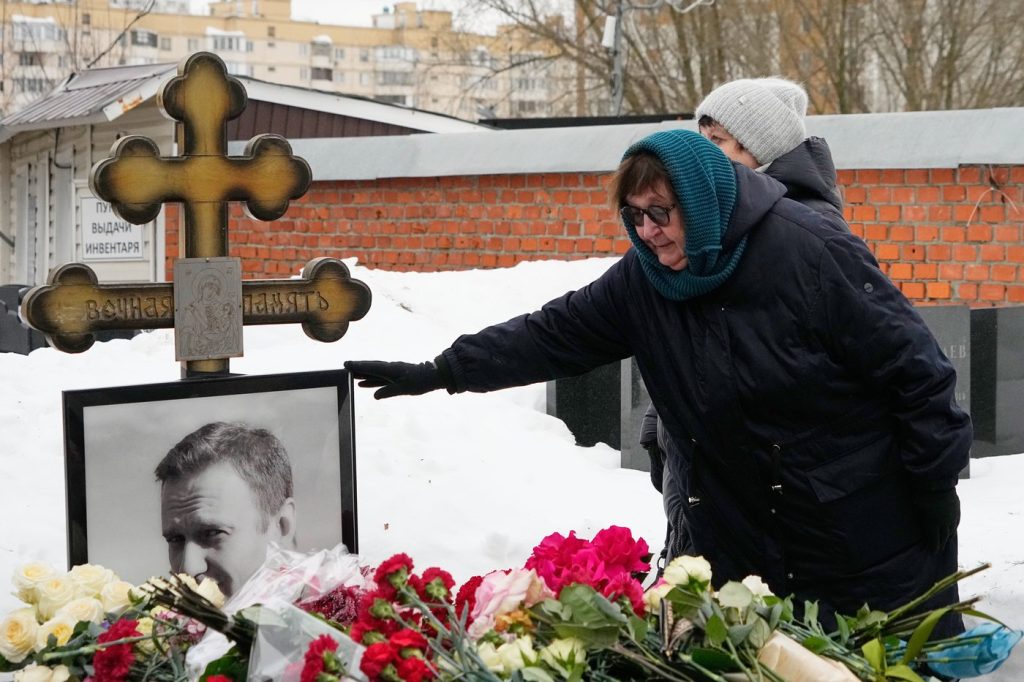
At the Borisovsky Cemetery in Moscow, Navalny’s mother, Lyudmila Navalnaya, along with his mother-in-law, laid flowers on his grave, as a mound of bouquets gathered amidst the heavy snow cover. Various representatives from European embassies were also present, with a notable security presence accompanying the event. A small choir performed by Navalny's graveside, further commemorating his life and contributions to Russian opposition politics.
In her address to the crowd, Lyudmila Navalnaya reiterated her conviction that her son was murdered by Russian authorities, a notion gaining traction among several European nations. "We knew that our son did not simply die in prison," she stated emphatically. "He was murdered." Meanwhile, the Kremlin dismissed these claims, asserting that Navalny succumbed to natural causes.
The timing of the anniversary coincided with a joint statement from five European countries— the United Kingdom, France, Germany, Sweden, and the Netherlands— asserting that Navalny had been poisoned with epibatidine, a lethal toxin associated with poison dart frogs. The foreign ministries involved stated that this neurotoxin, absent from Russia's natural environment, provided conclusive evidence of foul play, reinforcing suspicions of Kremlin involvement. The statement notably remarked, "Russia had the means, motive, and opportunity to administer this poison."
French President Emmanuel Macron expressed his solidarity with Navalny's memory, stating on social media, "I said then that I believed his death said everything about the Kremlin’s weakness and its fear of any opponent. It is now clear that this death was premeditated." He further voiced hopes for justice in the midst of ongoing repression faced by the Russian opposition.
Moscow’s official stance remains adamant in refuting these allegations, with a presidential spokesperson declaring such accusations as "biased and unfounded." The Kremlin maintains that Navalny fell ill while out for a walk, an explanation that has been met with skepticism both domestically and internationally.
In Germany, Navalny's widow, Yulia Navalnaya, attending the Munich Security Conference, expressed her unwavering belief that her husband had been poisoned, stating, "Putin killed Alexei with a chemical weapon," and urging for accountability for the Russian leader. Navalny himself had previously survived an assassination attempt in 2020 involving a nerve agent, which he attributed to the Kremlin.
The state of Russian opposition in the wake of Navalny's death remains fragmented, as many of his closest allies continue to operate from exile. Numerous opposition figures have received lengthy prison sentences in absentia, and some have been designated as "terrorists and extremists," a label applied to Navalny himself in January 2022. The absence of a united front poses a significant challenge for those opposing the Kremlin.
Despite these hurdles, there have been some positive developments, including the establishment of a new body by the Parliamentary Assembly of the Council of Europe (PACE) aimed at providing a platform for Russian democratic forces to engage with European lawmakers. While critics have raised concerns regarding the undemocratic nature of its formation, this initiative has been recognized as a vital step for anti-war activists.
In concluding statements on the anniversary of Navalny's death, Russian members of PACE highlighted the systemic issues within the Kremlin regime that led to his demise, affirming that Navalny "gave his life for a free Russia" and calling for continued efforts to ensure his legacy remains impactful in the quest for justice and political freedom in Russia.