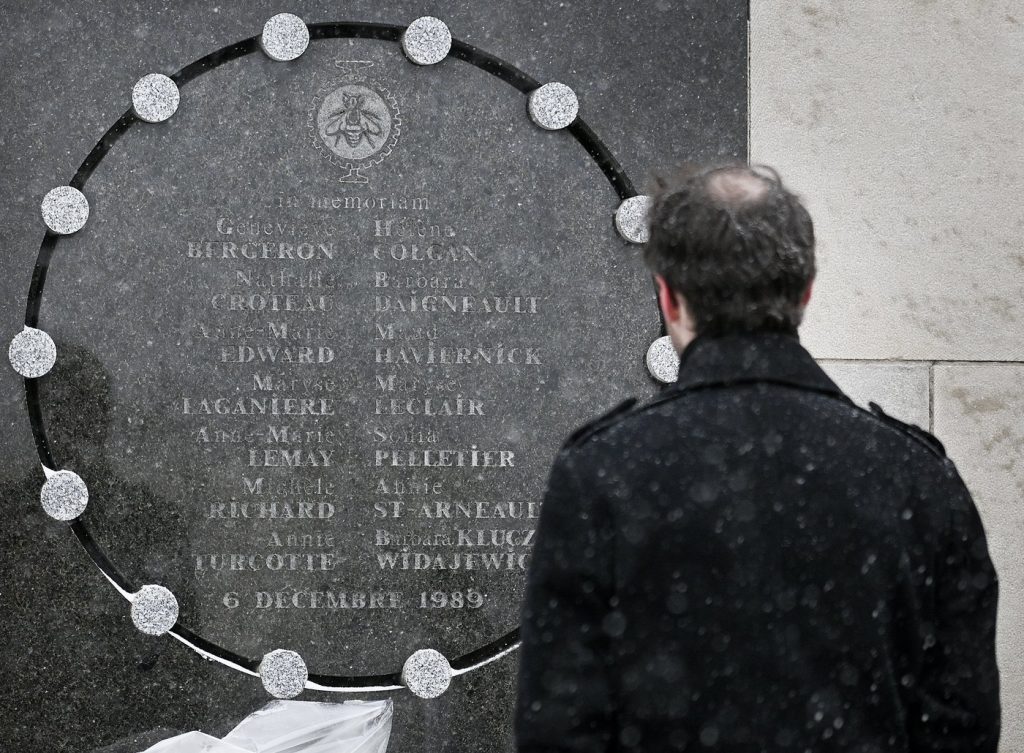
On December 6, 2023, Montrealers and citizens across Canada paused to commemorate the 14 women tragically murdered during the Polytechnique Montréal massacre, which occurred 36 years ago. This event is particularly significant as it emphasizes the continuing fight against gender-based violence.
Prime Minister Mark Carney attended the evening memorial in Montreal, recognizing the importance of remembering the victims while also acknowledging the ongoing challenges in addressing gender-based violence. He remarked that while progress has been made in areas like gun control, it has not been sufficient. "We have to do more with respect, not just to the control of guns… but also in enforcing (laws)," Carney asserted. He specifically mentioned upcoming legislation aimed at establishing stricter conditions related to bail in cases of intimate partner violence.
During the commemoration, a powerful visual tribute was made as 15 beams of light illuminated the night sky above Mount Royal, each light symbolically turned on as the names of the 14 victims were recited. The women who lost their lives in the 1989 massacre include Geneviève Bergeron, Hélène Colgan, Nathalie Croteau, Barbara Daigneault, Anne-Marie Edward, Maud Haviernick, Maryse Laganière, Maryse Leclair, Anne-Marie Lemay, Sonia Pelletier, Michèle Richard, Annie St-Arneault, Annie Turcotte, and Barbara Klucznik-Widajewicz.
The attacker, Marc Lépine, directed his rage towards feminists, taking the lives of these women before ultimately taking his own. This horrific event remains a painful reminder of the toll that gender-based violence inflicts on society. Catherine Bergeron, sister of Geneviève Bergeron, articulated the ongoing impact of this tragedy, stating, "Thirty-six years later, we are still here thinking of her, talking about her, and asking ourselves, 'Why? How?'" She emphasized the importance of remembering and inspiring action against such violence.
Quebec Premier François Legault urged citizens to actively oppose violence against women, stressing the responsibility of individuals to report instances of abuse. "Today, we have a duty to remember... but we also have a duty, each of us as citizens, when we know a woman is being assaulted, to report the perpetrator," he said. This statement underscores the commitment to preventing future tragedies and ensuring that all women have the right to live without fear.
Earlier on that day, a more intimate ceremony took place at Polytechnique Montréal, where students and staff laid wreaths and white roses before a memorial plaque. Maud Cohen, president of Polytechnique Montréal, reflected on the tragic past while also looking forward, stating that it is essential to work towards creating better opportunities and safety for women in engineering.
The National Day of Remembrance and Action on Violence Against Women, also known as White Ribbon Day, commemorates the anniversary of the Polytechnique massacre. Throughout the country, various tributes were held, including a vigil organized by engineering students at the University of Toronto. This group constructed a wooden and glass gazebo-style monument adorned with white roses to symbolize the lost potential of the victims. Kaija Mikes, one of the students, expressed her gratitude for the turnout and highlighted the persistent fear that women in engineering face today.
In a statement, Conservative Leader Pierre Poilievre emphasized that combatting violence against women is a "moral imperative," advocating for a society where every woman can live free from fear and with dignity. Montreal Mayor Soraya Martinez-Ferrada echoed similar sentiments, stating that women have a right to dream and thrive without fear. She emphasized the need to instill values of respect and equality in future generations, reaffirming that the fight against gender-based violence is far from over.
The events not only serve as a solemn remembrance of those lost but also as a rallying cry for ongoing action against violence targeted at women in all forms.