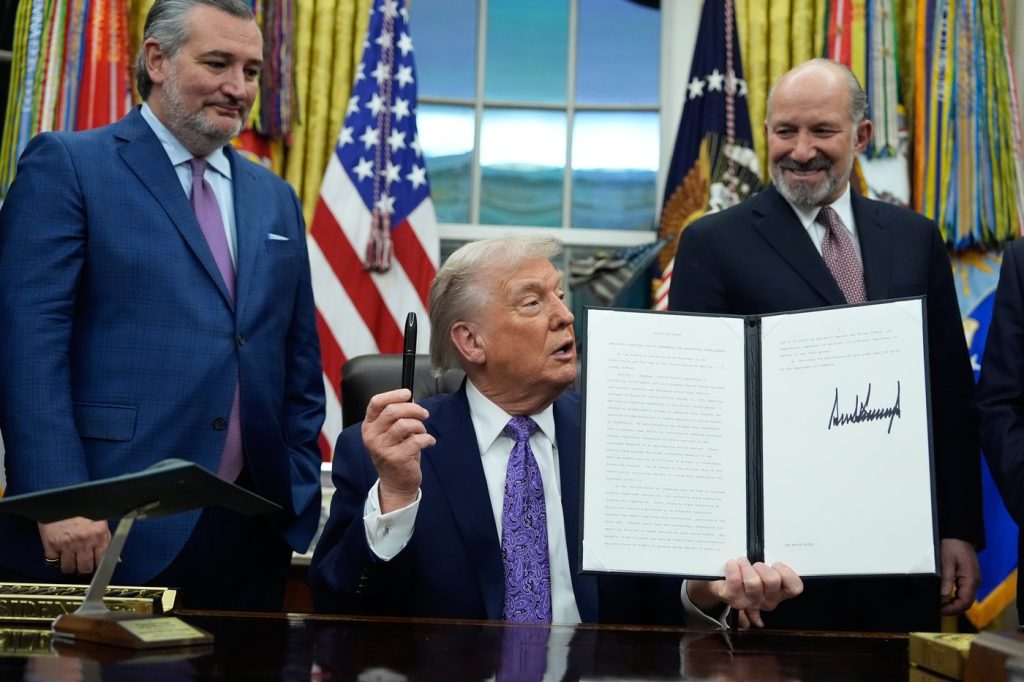
On Thursday, President Donald Trump signed an executive order that aims to prevent individual states from implementing their own regulations on artificial intelligence (AI). Trump emphasized that the rapidly evolving AI industry could be hindered by a patchwork of varying state laws, especially as the United States competes with China for leadership in this critical technology sector. He highlighted the need for streamlined regulations, warning that a system requiring approvals from 50 different states would be counterproductive to achieving technological dominance.
In the Oval Office, Trump expressed his belief that there should be a single regulatory framework for AI, similar to that of China, where companies receive centralized government approvals. He remarked on the significant investments expected in AI but cautioned against the impracticality of navigating multiple state regulations. The executive order authorizes the Attorney General to form a task force dedicated to contesting state laws and instructs the Commerce Department to identify state regulations that may hinder AI development.
The order outlines the potential for withholding funding from states that enforce laws regulating AI, including funding related to broadband deployment and other grant programs. Trump’s administration, represented by David Sacks, a venture capitalist deeply involved in AI investments, intends to challenge “the most onerous examples of state regulation,” while not opposing regulations aimed at protecting children.
States such as Colorado, California, Utah, and Texas have already enacted laws imposing certain AI regulations on private industries. These laws address concerns about privacy and data collection practices, requiring companies to adhere to stricter transparency standards. These state-level rules are seen as necessary responses to the growing influence of AI in everyday decision-making processes, such as job interviews, apartment leases, home loans, and medical care. However, research has highlighted the potential for these technologies to perpetuate biases, leading to discriminatory outcomes based on gender or race.
Beyond basic transparency and data collection limitations, more ambitious regulatory proposals from certain states aim to hold companies accountable for evaluating the risk of discrimination in their AI operations. Some states have also moved to regulate specific aspects of AI, such as prohibiting the use of deepfake technology in elections and banning its use for creating non-consensual adult content. Additionally, there are ongoing discussions about regulations governing the use of AI by government entities.
The executive order reflects a crucial moment in the ongoing debate over AI governance, balancing the need for innovation and competitiveness against the imperative to ensure ethical standards and protect civil liberties. As the landscape of AI regulation continues to evolve, the implications of this executive order will be closely monitored by various stakeholders, including policymakers, civil rights advocates, and technology companies.