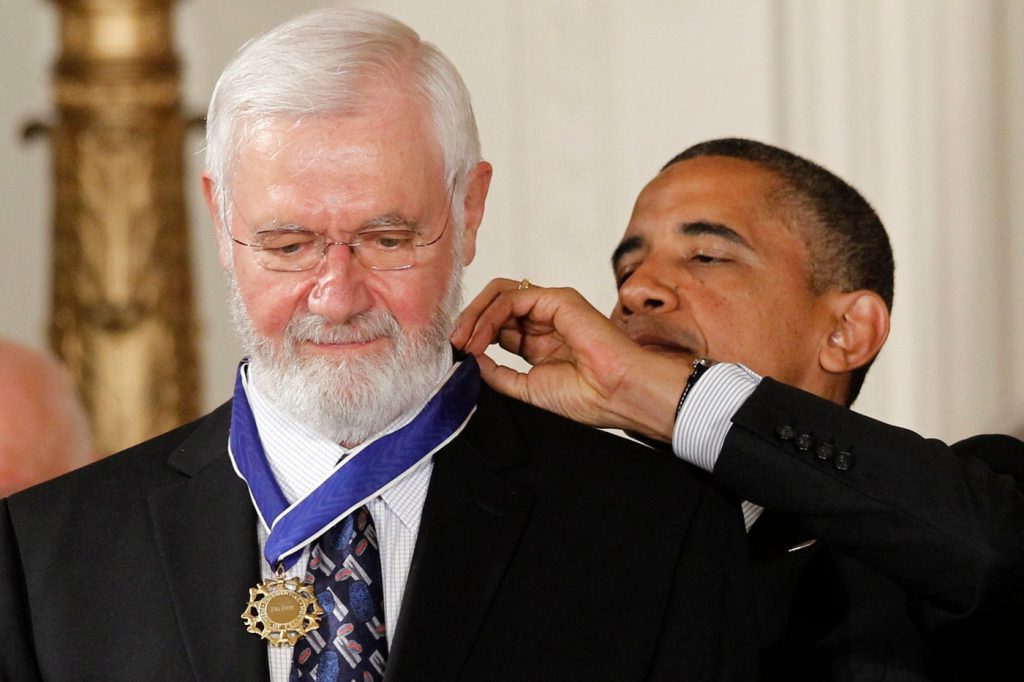
Dr. William Foege, recognized as a pivotal figure in one of humanity's remarkable public health achievements—the global eradication of smallpox—passed away at the age of 89. He died on Saturday in Atlanta, as announced by the Task Force for Global Health, an organization he co-founded.
Standing at 6 feet 7 inches, Foege was a towering presence in the public health sector, known for his sharp intellect and composed nature. His exceptional skills were instrumental in combatting various infectious diseases. Foege served as the director of the U.S. Centers for Disease Control and Prevention (CDC) from the late 1970s to early 1980s, during which time he played crucial roles in several health initiatives worldwide.
Foege's most significant contribution came before he took on the directorship of the CDC, particularly with his groundbreaking work on smallpox. This disease, notorious for its lethality, claimed the lives of approximately one-third of its victims and left many survivors with permanent facial scars. While smallpox vaccinations had gained traction and the disease had been eliminated in the United States, the threat persisted globally, with eradication efforts lagging during Foege's early medical career.
While serving as a medical missionary in Nigeria during the 1960s, Foege and his colleagues pioneered the “ring containment” strategy. This method involved identifying smallpox cases and vaccinating individuals who had come into contact with them, effectively containing outbreaks. This approach was critical, as there was insufficient vaccine supply to immunize entire populations. Foege detailed this method in his 2011 book, “House on Fire,” highlighting its necessity due to limited resources.
The success of the ring containment strategy was monumental, contributing significantly to a worldwide effort that ultimately led to the eradication of smallpox. The last naturally occurring case was recorded in Somalia in 1977, and in 1980, the World Health Organization officially declared smallpox eradicated from the planet.
Dr. Tom Frieden, a former CDC director who frequently consulted Foege, noted, “If you look at the simple metric of who has saved the most lives, he is right up there with the pantheon. Smallpox eradication has prevented hundreds of millions of deaths.” This statement underscores Foege’s monumental impact on global public health.
Foege was born on March 12, 1936, to a Lutheran minister in Colville, Washington. His interest in medicine sparked at the age of 13 while working at a local drugstore. He earned his medical degree from the University of Washington in 1961 and a master’s in public health from Harvard University in 1965.
As the director of the CDC from 1977 to 1983, Foege’s influence expanded beyond national borders. His career also included esteemed roles like executive director at The Carter Center and a senior fellow at the Bill and Melinda Gates Foundation. In recognition of his extraordinary contributions to medicine, President Barack Obama awarded him the Medal of Freedom in 2012, the nation’s highest civilian honor. In a ceremony in 2016, Duke University President Richard Brodhead referred to Foege as “the Father of Global Health.”
Dr. Patrick O'Carroll, the CEO of the Task Force for Global Health, reflected on Foege’s legacy, stating, “Bill Foege had an unflagging commitment to improving the health of people across the world, through powerful, purpose-driven coalitions applying the best science available. We try to honor that commitment in every one of our programs, every day.”
Foege’s life and work exemplify a commitment to global health that will continue to inspire future generations of public health professionals.