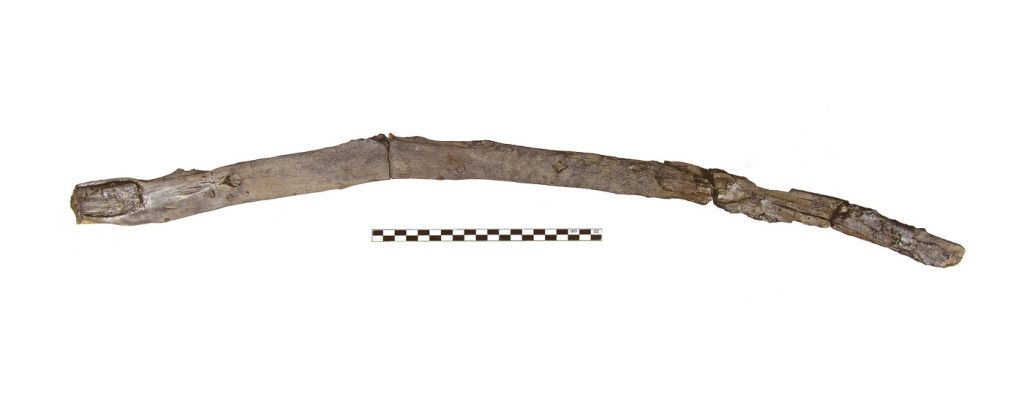
NEW YORK (AP) A significant archaeological discovery in Greece has revealed two artifacts identified as the oldest wooden tools ever uncovered, dating back an impressive 430,000 years. The findings come from the Megalopolis basin in Greece, where researchers have unearthed these tools alongside other remnants, including stone implements and elephant bones marked with cuts.
One of the artifacts is a slender stick measuring approximately 2 1/2 feet (80 centimeters) in length, believed to have been utilized for digging in muddy environments. The second artifact is a smaller, enigmatic piece of willow or poplar wood, which may have served to shape stone tools. This discovery has been reported in the journal Proceedings of the National Academy of Sciences, adding to our understanding of early human technology.
Ancient humans are known to have crafted a diverse array of tools from materials such as stone, bone, and wood. However, wooden tools are particularly difficult to find due to their propensity to decay. Such artifacts are often preserved only in specific environments, including ice, caves, or underwater settings. In this instance, it is believed that the newly discovered tools were quickly buried by sediment and subsequently preserved by the wet conditions of their surroundings over millennia.
Although these tools were not directly dated, the historic significance of the site, estimated to be around 430,000 years old, provides a contextual framework for understanding the age of the objects. Annemieke Milks, a study author from the University of Reading, expressed her excitement about being able to physically interact with these ancient artifacts, highlighting the rare opportunity they present for researchers.
Currently, no human remains have been discovered at the site, leaving the identity of the tool users ambiguous. The tools could have belonged to Neanderthals, early human ancestors, or other hominin species that existed during that time period. Archaeologist Jarod Hutson from the Smithsonian National Museum of Natural History emphasized that the site likely contains additional artifacts awaiting discovery. However, the understated nature of the new tools poses challenges for interpretation and comprehension of their exact functions.
Despite the tools' unremarkable appearance, Hutson remarked on the need for excitement regarding their historical value, given that their exact usage remains unknown. Comparatively, other ancient wooden tools, such as a collection of spears discovered in Germany and Chinese digging sticks dated at around 300,000 years old, are more recognizable in their application.
The discovery of these wooden tools contributes to our understanding of the technological advancements of early humans, offering insights into a little-known aspect of their survival strategies. Katerina Harvati, another author of the study from the University of Tübingen, articulated the significance of this find in illuminating the diverse toolkit utilized by our ancient ancestors.