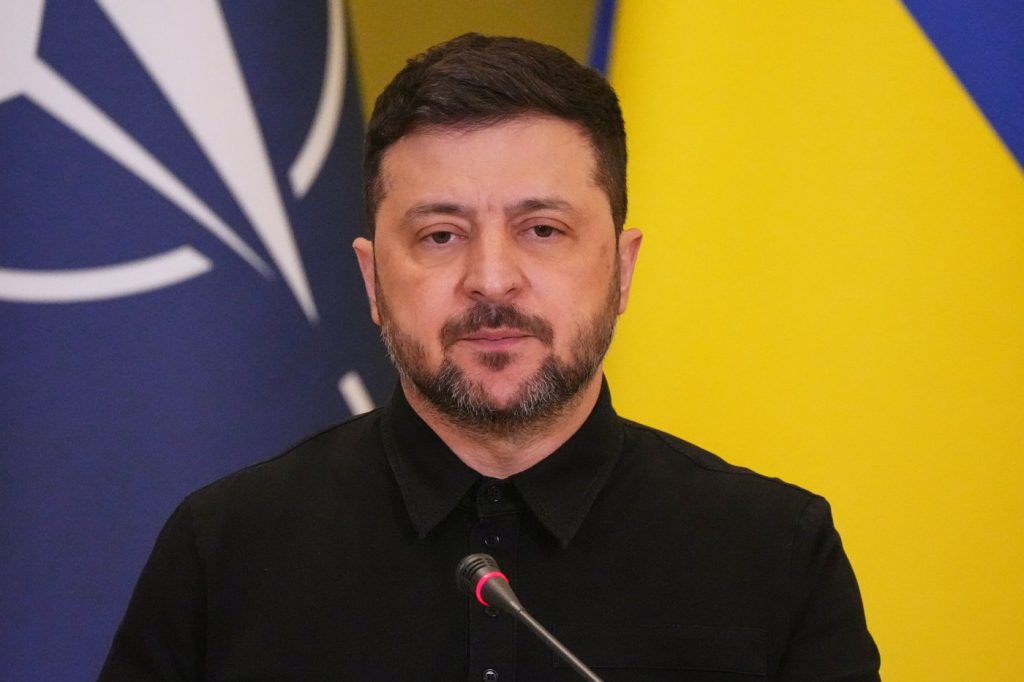
KYIV, Ukraine (AP) – President Volodymyr Zelenskyy announced that the United States has set a June deadline for Ukraine and Russia to negotiate a resolution to the ongoing conflict that has lasted nearly four years. This announcement came amid continuing Russian military attacks on Ukrainian energy infrastructure, which led to reduced output from nuclear power plants.
Zelenskyy revealed that the Trump administration intends to apply pressure on both sides to meet the June deadline. “The Americans are proposing the parties end the war by the beginning of this summer and will likely push for adherence to this timeline,” he stated during a press conference. His remarks were initially embargoed until Saturday morning.
The U.S. has suggested that the parties convene for the next round of trilateral talks next week for the first time in the United States, with Miami being the likely location. Zelenskyy confirmed Ukraine’s participation in these discussions.
During negotiations, Russia has reportedly introduced an economic proposal worth $12 trillion, which Zelenskyy referred to as the “Dmitriev package” after Russian envoy Kirill Dmitriev. This proposal forms part of broader discussions aimed at stabilizing bilateral economic relations with the U.S.
In parallel, Russian military actions intensified with over 400 drones and about 40 missiles launched against Ukrainian energy facilities overnight on Saturday. Zelenskyy detailed in a post on social media that these attacks targeted essential infrastructure, including the energy grid and generation and distribution networks.
The state energy transmission operator, Ukrenergo, reported that this represented the second major attack on energy infrastructure in 2023, compelling nuclear power plants across the country to lower their operational output. As a result, the power deficit in Ukraine has significantly increased, necessitating longer power outages across all regions.
The deadline for negotiations follows recent U.S.-brokered trilateral talks held in Abu Dhabi, which ended without any breakthroughs as the involved parties hold on to conflicting demands. Russia demands Ukraine's withdrawal from the Donbas region, a condition that Kyiv steadfastly refuses as a precondition for peace.
Zelenskyy expressed doubt about progress on managing the Russian-controlled Zaporizhzhia nuclear plant, stating that he is skeptical about a U.S. suggestion to transform the Donbas into a free economic zone as a possible compromise. He noted, “I do not know whether this can be implemented, because we had differing perspectives on it during discussions about a free economic zone.”
In the most recent round of talks, negotiators examined frameworks for technically monitoring a potential ceasefire. He mentioned that the U.S. has reiterated its commitment to playing a role in this crucial process.
As Russian aerial assaults have intensified in recent months, the focus has shifted to Ukraine’s power grid, leading to widespread blackouts and outages that disrupt heating and water supplies in homes during the harsh winter months. This situation has placed additional pressure on the Ukrainian government.
Zelenskyy revealed that the U.S. has proposed a ceasefire that would include a ban on strikes against energy infrastructure. Ukraine is prepared to adhere to such a pause, provided that Russia commits to it. However, he added that a previous U.S.-suggested one-week ceasefire was breached by Russia after only four days.