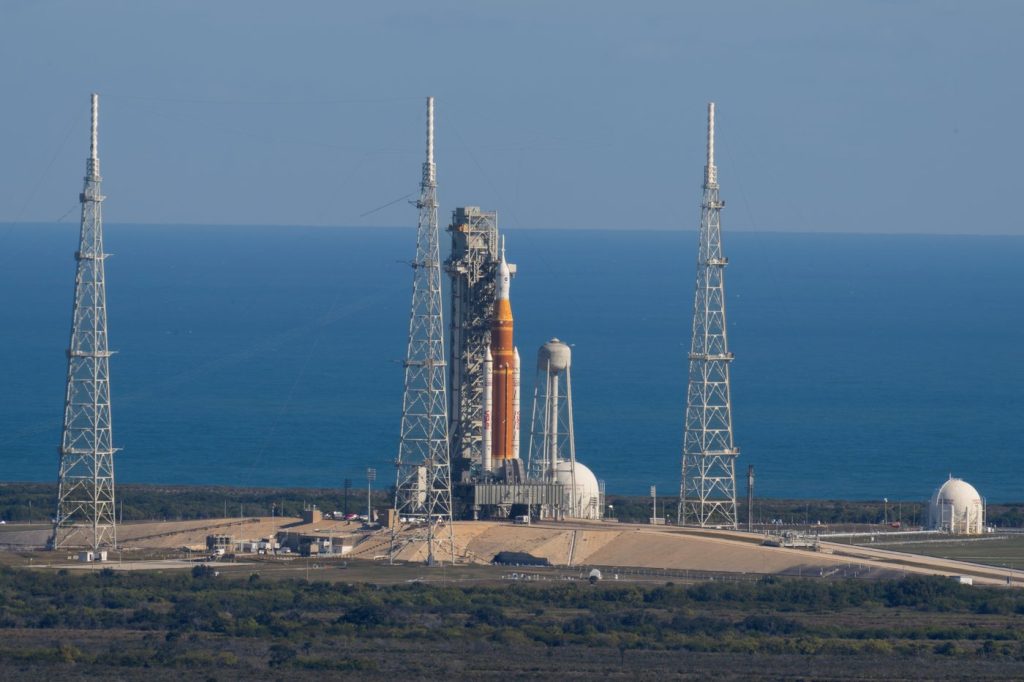
CAPE CANAVERAL, Fla. (AP) – NASA resumed its efforts to fuel the Artemis II Moon rocket on Thursday after addressing previous hydrogen leaks that had disrupted initial rehearsal attempts. The Artemis II mission will mark the first lunar flight with astronauts in more than 50 years, and these rehearsal tests are critical for its planned launch.
During this second attempt in January, launch teams successfully pumped over 700,000 gallons (approximately 2.6 million liters) of supercooled fuel into the 322-foot (98-meter) Space Launch System (SLS) rocket at Launch Complex 39B. The countdown proceeded as planned down to the half-minute mark, after which the team reversed the clocks to rehearse the final ten minutes again.
NASA concluded the test late at night, reporting minimal hydrogen leakage that fell well within safety protocols. This data analysis is pivotal in assessing whether a launch can be feasible by the target date of March 6, 2024, the earliest possible day when the crew of four astronauts could embark on their journey.
In a promising development, the U.S.-Canadian astronaut crew began a two-week quarantine period on Friday, enhancing NASA's flexibility regarding the launch window. Three of the astronauts attended the rehearsal to observe the fueling progress firsthand.
Two weeks prior, the rehearsal faced setbacks when significant quantities of supercooled liquid hydrogen leaked from connections between the launch pad and the SLS rocket. In response, engineers replaced malfunctioning seals and a blocked filter, hoping for successful outcomes in the repeat test. Following Thursday’s fueling results, NASA expressed renewed confidence in the changes made to the seals.
NASA's Artemis II mission has the potential to be historic; the astronauts would be the first to travel to the Moon since Apollo 17 in 1972, undertaking a 10-day round trip without landing or orbiting the lunar surface.
Notably, NASA has struggled with hydrogen fuel leaks dating back to the space shuttle era, as many of the SLS engines were derived from that program. The initial Artemis test flight, which occurred without crew, was delayed for months due to hydrogen leakage issues before it finally launched in November 2022.
The lengthy intervals between missions have compounded these challenges, as highlighted by NASA’s new administrator, Jared Isaacman. A tech entrepreneur who has personally funded missions through SpaceX, Isaacman has indicated that he plans to redesign the fuel connections between the rocket and the launch pad before the upcoming Artemis III mission, which aims to land astronauts near the Moon's south pole—though this mission is still several years away.
Isaacman emphasized that the utmost priority remains the safety of the astronauts, stating, “We will not launch unless we are ready," during discussions on the safety measures employed in the review of ongoing aerospace programs.
On the same day as the fueling test, Isaacman also released a critical report on Boeing's Starliner capsule program, which left two astronauts stranded for extended periods aboard the International Space Station. He noted that the situation could have resulted in the loss of crew members, holding both Boeing and NASA leadership accountable.
This latest round of tests is central not only to the success of Artemis II but also to the future of lunar exploration as NASA prepares for subsequent missions in its ambitious Artemis program.