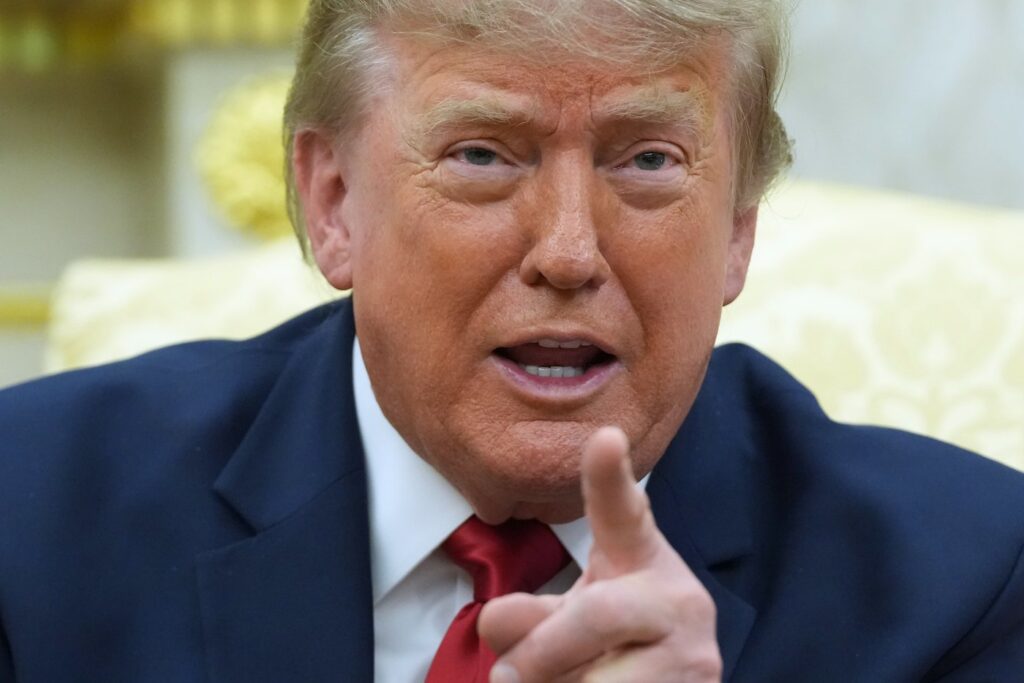
President Donald Trump is scheduled to deliver a primetime address this Thursday at 9 p.m., which he indicated will focus on elections, and may involve revisiting baseless conspiracy theories regarding his defeat to Democrat Joe Biden in the 2020 presidential race. The announcement comes amid Trump's increasing pressure on Republicans to implement tighter federal voting regulations ahead of the upcoming midterm elections in November.
In the lead-up to his address, Trump has been evasive about the specifics of his speech. However, he mentioned that he has "really big news" to share, emphasizing the importance of free and fair elections by stating, "without free and fair elections, you don’t have a country." Despite being asked for more details, he kept the content of the speech under wraps, teasing various topics he plans to touch upon.
Historically, Trump has utilized prime presidential addresses, typically reserved for significant announcements, to deliver politically charged messages. In December, he blamed the challenging economic situation on Democrats. However, this week's forthcoming address seems poised to go even further by amplifying false narratives surrounding the 2020 election in front of millions of viewers. Such rhetoric is aimed at bolstering Republican support in the midterms, which are crucial for Trump as he approaches the latter part of his presidency.
In a recent interview with the conservative outlet Newsmax, Trump reiterated unfounded claims of voter fraud concerning the Los Angeles primary election, suggesting that Republican Spencer Pratt's loss was a result of electoral misconduct, pointedly referencing California's extended vote-counting process. Following Trump's remarks, federal prosecutors announced they were launching fraud investigations tied to the election.
Trump's obsession with voter fraud can be traced back to at least 2016 when he infamously refused to commit to accepting electoral defeat. After winning, he initiated a voting integrity commission to back his claims of widespread fraud, which ultimately disbanded without substantiating any of his allegations. Following his 2020 loss to Biden, he again claimed that cheating occurred, particularly focusing on Georgia, where he infamously pressured the state's Secretary of State to "find 11,780 votes" to overturn Biden's victory. He and several allies faced indictments related to election interference, though those charges were later dismissed.
Despite repeated audits and reviews—many of which were conducted by Republican officials, including his former attorney general, who found no substantial evidence of fraud in 2020—Trump continues to raise doubts about the legitimacy of electoral processes. Moreover, as he gears up for the 2024 election, Trump appears to be laying the groundwork to claim electoral cheating as a preemptive defense against a possible loss.
During his current term, Trump has made voting regulation a cornerstone issue, frequently asserting that he won the presidency "three times." He is advocating for legislation that would mandate voter ID requirements and impose stringent limits on mail-in voting. As the midterm elections approach, Trump's narrative regarding election integrity has shifted into overdrive, especially regarding the potential repercussions if Republicans do not secure victories.
In a notable incident earlier this year, FBI agents executed a search warrant in Fulton County, Georgia, confiscating materials related to the 2020 election amidst increasing scrutiny of the past elections. Following these events, some political figures, such as Maryland Gov. Wes Moore, addressed the implications of Trump revisiting the 2020 election in his upcoming address. Moore derided the strategy as one for "losers," suggesting that the public is fatigued by repetitive discussions of elections from six years prior and accurately recognizing that Trump is unable to accept his loss.
Trump’s recent actions have included removing members from the federal Election Assistance Commission, a bipartisan group that had resisted his push for stringent voter documentation requirements. This ongoing battle over voting laws and regulations indicates that Trump remains entrenched in his perspective regarding elections, further complicating the political landscape as the midterms approach.