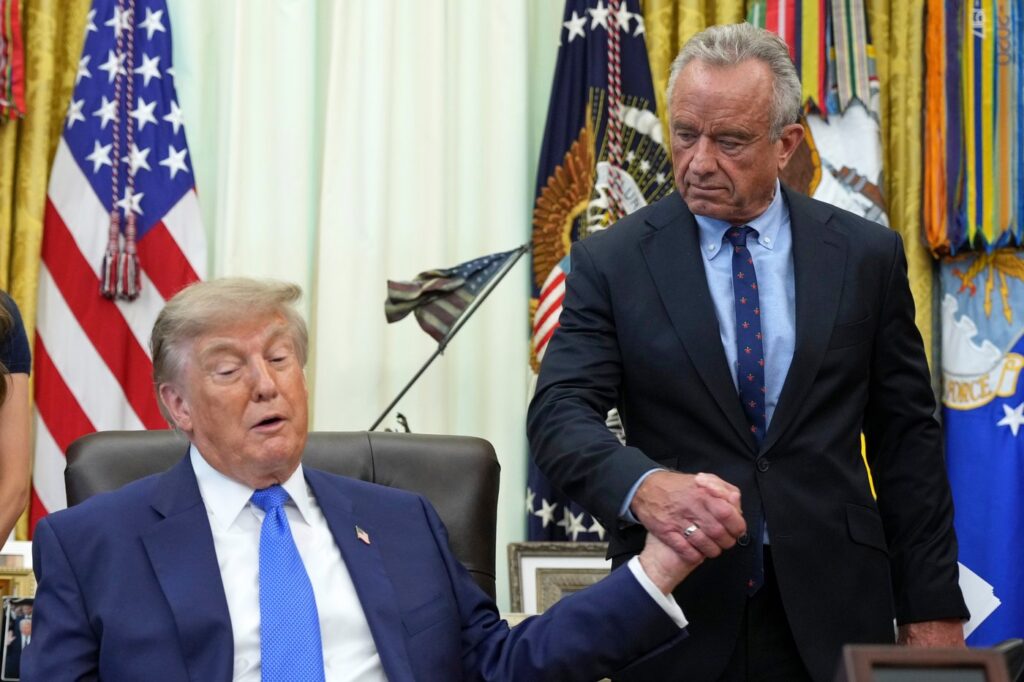
Doctors are expressing strong concerns regarding President Donald Trump’s recent executive order on vaccines, deeming it misguided and likely to breed fear and confusion among parents. This comes at a critical time when measles outbreaks are on the rise, vaccination rates are declining, and children are preparing to head back to school.
Michigan pediatrician Dr. Molly O’Shea highlighted the importance of ensuring children are vaccinated while completing their back-to-school checklists. She noted, “To put into question the safety or efficacy of these vaccines right now is really unfortunate and ill-conceived.”
Trump’s order, signed on Monday, advocates for splitting the measles, mumps, and rubella (MMR) vaccine into three separate shots and administering all childhood vaccinations during distinct appointments, whenever feasible. This directive mirrors changes to the childhood vaccine schedule that have been previously proposed by Trump’s health department but were halted by a federal judge. The department is currently led by Robert F. Kennedy Jr., a prominent figure in the anti-vaccine movement.
Trump has persistently hinted at a potential link between the number or timing of vaccines and the increasing rates of autism spectrum disorder, despite overwhelming evidence from decades of research debunking any such connection. He has also suggested that the MMR vaccine might be detrimental or even fatal.
Dr. Paul Offit, a vaccine researcher at the Children’s Hospital of Philadelphia, criticized the recommendations made by Trump and Kennedy, describing them as “not science-based.” He expressed concern that casting doubt on the effectiveness of the MMR vaccine poses risks to public health, especially amid one of the largest measles epidemics in over three decades.
In discussing his executive order, Trump described the current MMR vaccine as “lethal,” stating that when combined, the risks could be serious, while individually, the shots appear much safer and effective. This assertion was firmly rejected by healthcare professionals who emphasize that the combination vaccine has undergone extensive studies and safety monitoring, confirming its safety.
Dr. O’Shea reiterated that separating these vaccinations is scientifically unfounded and counterproductive to the immune response, stating, “There’s no value in separating them.” Currently, separate vaccines for these diseases are not available in the United States, but Trump's order requires the health department to devise a plan to offer them, asserting that it might provide parents with more options regarding vaccination timing and frequency.
Doctors lament that Trump’s remarks have reignited discredited theories linking vaccines to autism. The prevalence of autism diagnoses has been increasing over the years, with recent data revealing that approximately 1 in 31 children in the U.S. are diagnosed with autism spectrum disorder. Experts explain that this increase is partly due to a broader definition of autism, which has evolved as understanding of the condition has improved, and there is no singular cause to address.
Dr. Andrew Racine, the president of the American Academy of Pediatrics, emphasized that numerous well-structured studies worldwide have unequivocally found no link between childhood vaccines and autism. The misinformation propagated by Trump is viewed as misguided and harmful to families, as it complicates critical medical decisions.
Furthermore, the competing health recommendations generate additional confusion about vaccine schedules for children. In Trump’s first year, Kennedy initiated efforts to overhaul immunization guidelines by replacing members of a vaccine advisory committee and implementing revised recommendations that were subsequently blocked by a federal judge. Consequently, these recommendations aimed at 11 diseases differ from the pediatric academy’s schedule, which continues to advocate immunization against 18 diseases.
Despite insurance coverage not posing a barrier, with Medicaid and CHIP covering the vaccines recommended prior to Trump’s administration, the healthcare community is troubled by the potential rise in vaccine hesitancy. Recent federal data indicates a decline in kindergarten vaccination rates, with exemptions reaching an all-time high in the 2024-25 school year. Experts stress the concerns regarding families potentially delaying essential vaccinations for their children, creating vulnerabilities to vaccine-preventable diseases during gaps in care.
Michael Osterholm, an infectious disease expert at the University of Minnesota, emphasized the need for clear and evidence-based guidance for parents on protecting their children from preventable diseases. He noted that the progression of conflicting messages erodes public confidence in vaccination, ultimately putting children at risk.
In light of these developments, the healthcare community continues to advocate for science-backed public health messaging to mitigate the risks posed by misinformation surrounding vaccines.