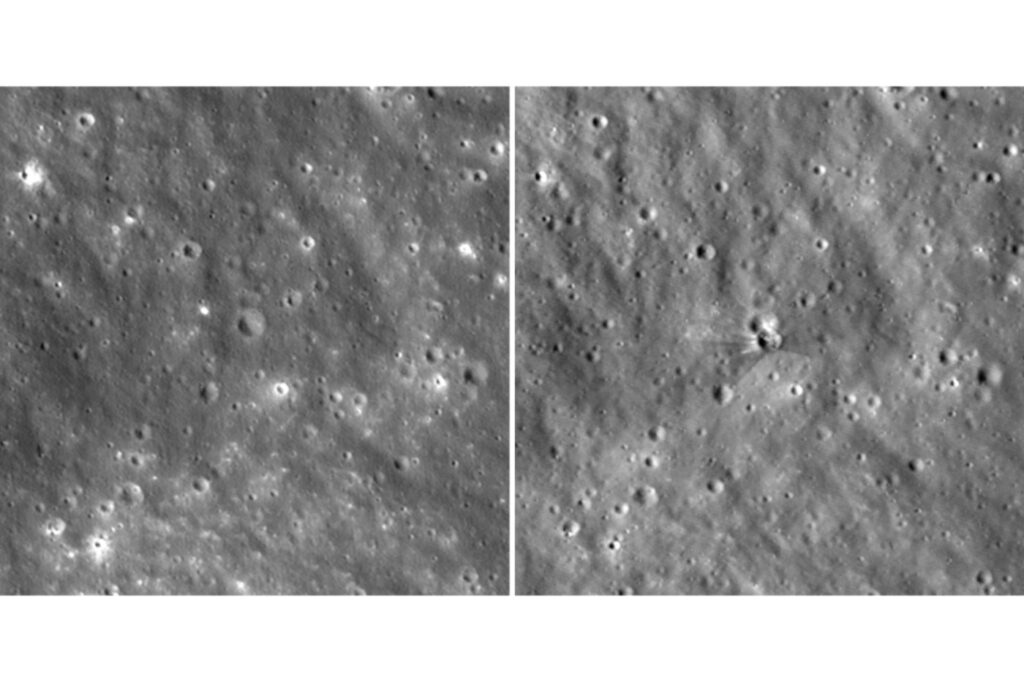
CAPE CANAVERAL, Fla. (AP) - A NASA spacecraft currently orbiting the Moon has captured the most detailed images to date of a crater formed by the impact of a SpaceX rocket. These before-and-after photos showcasing the crash site were released by NASA on Tuesday.
The Falcon rocket's upper stage collided with the Moon at an impressive speed of 5,400 mph (8,700 kph) on August 5, 2022, after drifting through space for over a year. This rocket had been launched to deploy two private Moon landers, which are expected to carry experiments and a small rover to the lunar surface in 2025, as part of NASA's initiative to promote commercial lunar exploration.
According to scientists analyzing the new images captured by NASA’s Lunar Reconnaissance Orbiter, the impact left behind a crater measuring approximately 60 feet (18 meters) in diameter and less than 10 feet (3 meters) deep. The photographs reveal not only the size of the crater but also the surrounding lunar surface, which exhibits dark and bright streaks resembling butterfly wings emanating from the impact point.
The darker streaks are indicative of excavated materials that were brought to the surface and altered by millions of years of exposure to solar wind, cosmic rays, and micrometeorite impacts. Conversely, the brighter rays signify fresh rocks and soil that have been displaced from deeper layers of the Moon's crust during the impact.
The Lunar Reconnaissance Orbiter managed to photograph the crater just a week after the collision, from an altitude of 60 miles (96 kilometers), while traveling at a speed of one mile per second. NASA flight controllers had to adjust the spacecraft's orientation to ensure the cameras were focused on the impact site. The orbiter, which completes a lunar polar orbit approximately every two hours, had to wait six days for the location of the crash to come into its view.
Prior to NASA's release of these images, South Korea's Danuri spacecraft was the first to arrive at the impact site and relay back photos of the event. The Lunar Reconnaissance Orbiter has been in operation since 2009, serving as critical observation equipment for NASA as the agency prepares for the return of astronauts to the lunar surface in the near future.
Overall, these developments highlight the ongoing advancements in Moon exploration and the pivotal role of both public and private partnerships in expanding our understanding of the lunar environment. With detailed imaging capabilities and the promise of future lunar missions, NASA continues to lay the groundwork for further exploration and eventual human presence on the Moon.