NEW YORK (AP) - A telescope at the European Southern Observatory has made a groundbreaking discovery in our galaxy, uncovering the fastest known star, which orbits the supermassive black hole located at the center of the Milky Way. This celestial object is racing around the black hole at astonishing speeds of approximately 15,534 miles per second (25,000 kilometers per second), which is nearly 100,000 times faster than a typical commercial airplane.
Astronomer Stefan Gillessen from the Max Planck Institute for Extraterrestrial Physics emphasized the extraordinary speed of this star, stating, "That star is really, extremely fast." In addition to its remarkable velocity, the newly identified star orbits the black hole at a closer distance than any previously observed star, completing a full revolution in just 8.7 years. This unique proximity allows the star to utilize the gravitational forces of the black hole, enabling it to travel at such high speeds without being pulled into it.
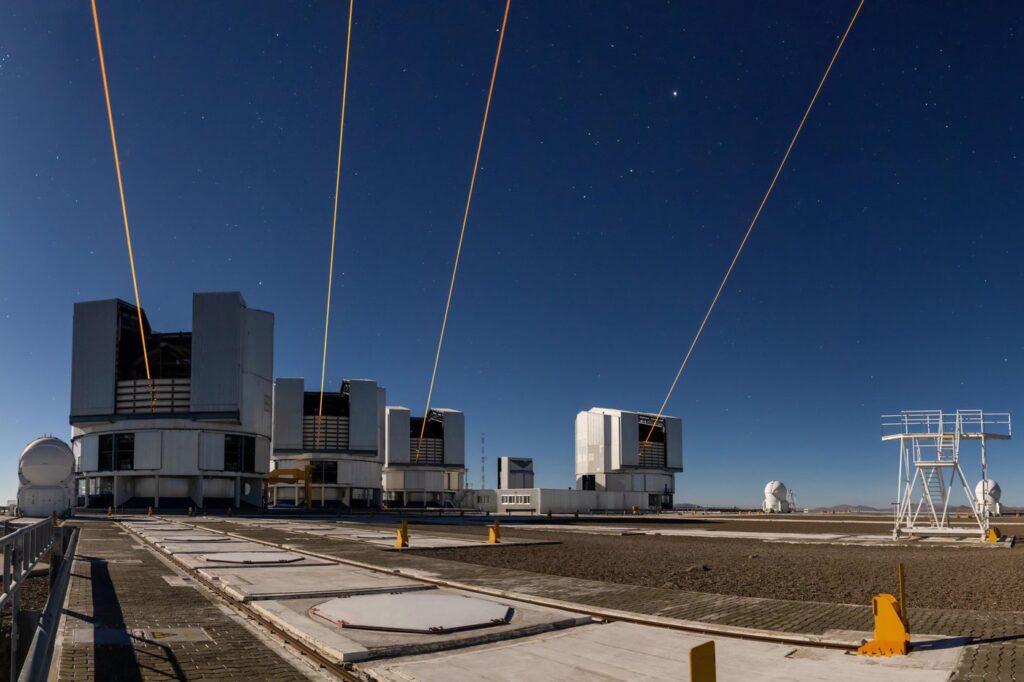
Gillessen and his team analyzed data gathered by the Very Large Telescope situated in Chile's Atacama Desert. Their findings were published in the journal Nature, shedding light on not only the star's speed but also the specific characteristics of its orbit. Among the several hundred stars that closely orbit this immense black hole, scientists have managed to map the orbits of approximately 50. This new discovery places the star ten times closer to the black hole than the previous record holder, which in turn allows it to be influenced by the rotational effects of the black hole.
The presence of supermassive black holes at the centers of nearly all large galaxies makes them intriguing yet challenging subjects for scientific inquiry. Since not even light can escape from these gravitational giants, the inner workings of black holes remain largely a mystery. Consequently, stars like the newly discovered one play a crucial role in helping scientists investigate the elusive properties of supermassive black holes, including their rotational speed and gravitational influence.
Advanced telescopes are proving invaluable in this research, as they enhance the ability to detect fainter stars that may have previously gone unnoticed. Astronomer Tuan Do from the University of California, Los Angeles, who was not part of the study, suggested that this discovery is merely "the tip of the iceberg." As observational technology improves, many more fast-moving stars could potentially be identified around the galaxy's black holes.
This stellar discovery not only provides insight into the dynamics of the Milky Way but also opens new avenues for research into the properties and behaviors of supermassive black holes, which continue to captivate astronomers and scientists alike. With ongoing advancements in telescope technology, the cosmos may reveal even more astonishing phenomena in the future.