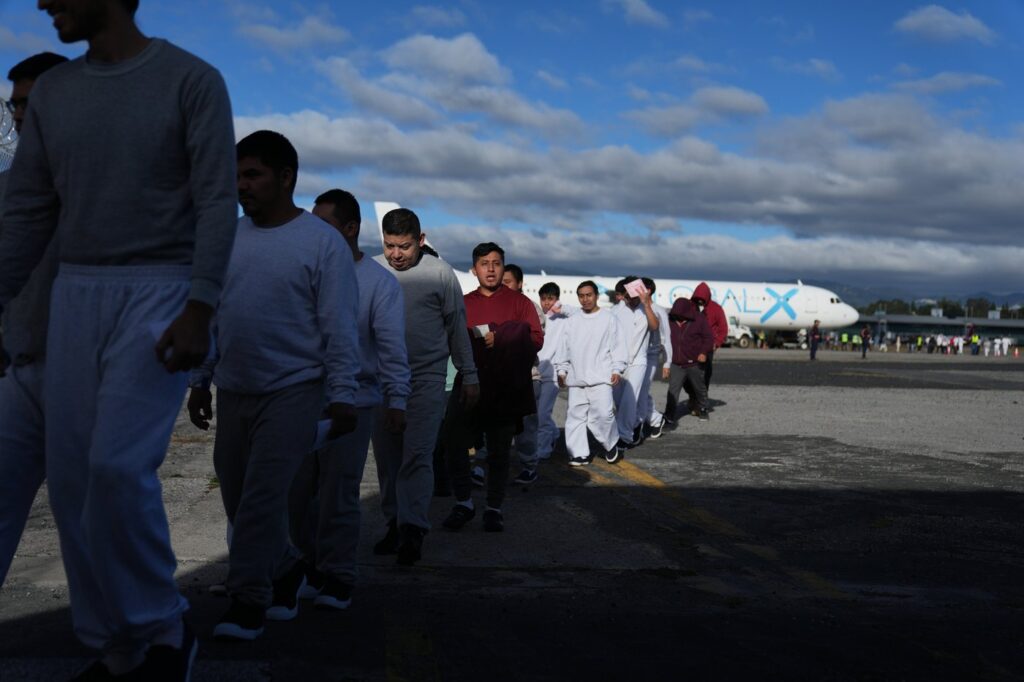
GUATEMALA CITY (AP) – In a noteworthy shift this year, the United States has deported nearly 2,300 Mexicans to Guatemala, with additional individuals also sent to Honduras. This marks a significant change from the early days of U.S. President Donald Trump's second term when deportations of this nature were minimal. Historically, Mexican deportees from the United States were primarily returned directly to Mexico, either by land or air, with only a few cases involving transit through other countries.
The recent increase in deportations to Central America has sparked concern among civil organizations. They speculate that the U.S. government is increasing pressure on Mexico, which has voiced concern over the deaths of 17 Mexicans in immigration custody or during enforcement actions. Additionally, Trump has broadened agreements with various Latin American nations to carry out joint operations against criminal organizations and has elevated security demands on Mexico.
Guatemalan President Bernardo Arévalo confirmed this year that, as part of a “transit stopover” arrangement with the Mexican government, 2,284 Mexicans deported from the U.S. have arrived in Guatemala. These individuals are subsequently sent to Mexico within 24 hours of their arrival and do not hold any refugee or asylum status. The operations are funded by the Mexican government or, in some instances, by U.S. financial backing.
The Mexican government's National Migration Institute (INM) acknowledged the practice of deporting Mexicans to Guatemala and Honduras as a primary tactic since April. They stated that these deportations serve to prevent Mexicans from attempting to re-enter the U.S. The U.S. Department of Homeland Security, which oversees immigration enforcement, commented that they are utilizing all legal avenues to implement what they claim to be the largest deportation effort in U.S. history, aligning with Trump's commitments.
Mexico's Foreign Ministry has expressed dissatisfaction with this practice, asserting that all Mexican citizens possess the right to enter their country. They have also indicated that they are collaborating with involved nations to ensure the safe return of their citizens.
Traditionally, Mexico has been receptive to receiving its deported citizens. However, since Trump’s first term, it has also accepted deportees from third countries, although details surrounding these arrangements have often been unclear. In 2025, Mexico reportedly received around 12,000 deported foreigners, primarily from Cuba and Venezuela, though the government has not updated these figures recently despite the ongoing practice.
Official documents reveal that 82 Mexicans deported from the U.S. arrived in Honduras' San Pedro Sula on two separate flights in August. An additional 35 Mexicans were documented as having arrived on later flights. Between May and mid-July, another 165 Mexicans were reportedly deported to Honduras. Organizations tracking these deportation flights have raised alarms regarding the potential risks faced by migrants who might have sought asylum in the U.S. or who lack resources in unfamiliar countries.
Experts like Savitri Arvey from Human Rights First have suggested that the tactic of third-country deportations may be intended to exert pressure on the Mexican government to prevent any Mexicans from crossing the U.S.-Mexico border. Some deportations were noted to have occurred via U.S. military flights.
As Trump emphasized immigration control as a priority during his administration, he forged agreements with several Latin American countries, including Mexico, Guatemala, El Salvador, Honduras, Costa Rica, and Panama, to act as "bridge" or destination countries for migrants expelled from the U.S. This approach has grown to involve an expanding range of countries, even extending to locations in Africa like Liberia.
Despite a recent uptick in deportations to other nations, Arévalo reported that Guatemala received only 15 Mexicans in 2025, while Honduras recorded six, and Costa Rica accepted 11, with individuals reportedly remaining there due to fears of returning to Mexico. Immigration attorneys have expressed concerns that the Trump administration may be exploiting third-country deportations as a loophole to indirectly force asylum seekers back towards Mexico, particularly when direct deportation would violate judicial orders recognizing the dangers they face. This issue has raised questions about the methods employed by U.S. immigration authorities.