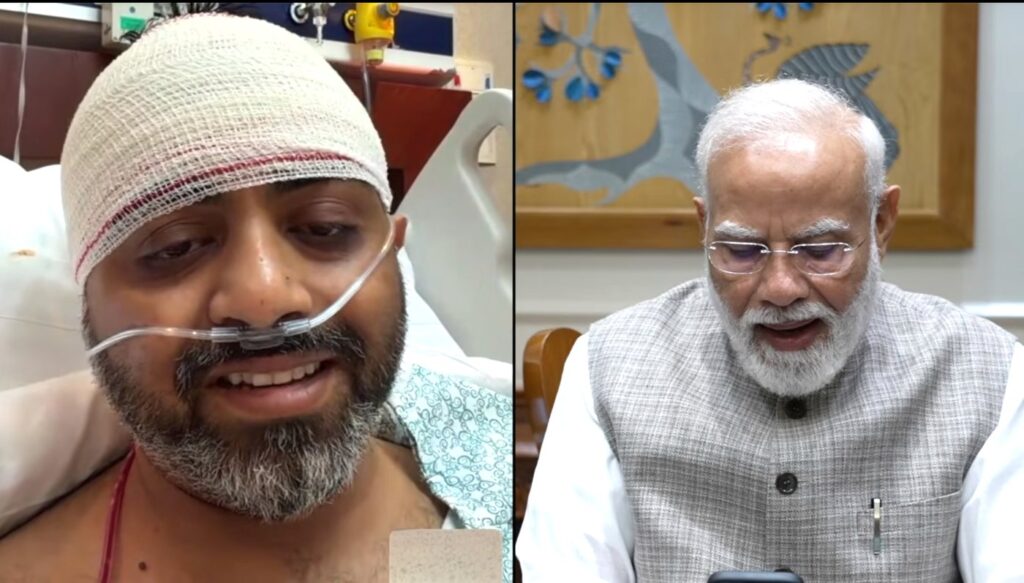
The Indian airline captain, Capt. Smit Machchhar, who played a crucial role in averting what appeared to be an attempted crash of a FlyDubai flight, recounted his harrowing experience during a live video call with Indian Prime Minister Narendra Modi. Capt. Machchhar, who suffered multiple stab wounds from his co-pilot during the incident, emphasized the urgency to act for the safety of the passengers as the aircraft went into a dramatic descent.
In a hospital in Abu Dhabi, Capt. Machchhar described his fight for survival, stating, “I had so many wounds. I had fallen down. I was fighting for my life. At one point I realized that if I didn’t get up… then passengers would lose their lives.” His resolve and instincts kicked in despite his injuries; he managed to open the cockpit door, allowing passengers to restrain the attacker as the Boeing 737 plunged drastically.
Machchhar, who has been flying for 17 years and has served as captain for 11 years, noted, “When I was on the ground I knew that the aircraft was falling… I told myself, ‘one last push Smit, just do it, the door is right there.'” He successfully opened the door despite continuous assaults from the co-pilot, and his actions prompted other passengers to join in managing the situation.
The crisis began over two hours into the flight when the aircraft experienced a sudden and sharp drop to 16,600 feet, marking the steepest descent recorded by flight tracking systems. Almost immediately, the airplane regained altitude, climbing to 21,725 feet only to descend once more to 15,000 feet, where it stabilized before landing safely more than an hour later.
Shortly after stabilizing, the aircraft transmitted its first distress signal, Squawk 7700, indicating a general emergency as it flew along the border between Saudi Arabia and Jordan. This was followed by a second distress signal, Squawk 7500, which suggested an unlawful interference—an indication of a potential hijacking or violent attack. The distress situation lasted approximately one hour.
After sending the second distress signal, the plane altered its course, briefly entering Jordanian airspace before making a 180-degree turn and heading southwest toward Tabuk, where it eventually landed, almost four hours after its departure from Dubai. Israeli Prime Minister Benjamin Netanyahu confirmed that the attacker, an Omani national, was arrested in Saudi Arabia, although the motivation behind the assault remains unclear. An investigation has been initiated by regional authorities.
The shocking incident has prompted a variety of responses across Israel, Saudi Arabia, the UAE, and beyond, raising significant concerns regarding aviation security at a time of heightened tensions in the Middle East amidst the ongoing U.S.-Iran conflict.
Consequently, the UAE has suspended all flights to Israel, creating complications for the hundreds of daily passengers who routinely travel between the two nations. In response to the crisis, Israel and the UAE have agreed to coordinate repatriation flights starting on Friday, according to an unnamed Israeli official. Earlier statements from the national carrier, El Al, indicated that the UAE was delaying the necessary landing permits for flights into Dubai.
In the context of these developments, Ben Gurion International Airport in Tel Aviv scheduled arrivals from Dubai late Friday and early Saturday through carriers Arkia and Israir. El Al is expected to operate flights transporting passengers from Dubai back to Israel on Sunday. Dubai has become a favored destination for Israeli tourists since the normalization of ties between Israel and the UAE in 2020 as part of the Abraham Accords brokered by the Trump administration.