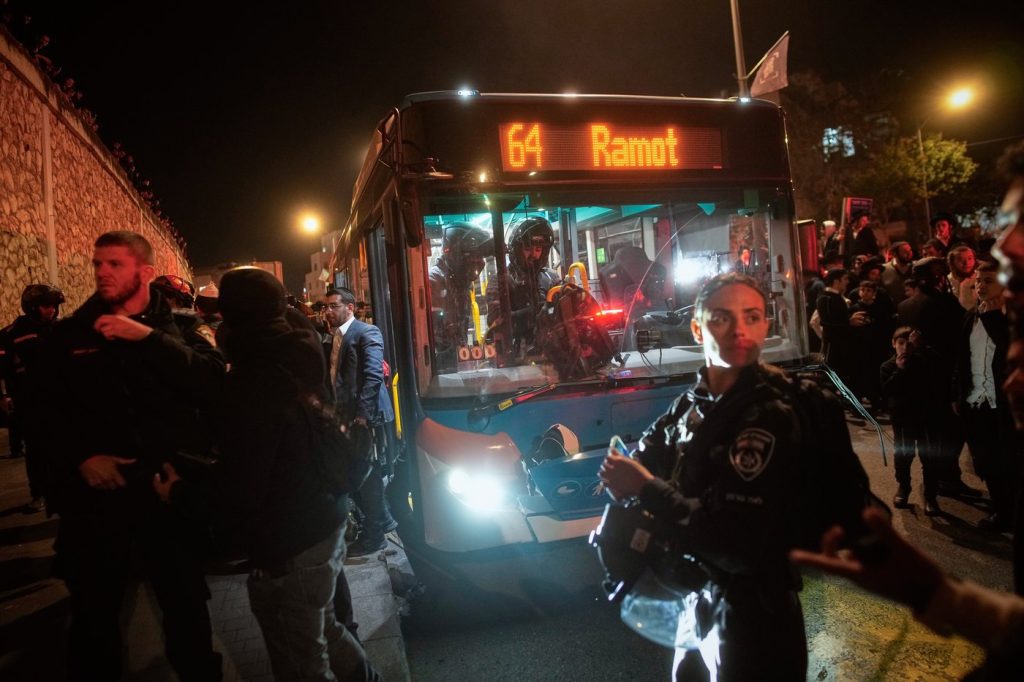
JERUSALEM (AP) — On Wednesday, Israeli Prime Minister Benjamin Netanyahu called for calm following a tragic incident in which a bus driver ran over and killed a 14-year-old boy during a protest involving thousands of ultra-Orthodox Jewish demonstrators. The protest was against proposed legislation that aims to draft ultra-Orthodox individuals into the Israeli military.
Netanyahu urged for restraint, highlighting the need to prevent further escalation that could lead to additional tragedies. He emphasized that the circumstances surrounding the boy's death, identified as yeshiva student Yosef Eisenthal, would be thoroughly investigated. Eyewitness accounts describe a chaotic scene, captured in video footage, where Eisenthal was trapped under the vehicle while the driver continued to drive for several meters amidst shouts and panic from onlookers.
Law enforcement officials arrested the bus driver, who claimed that he was attacked by protesters before unintentionally hitting the boy. As of Wednesday, police have extended the driver's arrest until January 15, though he has not yet been formally charged. Reports indicate that the protests turned violent, with demonstrators throwing eggs and other objects at police officers, reflecting rising tensions between the Israeli government and the ultra-Orthodox community, known as Haredim.
Since the founding of Israel in 1948, a limited number of highly regarded ultra-Orthodox scholars were granted exemptions from compulsory military service. Over the decades, this exemption has grown significantly, largely due to pressure from influential religious political parties. There exists a notable public sentiment among many secular Israelis advocating for a revision of this exemption, particularly among those who have served multiple rounds in combat during the ongoing conflict with the Palestinian militant group Hamas in Gaza.
The proposed measures to enlist ultra-Orthodox individuals into military service have faced fierce opposition and have occasionally sparked violence from religious groups. These groups argue that mandatory military service threatens to undermine their unique way of life. The situation presents a complex political challenge for Netanyahu, who depends on the backing of religious parties within the Israeli Parliament.
The events that unfolded during the protest reflect the fragile state of relations between the Israeli government and various religious communities, exacerbated by the ongoing discussions surrounding military commitments and public service. As tensions rise, the government faces the difficult task of navigating the competing interests of its diverse populace while addressing pressing national security concerns.