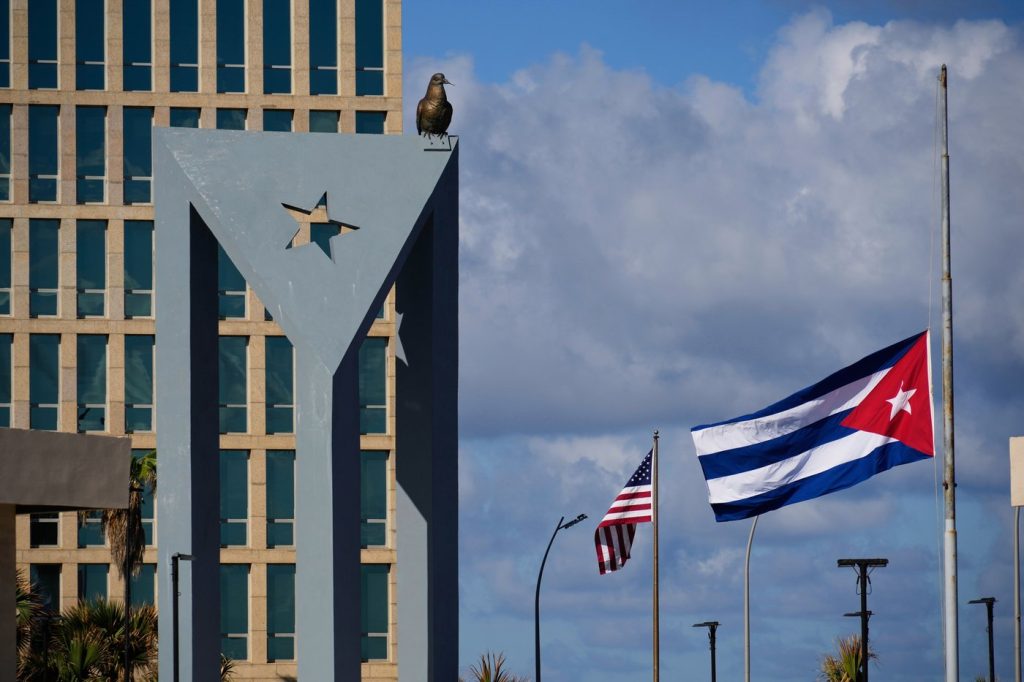
Cuban President Miguel Díaz-Canel announced on Monday that his administration is not engaged in discussions with the U.S. government, following remarks made by President Donald Trump, who threatened Cuba amidst the ongoing U.S. operations in Venezuela. Trump had suggested that Cuba should negotiate a deal “BEFORE IT IS TOO LATE,” leaving unclear what the specifics of such a deal would entail.
Díaz-Canel responded on the social media platform X, stating that any advancement in U.S.-Cuba relations must be founded on international law, rather than on hostility, economic coercion, or threats. He emphasized that Cuba has always been open to a serious and responsible dialogue with U.S. officials, including the current administration, based on principles of sovereign equality, mutual respect, and independence, and without interference in internal matters.
The backdrop to this tension is a reported severing of a crucial lifeline for Cuba, as Trump stated that Cuba could no longer depend on oil and financial support from Venezuela. This situation arose following a U.S. military operation on January 3, which resulted in the deaths of 32 Cuban officers and the arrest of Venezuelan President Nicolás Maduro. Prior to this incident, Cuba was estimated to be receiving 35,000 barrels of oil daily from Venezuela, alongside additional supplies from Mexico and Russia.
On Monday, Mexican President Claudia Sheinbaum refrained from disclosing current oil shipment data to Cuba or whether these shipments would increase following the disruption of Venezuelan supplies. She maintained that this aid has been ongoing and asserted that Mexico's fuel support to Cuba is not a concern, despite the decline in production from Mexico’s state-owned oil company, Petróleos Mexicanos. Sheinbaum reiterated her government’s willingness to facilitate dialogue between the U.S. and Cuba, should both parties agree.
Even with existing oil shipments from Venezuela, Cuba is already facing significant challenges, including widespread blackouts due to fuel shortages and deteriorating electrical infrastructure. Analysts are concerned that a further decline in petroleum supplies could exacerbate the island's ongoing crises, which are rooted in economic paralysis resulting from the COVID-19 pandemic and increasingly stringent U.S. sanctions implemented during the Trump administration. The Cuban government claims that these sanctions have cost over $7.5 billion between March 2024 and February 2025, a devastating figure for an island that saw tourism revenue peak at $3 billion annually in the previous decade.
These economic struggles have sparked a substantial wave of migration from Cuba, particularly towards the United States, where Cuban migrants historically enjoyed specific immigration privileges as exiles. Such privileges were curtailed prior to the closing of U.S. borders under Trump’s administration.
Experts such as Andy S. Gómez, a senior fellow in Cuban Studies at the University of Miami, view Díaz-Canel's statements as a strategic pause for the Cuban leadership to determine next steps. Although he believes Cuba is unlikely to initiate outreach to U.S. officials at this time, Gómez reflects that these are desperate times for the island. Conversely, Michael Galant from the Center for Economic and Policy Research in Washington, D.C., suggests that Cuba may be open to negotiations focused on easing sanctions, although he suspects that Trump is in no hurry to address the situation.
Díaz-Canel reiterated on X that there are no ongoing talks with the U.S. government, aside from technical discussions regarding migration. Despite heightened tensions, daily life continues for many Cubans, although concern about the potential for conflict remains prevalent. Individuals like Oreidy Guzmán expressed hope for change, while Meilyn Gómez prepared for the possibility of unpredictable outcomes under Trump’s leadership.
The current geopolitical climate is generating significant conversation among Cubans, both on the island and in the diaspora. Bartender Rubén Benítez noted a collective readiness among people to defend what little they have left, revealing a profound sense of anxiety amid this delicate and turbulent situation.