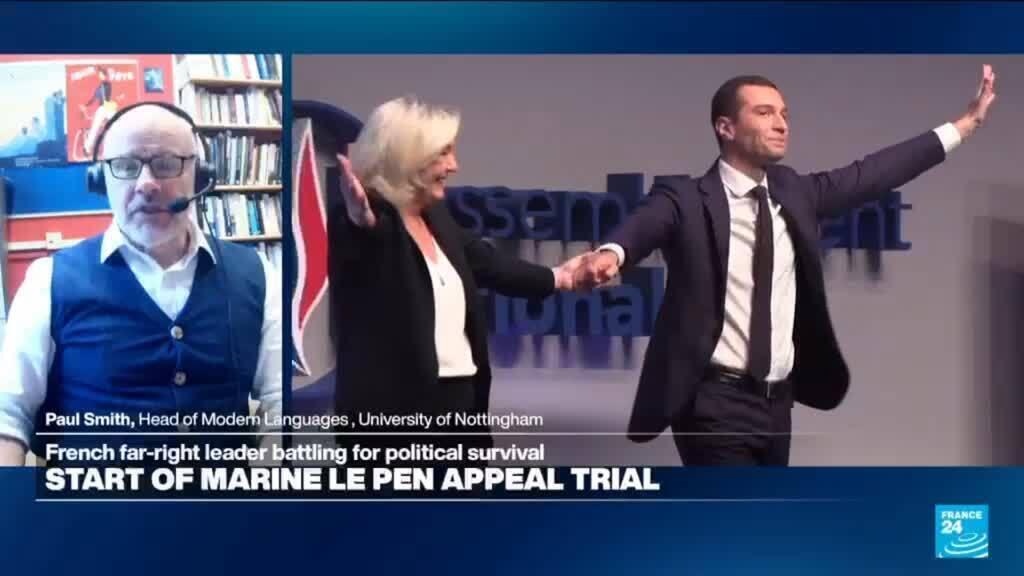
In a turbulent political landscape marked by disillusionment and shifting loyalties, France stands at a critical juncture. The rise of the far-right is not an isolated phenomenon within France but rather a reflection of broader political trends that are taking root across the Western world. These shifts are driven by what Professor Paul Smith, Head of Modern Languages at the University of Nottingham, terms "the politics of frustration," a sentiment that stirs feelings of being "left behind" in a rapidly changing society.
The current situation in France is emblematic of the discontent that is spreading across many Western democracies. Populist movements advocating for far-right and far-left policies have gained traction as traditional centrist parties struggle to maintain their relevance. The disillusionment felt by various segments of the population has led to a significant decline in support for these established political entities. Many voters are attracted to the simplicity and directness of far-right rhetoric, which often blames various societal challenges on immigration and globalization.
As France readies itself for a post-Macron era, the implications of this political shift become increasingly significant. President Emmanuel Macron's centrist government faced numerous challenges, including public sector strikes, combatting inflation, and the fallout from the COVID-19 pandemic. Macron’s attempts at economic reform have left some citizens feeling more alienated, raising questions about the viability of center politics in the long term. Furthermore, the ongoing debates surrounding issues such as national identity, security, and economic inequality exacerbate societal tensions, paving the way for more extreme political ideologies to capture public imagination.
The far-right National Rally, led by Marine Le Pen, has capitalized on these frustrations by presenting itself as a force of change that resonates with voters who feel ignored by mainstream parties. Similarly, left-wing parties have also experienced a resurgence, appealing to those disillusioned with economic inequalities and advocating for a more equitable society. This convergence of far-right and far-left sentiments creates an uncertain political landscape where the center may continue to erode, leading to a fragmentation of the political sphere.
Looking ahead, as the 2027 presidential elections approach, the question looms whether France will continue to see a decline in centrist politics while the far-right and far-left gain ground. The stakes are high, not only for France but for the broader European Union, as the implications of domestic political shifts often resonate beyond national borders. The rising popularity of populist politics feeds into a cycle of polarization that can disrupt social cohesion and destabilize democratic institutions, challenging the very fabric of liberal democracy in the region.
While Macron remains a key figure in shaping France's political future, the dynamics that have contributed to his administration's challenges suggest a turbulent road ahead. As a result, political analysts are closely observing how the electorate responds to ongoing crises and whether they will gravitate towards untested extremes or seek to revive the center. The landscape of French politics is indeed ripe for transformation, with far-reaching consequences for governance, social unity, and France's role in European and global affairs.
```