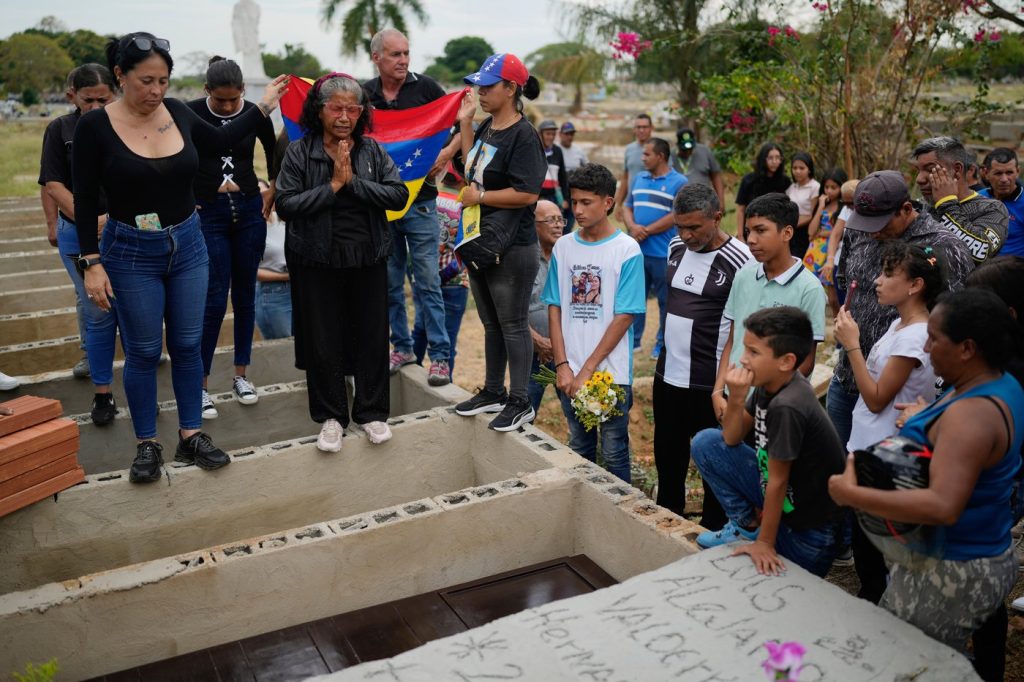
GUANARE, Venezuela (AP) — Freedom came too late for Edilson Torres. The 51-year-old police officer was buried in his rural hometown on Tuesday following his death in a Venezuelan prison. He had been held incommunicado since December, with his family asserting that his detention was politically motivated due to accusations against him. Torres died of a heart attack on Saturday, just as his family was hoping for his release amid government promises to free prisoners as a gesture of goodwill following the U.S. capture of former President Nicolás Maduro. The family's loss has left them devastated, intensifying their grief as well as drawing attention to the plight of numerous families of political detainees in Venezuela.
In the wake of Torres' death, many families who had previously hesitated to seek help from advocacy groups have begun to step forward, seeking to designate their loved ones as “political prisoners.” According to Alfredo Romero, the director of Foro Penal, a non-governmental organization that tracks and advocates for Venezuelan prisoners, there has been a “flood of messages” from families over the past week. Romero noted that these families are increasingly motivated by a newfound hope of potential releases, indicating they view it as an opportunity to rectify their circumstances.
Jorge Rodríguez, the head of Venezuela's national assembly, indicated last week that a “significant number” of prisoners, both Venezuelan and foreign, would be released as part of a peace initiative following the capture of Maduro. For years, both the U.S. and the Venezuelan opposition have demanded the release of detained opposition figures, activists, and journalists, whom they allege are used as political tools by the ruling government. However, the Venezuelan government disputes the notion that there are unjustly detained prisoners, instead claiming that those incarcerated are involved in destabilizing activities against the Maduro regime.
After Torres' passing, Venezuela's Attorney General Tarek William Saab stated that Torres' case was assigned to a terrorism unit and linked to criminal activities as detected by state security agencies. This vague characterization aligns with past accusations directed at critics of the government. Romero from Foro Penal indicated that out of the roughly 300 families that have reached out recently, around 100 of those cases have been verified as politically motivated. This count is in addition to over 800 individuals already reported as detained for political reasons in the country.
As of Tuesday evening, Foro Penal confirmed that 56 individuals deemed political prisoners had been released, although they criticized the government's lack of transparency surrounding these releases. The Venezuelan government refuted Foro Penal's figures, claiming a much higher number of 400 prisoners had been freed, yet it did not provide evidence or details concerning the identities of those released, raising doubts over the official narrative.
Before Torres' funeral, a procession of cars and motorcycles made a stop at a local jail, where his wife is currently detained under unclear circumstances. During the somber ceremony, Torres’ sister, Emelyn Torres, expressed her heartbreak, especially after learning that individuals connected to the WhatsApp group that led to her brother’s arrest had just been released.
Some of those released recently include human rights attorney Rocío San Miguel and opposition leader Biagio Pilieri. Italian businessman Marco Burlò, who was released and subsequently spoke to reporters outside a Rome airport, called his detention a “pure and real kidnapping,” describing the isolation and emotional toll of being cut off from contact with his family and legal representation.
The limited releases in recent days have led to growing criticism from family members of detainees, human rights organizations, and politicians in the U.S., all of whom accuse the Venezuelan government of failing to fulfill commitments regarding broader prisoner releases. Nonetheless, the rapid political changes in Venezuela have created a rare glimmer of hope for families who have spent years contemplating the fate of their loved ones.
Authorities in Venezuela have been accused of an ongoing crackdown on dissent, further exacerbated by the controversial elections in 2024, which Maduro claimed to have won despite widespread claims of electoral fraud. As mass protests erupted, the government detained thousands, and new laws limiting the activities of human rights organizations have instilled fear among families, effectively silencing many for years, until now.