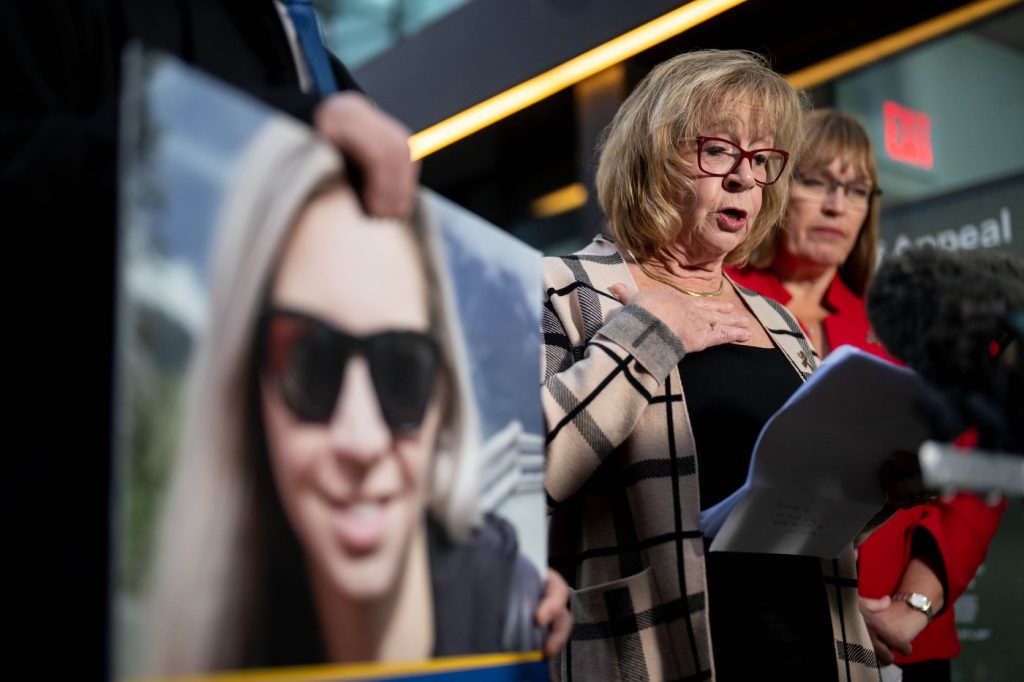
OTTAWA Gaye and Jim O’Neill have spent countless hours reflecting on their daughter Sam's final hours in April 2023, a painful memory they hope no one else has to endure. This heartache has propelled them to join a long-standing legal campaign aimed at reforming the delivery of medical assistance in dying (MAID) in British Columbia.
The O’Neills are currently at the center of a Charter of Rights challenge before the B.C. Supreme Court. Their case seeks to put an end to the practice of "forced transfers," which compel patients to leave faith-based medical facilities before they can access assisted dying services.
Sam O’Neill, who tragically passed away at the age of 34 due to cervical cancer that metastasized throughout her body, was the eldest of three children. Throughout her life, she was characterized as stubborn, fiercely independent, and kind-hearted. A devoted animal lover, Sam even advocated for a vegan lifestyle among her family and friends.
Before her illness, Sam lived in Vancouver, having moved from her home province of Ontario. She led an active life, participating in various sports including soccer and hockey, and was known for her great sense of humor, particularly showcased in her travel blog. In December 2021, she recorded a personal best in her tenth marathon held in California.
For her parents, the news of Sam's illness in April 2022 was devastating. Gaye and Jim O’Neill rushed to her side on May 1, only to find their daughter confined to a hospital bed instead of preparing for a marathon. Following her diagnosis, she underwent extensive chemotherapy and radiation at St. Paul’s Hospital, operated by Providence Health Care Society, a Catholic organization with 18 health care facilities in the Vancouver area.
Early in 2023, Sam was assessed for MAID—something she kept private from her family until later. "I thought she was getting someone to clean her house," Jim recounted, unaware of her true intentions. As her condition deteriorated in March 2023, following an injury that required her return to St. Paul’s by ambulance, her pain management became increasingly difficult.
Despite ongoing attempts to alleviate her suffering, after enduring two painful procedures in early April, Sam made the heartbreaking decision to seek a medically assisted death. However, due to Providence Health’s refusal to allow assisted dying within its facilities, Sam was required to transfer to St. John Hospice for the procedure.
Though the hospice was also managed by Providence, an adjacent area operated by Vancouver Coastal Health permitted MAID. Her parents described how her final hours were marred by logistical complications surrounding her transfer, which hindered her ability to bid farewell to her loved ones properly.
Devastated by the experience, Gaye recounted visiting Sam in a humiliating situation, where she found her daughter sitting on a commode, wrapped in a sheet. "It was shocking and terrible," she reflected. Sam was heavily sedated for the transfer and did not regain consciousness afterwards.
Providence has defended its care of Sam in court filings, claiming that family and friends were able to say goodbye in her room and stating that she had chosen to be sedated prior to the move. They also noted that Sam's medical condition necessitated her being on a commode for comfort.
In the legal battle, Daphne Gilbert, a law professor, connected with the O’Neill family after hearing their story through the media. She identified their experience as a poignant case for challenging the issue of forced transfers. Together with advocacy group Dying With Dignity Canada and Dr. Jyothi Jayaraman, a palliative care physician who resigned from Providence due to differing ethical beliefs, the O’Neills are pursuing their case in the B.C. Supreme Court.
The court will ultimately be tasked with determining whether institutions like Providence are entitled to the same religious freedoms as individuals, with Providence arguing that a requirement to perform MAID would infringe upon its rights. Legal experts, including Gilbert, anticipate that the outcome might eventually be appealed to the Supreme Court of Canada.
For Gaye and Jim O’Neill, the journey ahead is filled with uncertainty and challenges that could extend over several years. "We want to protect other people," Jim asserted, underscoring their commitment to advocating for change in the assisted dying policy framework in British Columbia.