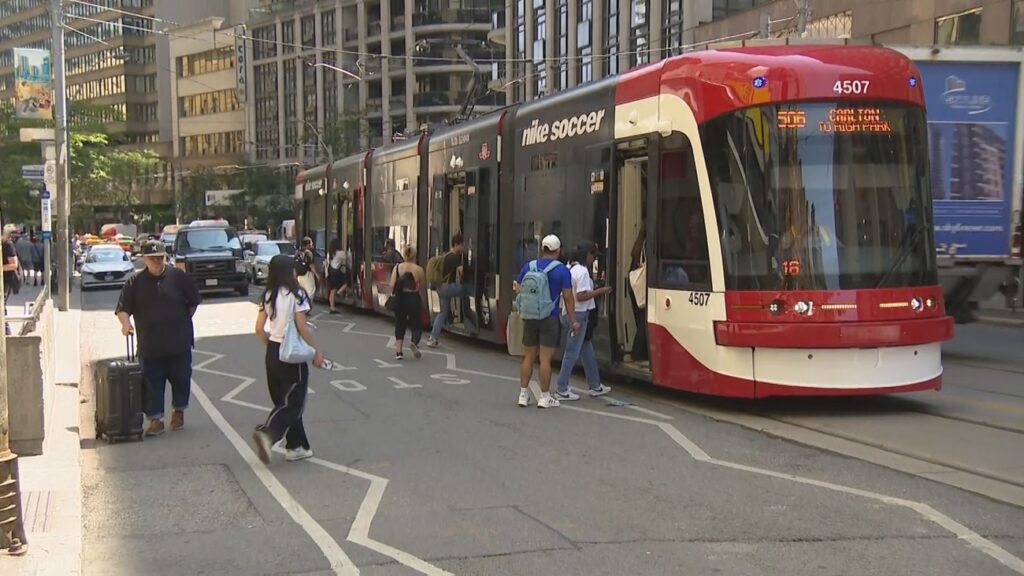
On Monday, the Toronto Transit Commission (TTC) began a nine-month pilot project aimed at addressing illegal passing of streetcars, particularly in mixed traffic areas. This initiative utilizes specialized cameras equipped with artificial intelligence, which will be mounted on four streetcars operating on the 501 Queen, 504 King, 505 Dundas, 506 Carlton, and 511 Bathurst routes. The project seeks to gather data that could lead to enhanced enforcement capabilities.
The TTC awarded a $460,000 contract to Gatekeeper Systems, a British Columbia-based company specializing in video systems for transit and school bus networks. These cameras will document instances when vehicles enter a streetcar's "violation zone" while the streetcar is stopped for passengers. If captured, the video evidence, including the vehicle's license plate, will be stored and uploaded to Gatekeeper's system. This information would allow enforcement authorities to potentially issue tickets based on the evidence collected.
Doug Dyment, president and CEO of Gatekeeper Systems, emphasized the efficiency of using AI technology to identify violations automatically, saving the TTC numerous hours that would otherwise be spent manually reviewing footage. He explained that without AI, video analysts would need to sift through extensive amounts of footage to find relevant incidents, making the process time-consuming and labor-intensive.
Dyment mentioned that the flagged evidence could be thoroughly reviewed by enforcement authorities before processing tickets. He pointed out that the TTC is the first significant transit operator in Canada to adopt such automated video enforcement technology. Recently, the Long Island Rail Road in New York also contracted with his company for a similar system.
According to the Ontario Highway Traffic Act, it is illegal for vehicles to pass a streetcar that is stopped with its doors open for passenger boarding or disembarking. Violators can face fines of up to $183 and receive three demerit points; however, the current law does not allow automated enforcement systems to issue tickets. As a result, enforcement is limited to warnings for vehicle owners.
TTC CEO Mandeep Lali described the initiative as focused on safety and termed it a "proof of concept." He noted the importance of evaluating the effectiveness of the technology to determine its future applications. As part of the pilot project, TTC staff will review and analyze data monthly and present a report to the agency's board of directors to decide whether to continue or expand the program.
From 2014 to 2024, there were 141 reported instances of streetcar riders being struck by passing vehicles, demonstrating the critical need for improved safety measures. Lali posed the question of how to achieve zero incidents and ensure the safety of all passengers, indicating a strong commitment to reducing risks associated with illegal passing.
Mayor Olivia Chow expressed her support for the pilot project, emphasizing the importance of ensuring safety for transit riders. She warned drivers that while tickets may not be issued immediately, the awareness of the surveillance system is meant to deter illegal activities. Chow stated that if the municipal staff receive approval from the Ontario government, they would move towards issuing tickets based on the evidence gathered during the pilot.
Although the Ontario government amended the Highway Traffic Act to permit camera enforcement in 2022, the authority to issue fines has yet to be granted. Past legislation allowed municipalities to use speed cameras but was later revoked, creating a challenging environment for potential enforcement of streetcar-related traffic violations.
Vincent Puhakka, a volunteer with the advocacy group TTCriders and a frequent streetcar user, remarked that the initiative is "long, long overdue." He shared personal experiences of witnessing vehicles pass open streetcar doors, which he finds frustrating. Puhakka believes redesigning streets could enhance safety but supports the pilot project and hopes for the eventual ability to issue fines to lawbreakers. He concluded that success would mean a citywide implementation of this technology across all streetcar routes.