SEOUL, South Korea (AP) – North Korea responded on Wednesday to the U.S. decision to scale back military exercises with South Korea, reiterating its stance that such drills remain provocative. This statement from the North dampened hopes for an early resumption of diplomacy between North Korean leader Kim Jong Un and U.S. President Donald Trump.
Kim Yo Jong, the influential sister of Kim Jong Un, issued the comments on Wednesday night, marking North Korea's first reaction to Trump's decision to drastically cut the annual military exercises conducted with South Korea. Kim Yo Jong stated, “We think it’s not worth making comments on that and we have no interest in it at all. The provocative, aggressive nature of the drills won’t change even though their duration and size were reduced.”
She also referenced a number of military drills carried out by the U.S. and South Korea earlier in the year, along with South Korea’s initiatives to introduce nuclear-powered submarines. Furthermore, Kim Yo Jong emphasized that there are currently no communications between Trump and her brother Kim. Earlier in the week, Trump remarked to reporters that Kim had responded positively to his request for a meeting.
Despite the absence of North Korea's usual harsh rhetoric in her statement, Kim Yo Jong asserted that relations between her brother and Trump are “still excellent.” She mentioned that her brother holds “good memories” of Trump, hinting at an effort by North Korea to manage relations with the U.S. while seeking greater concessions to restart negotiations.
Trump acknowledged on Wednesday that he plans to meet with Kim Jong Un within the year but refrained from discussing any communication, stating that he gets along well with the North Korean leader.
Hours prior to Kim Yo Jong’s statement, both South Korean and U.S. military officials confirmed the scaling back of the 11-day Ulchi Freedom Shield exercises. Trump had earlier directed the Pentagon to “substantially reduce” these exercises, citing what he described as a positive relationship with Kim and South Korea’s reluctance to support him over issues related to Iran.
South Korean officials expressed confusion over Trump’s announcement, which came without prior notice, raising concerns regarding joint defense readiness. The military noted that the drills would conclude on Friday, rather than on the initially planned date of August 27. It was also reported that some joint field training exercises would be downsized.
The Pentagon stated it continues training to enhance tactical capabilities but will alter some events, either canceling them or converting them into simulations. The statement assured that essential readiness and training objectives will not be compromised.
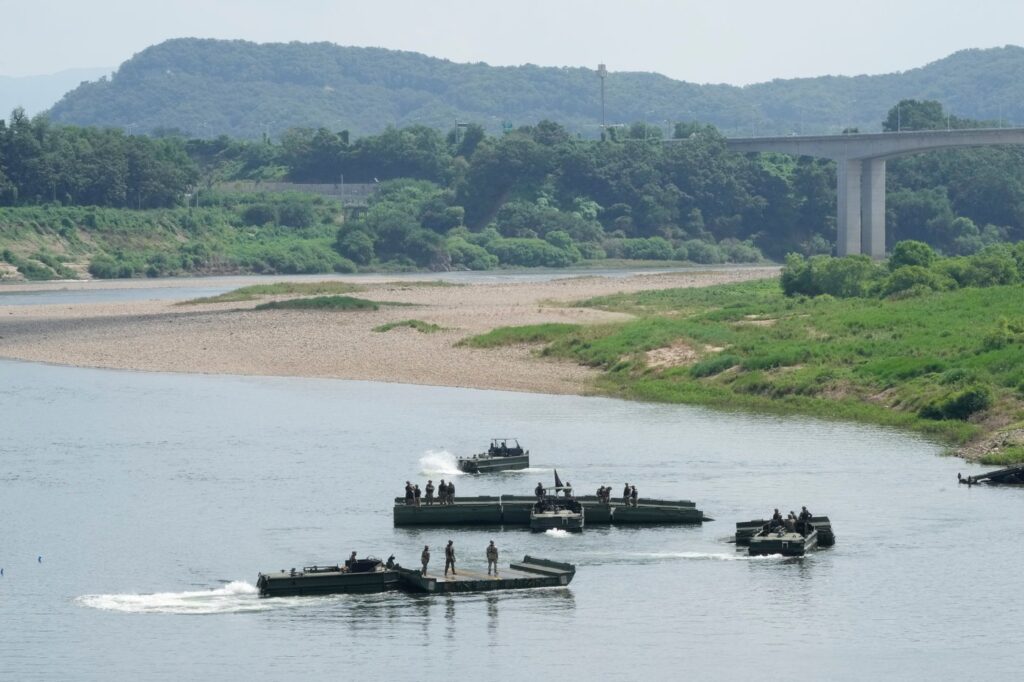
Ulchi Freedom Shield primarily consists of computer-simulated command post exercises designed to improve the allies' ability to respond to potential North Korean aggression. North Korea has long viewed these drills as rehearsals for invasion, prompting retaliatory missile tests. Just days before this month's exercises commenced, North Korea launched two ballistic missiles into the sea.
This month’s drills were initially scheduled to unfold in two phases, simulating defensive and counteroffensive operations against North Korean attacks. However, North Korea remains highly sensitive to counteroffensive drills, according to South Korean media.
On the same day, North Korea’s state news agency, KCNA, described the U.S.-South Korean military drills as “frantic” and “extremely dangerous,” vowing to counteract what it sees as hostilities. Experts suggest that Kim, encouraged by North Korea’s advancing nuclear program and military cooperation with Russia, is unlikely to embrace Trump's overture for dialogue unless offered significant concessions. Kim had previously indicated a willingness to negotiate only if the U.S. dropped its demand for North Korean denuclearization as a precondition.
Trump asserted that North Korea has approximately 57 nuclear weapons, although some analysts estimate the arsenals may exceed 100 warheads. South Korea’s intelligence agency had estimated last year that North Korea deployed about 15,000 troops to support Russia in its conflict with Ukraine. Recently, Ukrainian President Volodymyr Zelenskyy claimed that North Korea was preparing to send more troops to Russia; however, Kim Yo Jong dismissed this assertion as “an ungrounded farce.”
South Korean President Lee Jae Myung praised Trump's decision, expressing hope that it would facilitate a reopening of dialogue between Washington and Pyongyang and contribute to peace on the Korean Peninsula. Lee, a liberal leader, advocates for improved relations with North Korea.
Conversely, South Korea’s main opposition conservative party criticized Lee’s government for prioritizing the revival of Trump-Kim diplomacy at the expense of national security concerns arising from Trump’s decision.
Trump and Kim previously met three times from 2018 to 2019; however, their diplomatic efforts eventually fell apart due to disagreements over North Korea's call for substantial sanctions relief in exchange for limited denuclearization measures.
Trump’s actions appear to reflect a greater focus on strengthening alliances with South Korea over issues related to Iran, suggesting a strategy that applies pressure to South Korea for substantial support concerning the Iran conflict. Analysts have indicated that Trump’s decision to reduce drills may be more about compelling South Korea to cooperate with the U.S. regarding Iran than about fostering dialogue with North Korea.
The situation remains fluid, and while adjustments have been made in military cooperation between the U.S. and South Korea in response to diplomatic overtures, the long-standing tensions on the Korean Peninsula persist, with significant military implications for regional security.