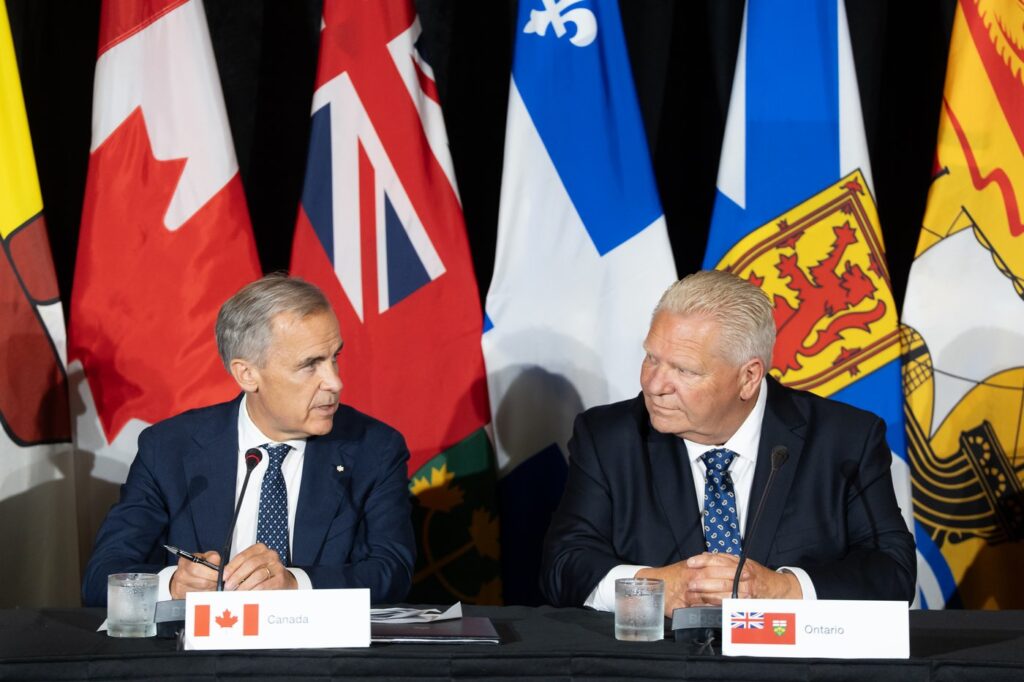
Several premiers across Canada demonstrated solidarity on Saturday after the country found itself embroiled in a trade war with the United States. This came after U.S. President Donald Trump introduced new 50 per cent tariffs on billions of dollars in Canadian exports, spurred by failed trade negotiations the night before.
Manitoba Premier Wab Kinew expressed a strong sense of unity among the provincial leaders during a virtual meeting with Prime Minister Mark Carney. Kinew affirmed that his government stands firmly behind Canada's retaliatory measures set to begin next month. He voiced his disappointment towards Trump and his administration, emphasizing the collective pride Canadians share for their country. Kinew stated, “(Trump's) not in touch. He doesn’t care about the American people and the cost of living.”
In response to the tariffs imposed by the U.S., Prime Minister Carney pledged that Canada would retaliate dollar-for-dollar by imposing similar tariffs starting next month. These measures are expected to target various sectors, including steel, dairy, appliances, agricultural equipment, pulp and paper, and electronics. Ontario Premier Doug Ford, who had remained silent during the initial trade talks, praised Carney’s decision to abandon the U.S. trade deal offers, declaring that Trump cannot be trusted. Ford used metaphorical language, specifying that Trump resembles a bully who would metaphorically strip Canadians of their belongings, reinforcing the necessity for Ontario and other provinces to unite.
Carney explained that discussions were halted on Friday night because the U.S. had offered what he characterized as a “bad deal,” attempting to restrict Canada’s ability to engage with other trading partners and safeguard protections for the French language. He articulated that the negotiations felt like a “power play,” which raised concerns regarding Canadian sovereignty, asserting, “You’re at war when you get attacked, we got attacked.”
British Columbia Premier David Eby went so far as to describe the U.S.-Canada relationship as abusive, stating, “They cannot have a positive relationship with Canada and benefit from what is in this country, while at the same time attacking us.” He warned that acquiescing to U.S. demands would degrade Canada to the economic status of the 51st state. Meanwhile, Quebec’s Premier Christine Fréchette highlighted the immense financial impact of the new tariffs on her province, estimating that $7.7 billion worth of goods would be affected. She announced various support programs for local businesses contending with the financial strain imposed by the tariffs, urging fellow Quebecers to opt for local products.
New Brunswick Premier Susan Holt echoed similar sentiments, urging residents to sustain local businesses in light of the unjust tariffs that would adversely affect the economy. “Now, more than ever, we need to double down on buying local and supporting New Brunswick businesses and workers,” Holt asserted. In contrast, Alberta Premier Danielle Smith expressed disappointment over the trade talks’ collapse and echoed caution, stating that no one should celebrate retaliatory measures that would result in increased costs for farmers needing essential equipment.
Other provincial leaders shared their thoughts on social media, reinforcing the need for unity among the provinces. Nova Scotia Premier Tim Houston observed that the prevailing distrust towards the U.S. should drive Canada to be stronger and more resolute. Newfoundland and Labrador Premier Tony Wakeham and Saskatchewan Premier Scott Moe expressed their full support for Carney’s stance, while Prince Edward Island Premier Rob Lantz emphasized the effectiveness of the “Team Canada” approach historically and reiterated the importance of maintaining that strength and unity during these challenging times.
The new U.S. tariffs target an array of Canadian goods worth approximately $28 billion, affecting products from hockey sticks to essential oils and dairy items. According to U.S. Trade Representative Jamieson Greer, the U.S. and Canada had “declined” to finalize a tentative agreement, with the onus placed solely on Canada. Carney announced that more details regarding the retaliatory measures and support for impacted sectors would be forthcoming, with those counter tariffs set to be enforced on September 8, the day following Labour Day.