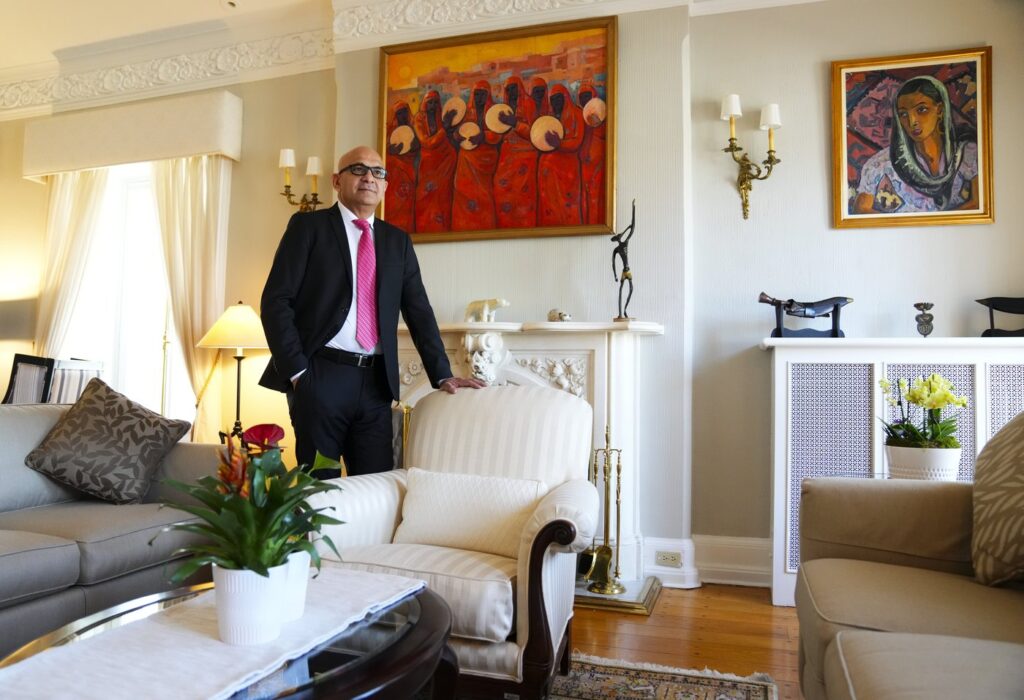
OTTAWA – South Africa's High Commissioner to Canada, Rieaz Shaik, has expressed concern that Canada's slow and unassertive approach to expanding trade with African nations may hinder its competitive edge compared to other countries already establishing robust commercial ties on the continent. Shaik emphasized that Ottawa still predominantly views African nations as recipients of aid and security assistance, despite an Africa strategy aimed at recognizing these countries as dynamic markets poised for significant growth.
In his comments to The Canadian Press, Shaik criticized Canada for not fully transitioning its perspective towards Africa. “With all second-movers in any market,” he stated, “you run the risk of not getting into the market – or the market becomes saturated.” This sentiment is echoed by advocates who argue for deeper engagement in Africa, pointing out that nations such as China and the United Arab Emirates are solidifying their relationships in the region, potentially leading to lucrative opportunities in the long run.
A Senate foreign affairs committee report from December highlighted the necessity for Canada to bolster its foreign service with a focus on expanding trade in diverse sectors beyond mining. Shaik is actively pursuing a strategic partnership agreement between Canada and South Africa, targeting collaboration in five key sectors: agribusiness, infrastructure, mining, energy, and advanced technologies. The realization of this partnership would hinge upon the establishment of a foreign investment promotion and protection agreement, which aims to create legally binding rules that safeguard and promote foreign investment between the two nations.
The last investment pact between Canada and South Africa was signed in 1997, and efforts have been underway for several years to upgrade this agreement. Talks are currently centered on investor-dispute tribunals, where Canada is advocating for an international resolution mechanism, while South Africa’s constitution mandates that such issues be resolved within its domestic courts. Shaik remarked, “It is more an issue of sequencing rather than issue of substance that divides us.”
He envisions this new partnership enabling South Africa to serve as a launchpad for Canada’s engagement with other southern African countries and, eventually, the African Continental Free Trade Area, which encompasses a large portion of the continent. Conversely, he sees Canada as a gateway for South Africa to expand its business into the U.S., Mexico, and Latin America, stating, “We are both, in our own rights, relatively small markets. But based in our regions, we become significant markets.”
Shaik highlighted the potential for existing Canadian firms in South Africa, such as AGT Foods, McCain, and Hatch, to expand their operations across Africa if presented with appropriate market access and support from Ottawa. He urged Canadian leaders to establish terms for increased trade with Africa proactively, rather than waiting for the market to mature while focusing efforts on Europe, China, and India. “I think reality will force it – will force the African continental market into Canada. The only question then is whether Canada would be a first-mover,” he said, suggesting that adopting a second-mover strategy could lead Canada to miss out on critical opportunities.
South Africa’s commitment to enhancing trade ties with Canada is clear, as demonstrated by the recent delegation led by the deputy foreign minister to Saskatchewan, where they explored technological innovation in agriculture and how business strategies can maximize crop exports. Shaik specifically commended Alberta and Saskatchewan for fostering industry development ecosystems, noting their proactive approach to engaging market interests.
Moreover, he underscored the importance of learning from African advancements in technology, particularly the move from cash to mobile payment systems and the use of bank branches for delivering government services. Shaik suggested that Canadian artificial intelligence leaders might consider piloting programs in Africa, which would allow them to commercialize their innovations without relying solely on American market dynamics and resources. “One of the fundamental weaknesses of the Canadian AI industry is that while it develops the intellectual property, to reach scale it has to go to the U.S.,” he noted.
Overall, Shaik believes that achieving former Bank of Canada Governor Mark Carney's objective of doubling non-U.S. exports in the next decade will necessitate changing corporate sector mindsets to engage more with markets beyond Washington. He pointed out that there is a need to motivate Canadian elites in the financial sector, drawing a parallel with a “boiling-frog scenario” where complacency could reign even as conditions change for the worse. “Even though the water is getting hotter, it’s comfortable; what we have at the moment,” he concluded.