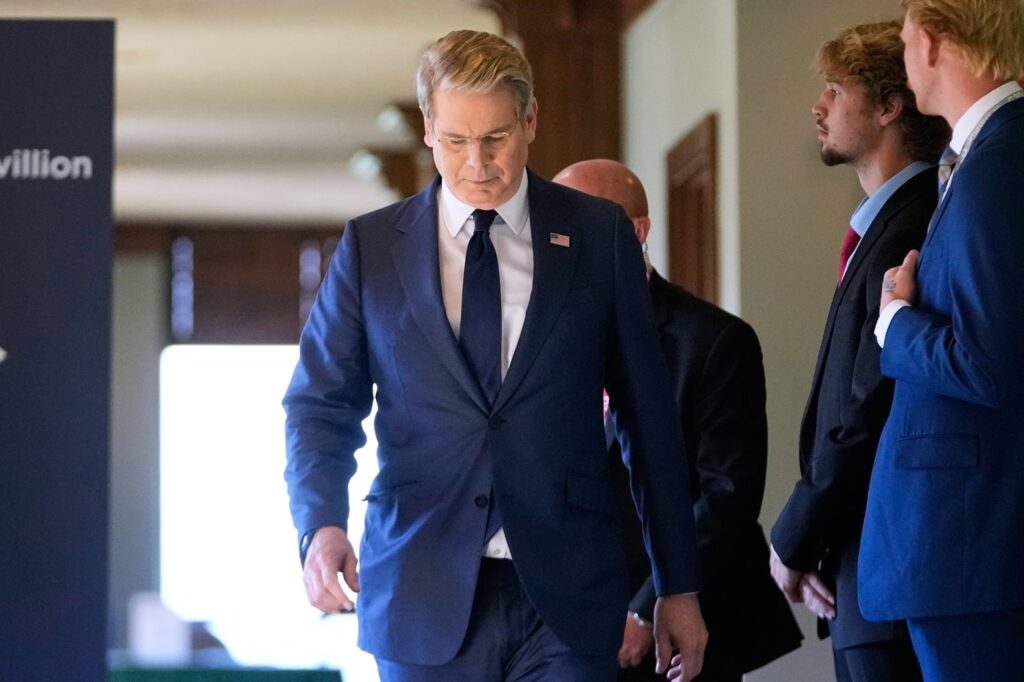
ASHEVILLE, N.C. (AP) — Treasury Secretary Scott Bessent announced on Tuesday that 19 out of the 20 members of the G20 had reached an agreement to tackle the issue of “cheap exports” contributing to global economic imbalances, with China being the sole dissenting member. Bessent's remarks followed a two-day meeting that engaged finance ministers and central bankers in discussions focused on global growth and trade practices.
During the press conference, Bessent conveyed his emphasis on addressing trade imbalances through methods similar to those used by the Trump administration, advocating for tariffs and other regulatory measures. “We believe that non-market-based economies pushing out a never-ending stream of cheap exports is not sustainable,” he stated, underscoring the consensus among all but one G20 country.
Identifying China as the culprit, Bessent referred specifically to China’s large current account surplus, which raises concerns about its trading practices. The Trump administration has consistently attributed rising trade deficits, particularly with China, to unfair trade practices. As he wrapped up the conference, Bessent also pointed to the upcoming meeting between President Donald Trump and Chinese President Xi Jinping, highlighting the potential for significant discussions regarding trade policy.
While speaking about the impact of tariffs, Bessent noted that the new U.S. "tariff wall" would lead to an influx of Chinese goods into other nations’ markets. He voiced concerns that countries need to reassess their strategies to protect local jobs and manufacturing sectors from offshoring.
In a further reflection on global issues, Bessent addressed the topic of artificial intelligence (AI) during the press conference, mentioning that Trump and Xi would discuss AI policy later in the month. He expressed the necessity for stronger regulations to prevent unauthorized entities from developing AI models. He criticized AI companies for their lack of transparency regarding their practices and the distribution of benefits, urging them to communicate their value to the American public.
Following the G20 meetings, Trump conveyed positive sentiments on his social media, claiming “very productive and positive conversations were had” and urging other countries to emulate the U.S. approach. Nevertheless, the tariff strategies implemented by the Trump administration have faced scrutiny from economists and politicians, with the Tax Foundation estimating that tariffs imposed from 2025 raised consumer goods prices by approximately 7% compared to pre-tariff trends.
In February, the U.S. Supreme Court ruled the broad global tariffs enacted by the Trump administration unconstitutional. Subsequently, the administration has been modifying its trade policies and considers imposing an additional 7.5% tariff on Chinese imports due to concerns about excessive industrial capacity and forced labor practices.
On another front, Bessent reported fruitful discussions with Chinese officials concerning Iran, establishing a shared stance that Iran “cannot have a nuclear weapon” and affirming the need for unrestricted trade through the Strait of Hormuz. He tied this matter back to the broader theme of trade, criticizing China’s substantial trade surplus, which reached a record $1.2 trillion in 2025, as a significant impediment to global economic progress and attributing this to excessive regulations.
Global debt has surged to a staggering $353 trillion, with U.S. debt alone hitting $40 trillion by August. Despite concerns over a potential sell-off in U.S. government bonds, Bessent reassured that the situation is not dire. Meanwhile, the presence of Russian Finance Minister Anton Siluanov at the conference sparked unease among attendees, with Canadian Finance Minister François-Philippe Champagne expressing that Russia’s attendance created discomfort around the table. European Commissioner for the Economy, Valdis Dombrovskis, echoed sentiments against normalizing relations with Russia during a press briefing.
Bessent defended the decision to include Siluanov in the discussions, arguing that engaging in dialogue is vital for resolving ongoing conflicts. He recognized the discomfort expressed by some European colleagues but stressed the need for communication to pursue a resolution to the issues facing the global community.