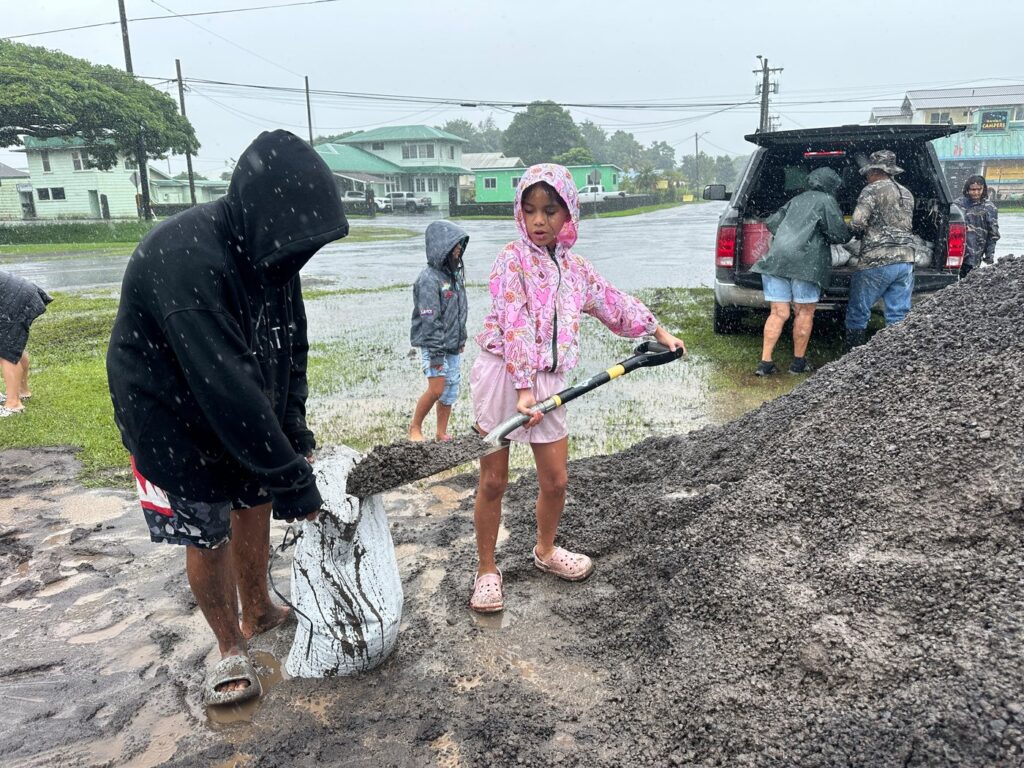
HILO, Hawaii (AP) — Hurricane Nolo has recently managed to skirt the Hawaiian Islands, gaining intensity and posing risks of flash floods, dangerous winds, and extreme surf in areas still recovering from previous storms. On Saturday, Nolo was positioned about 165 miles (266 kilometers) south-southwest of Hawaii's southernmost point, moving southwest with maximum sustained winds reaching 90 mph (150 kph). Forecasters predict that Nolo could strengthen into a major hurricane by late Sunday into early Monday as it continues traveling westward.
Despite the hurricane watch being canceled and no direct landfall expected, forecasters cautioned that Nolo's outer bands could trigger life-threatening flooding and mudslides. The Big Island may receive rainfall totals of up to 20 inches (51 centimeters), with heavy rain expected on other islands as well. Michael Brennan, director of the National Hurricane Center, advised caution, stating, “Don’t venture out if you don’t have to into the dangerous flooding environment, but also high winds. We can have trees and power lines down.”
On the southern part of the Big Island, heavy rain continued to contribute to flooding, leading to partial closures of major highways connecting Kailua-Kona and Hilo. In Naalehu, National Guard members were observed assisting residents navigating flooded streets. Over 120 guard members were activated on the island, part of approximately 400 statewide following an emergency proclamation from the governor. The humanitarian organization CORE, alongside other partners, has been packing and shipping supplies such as camp stoves and hygiene products for a community relief hub that has been operational since the previous Hurricane Lala in August.
Many residents are still in recovery mode from Hurricane Lala, which produced significant rainfall and winds powerful enough to displace about 100 homes on the Big Island. On Saturday morning, despite beach closures, some swimmers were seen at Carlsmith Beach Park in Hilo. Andrea Gill, a local resident, expressed hope that the islands would avoid the hurricane's full impact, noting, “We’re used to lots of rain. We’re not used to wind. So it’s always a blessing when we don’t get the wind from the hurricane.”
In response to the situation, President Donald Trump approved an emergency declaration, allowing the Federal Emergency Management Agency (FEMA) to coordinate disaster assistance and provide funding support. Crews from Hawaiian Electric, who were previously restoring power in Kauai following Hurricane Lowell, have been dispatched to Oahu, Maui, and the Big Island to address the looming storm's effects.
In a separate development, a brush fire erupted Saturday on the west side of Maui, prompting mandatory evacuations for some residents and the closure of parts of a highway. The fire was located near the Olowalu area, roughly 7 miles (11 kilometers) south of Lahaina, which had faced deadly fires earlier in 2023. County officials established two evacuation centers to assist affected residents. The National Weather Service issued a high wind warning for parts of Maui, indicating possible winds of at least 40 mph (64 kph) with gusts exceeding 60 mph (97 kph).
The Pacific hurricane season has been notably active this year, as highlighted by National Weather Service lead forecaster Bob Oravec. He noted that storm activity is above average for this time of year, which aligns with El Niño conditions that typically lead to increased tropical storm and hurricane occurrences.
Meanwhile, Mexico is bracing for Hurricane Polo, which is currently making its way toward the Baja California Peninsula. With maximum sustained winds recorded at 140 mph (220 kph), Polo is categorized as a Category 4 storm, although it is anticipated to weaken somewhat ahead of its expected landfall on Monday. In its projected path lies San Juanico, a small fishing community on Baja's Pacific coast, where residents are already grappling with access to essential needs.
Gloriely Robles Meza, a hotel manager in San Juanico, expressed concern over the impending storm, mentioning, “Our people are concerned about this event. We haven’t faced such a worrying situation in many years.” The community, with only recent access to full-time electricity, faces the considerable challenge of preparing for the storm independently, while residents worry about potential road washouts that could hinder access to medical facilities. Efforts are underway to convert a local elementary school into a shelter, but concerns remain regarding post-storm recovery efforts and emergency services access.
As residents of both Hawaii and Mexico prepare for the potential impacts of these powerful storms, the broader patterns of hurricane activity in the Pacific illustrate the growing challenges posed by climate conditions and the need for coordinated emergency responses.