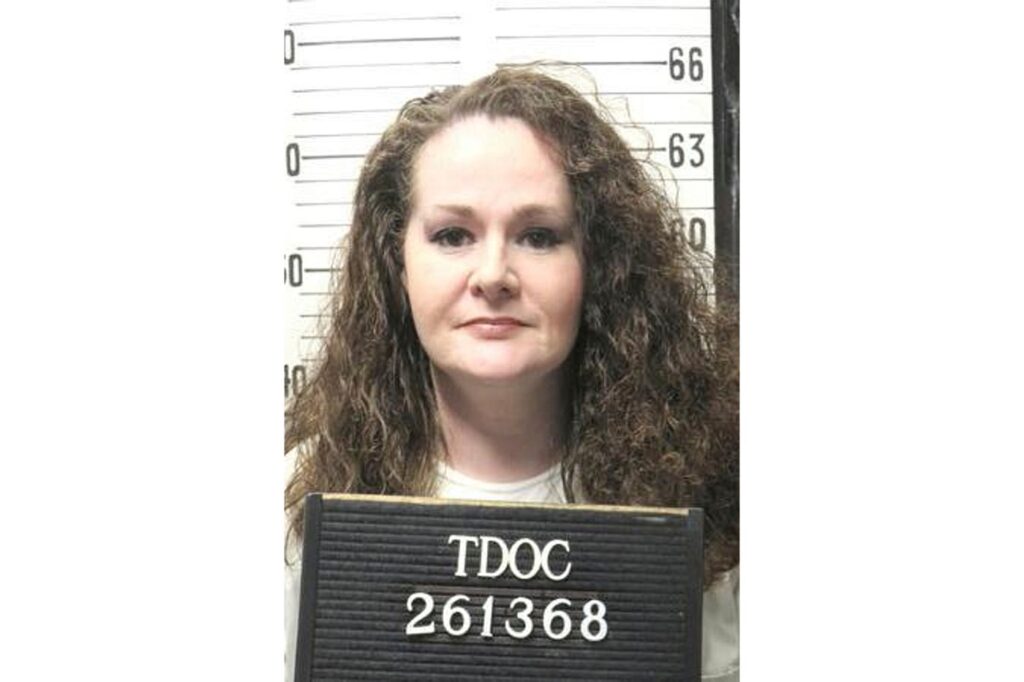
NASHVILLE, Tenn. (AP) – Tennessee officials failed to execute Christa Gail Pike on Wednesday, despite administering two doses of a lethal drug for a murder committed in 1995. Governor Bill Lee subsequently halted all remaining executions in the state for the year following this unprecedented failure, according to a death penalty expert.
Pike, 50, was presumed alive and reported to be snoring loudly after the lethal injection attempt before being transported to a hospital. Her attorneys stated they had not received any updates regarding her condition.
Scheduled for execution at 10 a.m. on Wednesday, Pike would have been the first woman executed in Tennessee in over 200 years. An appeals court issued a stay just an hour before the execution was set to begin, but hours later, the U.S. Supreme Court overturned that stay, allowing the execution to proceed.
According to Pike’s attorneys, the execution team administered two doses of pentobarbital, the drug used for lethal injections. In response to the incident, Governor Lee announced a comprehensive third-party review to investigate what went wrong and emphasized the state's responsibility to carry out executions lawfully and effectively.
The Tennessee Department of Correction stated that all procedures were followed according to the state’s established execution protocol, which includes administering a secondary set of drug syringes if the inmate does not succumb after the first set. However, the protocol lacks clarity on actions to take if the inmate remains alive after the second set.
Robin M. Maher, the executive director of the Death Penalty Information Center, described Pike’s experience as "singular and unparalleled." She noted that while some inmates have survived complications from executions due to failures in accessing veins, no one had previously survived after receiving the lethal drugs.
Media witnesses, observing from a separate room, reported that the execution chamber's curtains were raised at 7:27 p.m., revealing Pike strapped to a gurney. In what were believed to be her last words, she stated, "I’m going to leave this world the way I spent most of my life and that is in love," expressing a sense of peace. However, she later raised her head and questioned prison officials about sensations in her arm, the context of which was unclear.
By 8:26 p.m., witnesses reported that the second dose of pentobarbital had been administered. However, Pike continued to emit sounds indicating she was alive until 8:53 p.m., when the microphone was turned off and witnesses were escorted from the area.
Pike's attorneys filed an emergency motion with the Tennessee Supreme Court seeking to halt the execution, arguing that she was experiencing "unnecessary agony" and that her rights to avoid cruel and unusual punishment were being violated. They also filed motions in other courts, including the Sixth Circuit.
This incident marked the second time in 2023 that Tennessee failed to carry out an execution, following an aborted attempt in May to execute Tony Carruthers, who was convicted of multiple killings. Executioners were unable to place an IV for the lethal injection after multiple attempts.
Pike and her boyfriend were convicted for the vicious stabbing and beating of Colleen Slemmer, a 19-year-old classmate, in 1995. The brutal nature of the crime captured significant media attention, particularly due to the pentagram carved into Slemmer’s body, which fueled fears of satanic worship during that era.
As the execution date approached, public debate intensified over the appropriateness of the death penalty for young offenders. Pike was 18 at the time of her crime, and her advocates highlighted her mental health issues and allegations of childhood sexual abuse as factors warranting reconsideration of her death sentence.
Slemmer's mother had arrived in Nashville anticipating the execution of her daughter’s murderer and expressed her long-standing desire to see this sentence carried out. She reflected on the painful memory of her daughter's ordeal during the attack.
Historically, executions of women have been rare in the United States. Since the death penalty was reinstated by the Supreme Court in 1976, only 18 women have been executed, which constitutes approximately 1% of all executions. Pike was expected to become the 30th person executed in the U.S. in 2023, following an execution carried out in Florida just days prior.
In light of this incident, Tennessee announced plans to switch to a single-drug method of lethal injection using pentobarbital, a decision made after previous complications with ensuring the quality of their execution drugs.
___