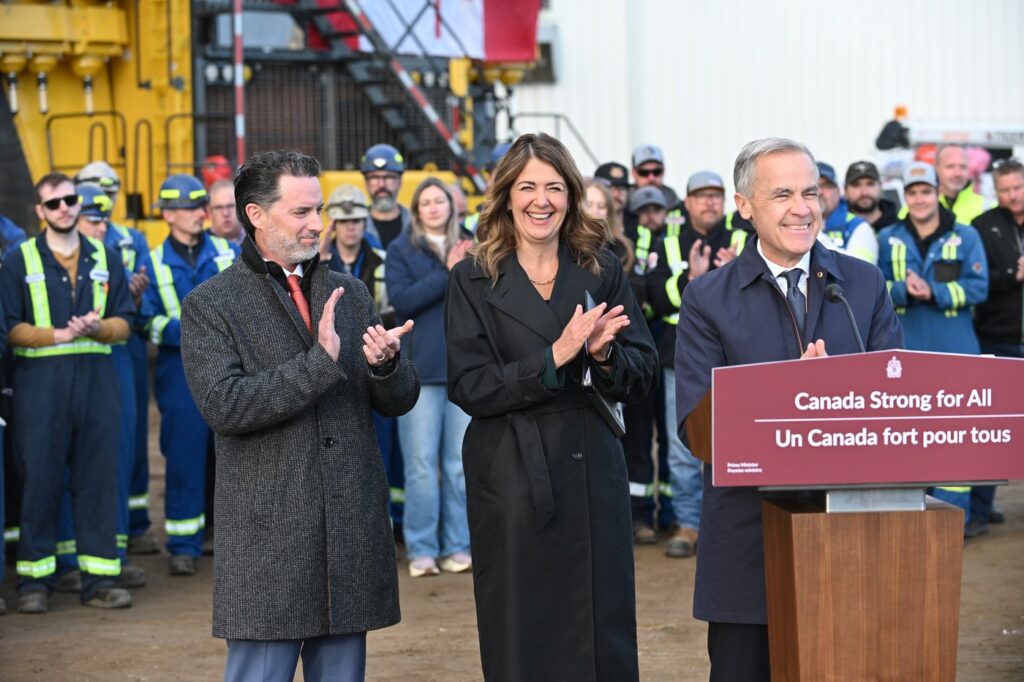
CALGARY – Prime Minister Mark Carney expressed optimism on Thursday regarding oilsands producers’ readiness to invest in expansion projects to support the proposed Pacific Link pipeline, which has been classified as Canada's first project of national interest. Speaking at a news conference in Fort McMurray, Alberta, Carney highlighted the pipeline as a significant opportunity for oilsands companies to access Asian markets, which are willing to pay higher prices for Canadian crude.
According to Carney, the narrowing price gap between Alberta's heavy crude and light, globally traded crude could result in a $6-billion annual benefit for the industry. He also discussed initiatives undertaken by his government to enhance investor confidence, including a streamlined regulatory review process that aims to expedite project approvals. Previously, projects often faced lengthy delays; under the new approach, the goal is to "do the work once and get to the right answer on time." Additionally, Carney noted recent expansions in business tax incentives, enabling companies to quickly recover costs on a wider range of investments.
Carney pointed out that the five largest oilsands producers are collectively planning to construct the Pathways carbon storage project in Alberta, which is essential for the pipeline’s advancement. The Alberta government submitted its application for the ambitious million-barrel-per-day pipeline project in July to the major projects office established by Ottawa to accelerate infrastructure deemed in Canada’s national interest. The project is estimated to cost between $35.2 billion and $43.7 billion, with the Alberta and federal governments jointly covering 90% of the total costs, while Pembina Pipeline Corp. holds the remainder.
The pipeline would connect Bruderheim, Alberta, to a marine export terminal intended for Delta, British Columbia. The accompanying explanatory note from the cabinet states that producers have the financial capacity to fund "a significant share" of the necessary growth to fully utilize the pipeline. It also emphasizes that demand for Canadian crude in the Asia-Pacific region is expected to be "resilient," with markets in China, India, South Korea, and Japan actively seeking dependable heavy crude supplies. To guarantee long-term engagement, the project partners are planning to hold an "open season" in the spring, a formal process for soliciting bids from potential customers and allocating pipeline capacity accordingly.
Lance Mortlock, managing partner at EY Canada, acknowledged that there exists a "chicken and egg" situation regarding the construction of the new pipeline and the continued growth of oilsands production to fill it in the long term. Although producers have been hesitant to make large-scale investments in recent years, largely due to insufficient pipeline infrastructure, the industry is now beginning to welcome Ottawa’s efforts to simplify the regulatory framework, retract certain environmental policies from the Trudeau administration, and enhance tax incentives for new investments. Smaller, shorter-term pipeline expansion projects are on the horizon, targeting both the U.S. market and the West Coast.
Mortlock predicts the emergence of significant capital projects, identifying the likelihood of smaller in situ expansions of 150,000 to 200,000 barrels per day, using steam-driven operations with a reduced environmental footprint. "Now the discussion is evolving at some oilsands companies to determine the nature of their asset development, including the dimensions and scheduling of these assets," he said.
Andrew Botterill, who leads Deloitte Canada’s oil, gas, and chemicals practice, stated that previous uncertainties have been addressed, allowing producers to concentrate on the practical aspects of the new approval process. He emphasized the need for regulators to ensure the development of optimal, safe projects. "Now we can begin to evaluate and manage risks associated with these projects rather than being burdened by overarching concerns," Botterill noted.
However, environmental advocates have criticized the Canadian government for its financial involvement in a fossil fuel project, especially as the global focus shifts toward renewables and electrification to mitigate climate change. Environmental Defence described the investment as "a reckless waste of Canadians' money," arguing that the pipeline may not be operational until after the peak of global oil demand, making it an unappealing prospect for new buyers. Emilia Belliveau, the group’s energy transition program manager, emphasized that the project would exacerbate climate change-related damages, which already cost Canada millions annually in natural disasters including floods and wildfires.
Organizations like Stand.earth and the Pembina Institute have labeled the Pacific Link pipeline as financially unviable. "Canadians should scrutinize why private investors are unwilling to back this high-risk, high-cost project," said Janetta McKenzie from the Pembina Institute, asserting that the declining outlook for global oil demand undercuts the business case for such an initiative.
This report was first published on October 1, 2026.
Companies in this story: (TSX:PPL)