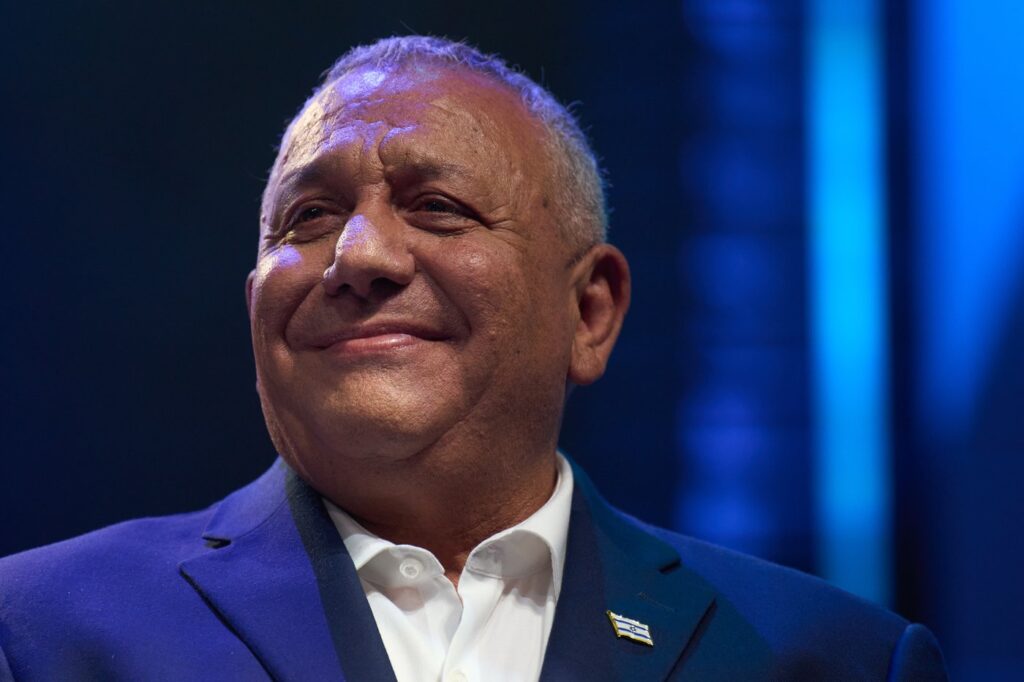
JERUSALEM (AP) — Israeli President Isaac Herzog announced on Saturday night that he would grant opposition candidate Gadi Eisenkot the first opportunity to form a governing coalition after the elections held on October 27, 2023.
Eisenkot, a former military chief who emerged as the main challenger to Prime Minister Benjamin Netanyahu, has taken a significant step closer to potentially ousting Israel's longest-serving premier. Following Herzog's announcement, Eisenkot declared on his X account, “This is the time to establish a national emergency government. I will do anything possible to prove us worthy.”
The new leader has a period of up to six weeks to form a coalition, which poses a considerable challenge due to the deep divisions within the country, particularly in the aftermath of the Hamas-led attacks on October 7 and the subsequent three years of conflict in Gaza and beyond.
In meetings with President Herzog, representatives from most of Israel's major political parties supported Eisenkot taking the lead in forming a new government. However, achieving the parliamentary majority necessary remains complicated, with any potential coalition likely requiring significant compromises from the parties involved, potentially alienating their voter bases.
Following last month's elections, Netanyahu and his allies lost their parliamentary majority. However, Eisenkot's bloc also failed to secure a majority, leaving the Arab-led parties, which made historic gains, as potential but politically sensitive kingmakers in the coalition-building process.
It is noteworthy that an Arab party has been part of a governing coalition only once in Israel’s history. Forming such an alliance could be especially contentious for Eisenkot after years of military conflict in Gaza. Netanyahu has actively campaigned against any potential alliance between Eisenkot and the Arab parties, making unsubstantiated claims that Arab parties “stole” the elections. He has argued for a “national unity government” through a video statement, warning against quickly establishing a government with what he terms “terrorist supporters,” referring to the Arab-led parties.
Netanyahu and his allies have consistently framed the Arab-led coalition as a threat to national security while Eisenkot has signaled a willingness to collaborate with them under certain conditions, including a commitment to eradicate Hamas. The prospect of negotiating with Netanyahu, whose Likud party is the largest in parliament, also exists, but substantial differences on numerous issues pose significant obstacles. This includes Netanyahu's dependence on religious parties demanding draft exemptions for ultra-Orthodox men and his opposition to a formal investigation into the security failures leading up to the October 7 attacks.
Eisenkot could contemplate forming a “minority” government backed by external support from Arab parties that would not formally join his coalition. However, members of his bloc have expressed rejection of such an arrangement. Eisenkot's party, Yashar, criticized Netanyahu's video statement and urged Likud members to dissociate from “radical parties,” alluding to far-right factions within Netanyahu’s religious-nationalist base. Their statement asserted that Eisenkot would only include parties and parliament members aligned with his party's principles.