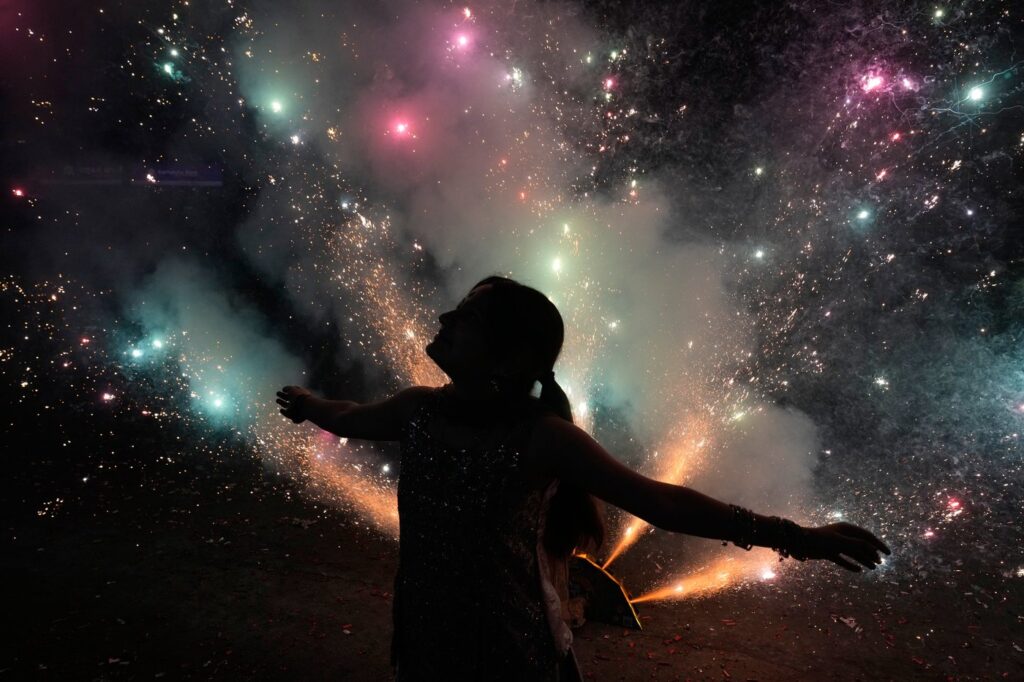
NEW DELHI (AP) – A thick blanket of smog engulfed India's capital early Monday following the Diwali celebrations, during which residents lit firecrackers despite existing restrictions. This surge in fireworks exacerbated the already high pollution levels, leading to a seasonal air pollution crisis that New Delhi experiences annually.
On the night of Sunday, the Hindu festival of lights brought enthusiastic celebrations, with firecrackers releasing copious smoke and fine particulate matter into the atmosphere. By Monday morning, the Air Quality Index (AQI) soared past 350 in several areas of the capital, categorizing it as severe and posing significant health risks to residents. Monitoring stations throughout the city recorded similarly alarming pollution levels, while visibility worsened, creating a gray haze that enveloped streets and high-rise buildings.
In October, India's Supreme Court had attempted to mitigate Diwali-related pollution by limiting the use of conventional firecrackers, permitting only the use of approved "green firecrackers" under specified conditions. These green firecrackers are designed to produce fewer emissions; however, they are not entirely pollution-free, still contributing to the release of particulate matter and other pollutants that exacerbate the hazardous air conditions in the capital.
New Delhi and its metropolitan region, home to more than 30 million inhabitants, consistently rank among the most polluted cities globally during winter months. The pollution crisis intensifies as the Diwali celebrations coincide with cooler weather conditions and the burning of crop residues in neighboring states like Punjab and Haryana. After the rice harvest, farmers often set fire to leftover stalks to prepare the fields for the next planting season. The resulting smoke drifts towards New Delhi, compounding the pollution that arises from traffic, industrial activities, construction dust, and other local sources.
The severity of this pollution problem peaks in late October and November, when low temperatures, minimal wind speeds, and stagnant atmospheric conditions prevent the dispersal of pollutants. Consequently, a thick haze can linger over New Delhi and its surroundings for several days, impacting air quality and public health.
In response to the persistent pollution, authorities in New Delhi have introduced several measures aimed at curbing emissions. These include restrictions on construction activities and limitations on the use of diesel generators, alongside judicial efforts to regulate firecracker sales and use. However, these initiatives have failed to eliminate the chronic issue of severe pollution that recurs annually.
Environmentalists advocate for long-term solutions to address New Delhi's air quality crisis. Suggested measures include transitioning to cleaner energy sources and implementing stricter controls on vehicle emissions to effectively mitigate the yearly pollution emergency.