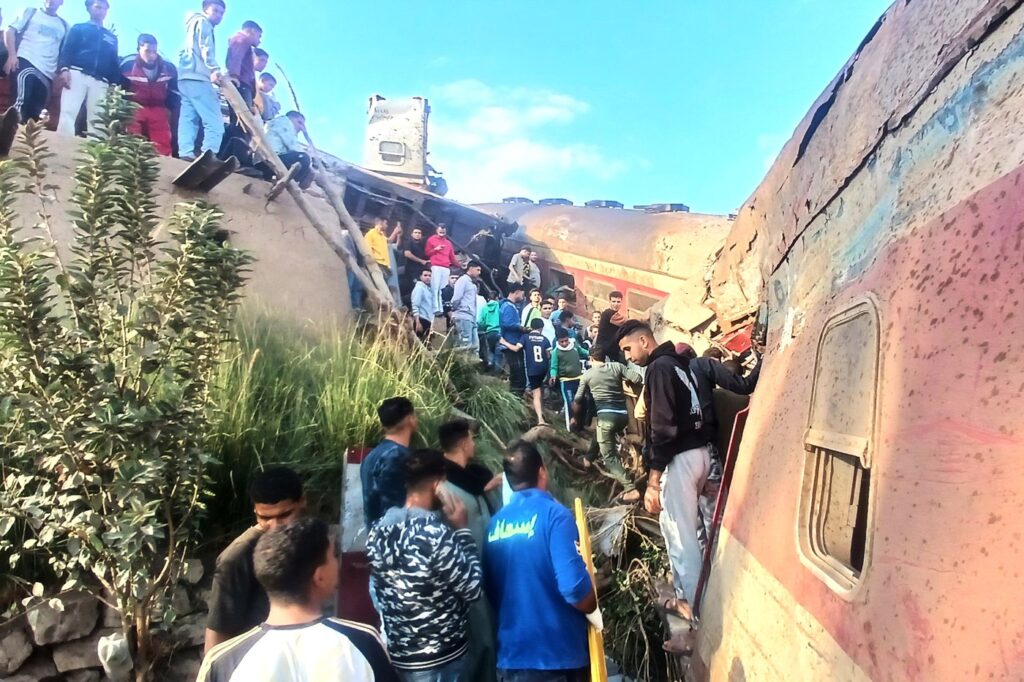
AL-AYYAT, Egypt (AP) — On Sunday, two trains collided just south of Cairo, resulting in the deaths of seven individuals and injuring at least 125 others, according to authorities. Notably, the train's conductor was among those tragically killed.
The Egyptian Health Ministry reported the casualty numbers in a statement, noting that over 70 of the injured had been treated and discharged from medical facilities following the incident.
The collision occurred in the al-Ayyat district of Giza province, approximately 52 kilometers (32 miles) south of Cairo. The accident transpired when a train en route to Fayoum province collided with the rear of another train that was stationary and heading towards Aswan province. This was detailed by officials from the Transportation Ministry.
Investigators from the Chief Prosecutor’s office promptly arrived at the scene. Their preliminary inspection revealed that the train traveling from Giza to Fayoum collided with the last carriage of the Cairo to Aswan train, which had been stopped on the same track in the same direction as the moving train.
Train crashes and derailments have unfortunately become commonplace in Egypt, a nation with a railway system plagued by mismanagement and inadequate equipment maintenance. Despite this, the Egyptian government has announced various modernization initiatives aimed at improving the railway infrastructure in recent years.
Ayman Gamal, a local resident from Kafr Girza in al-Ayyat, shared that community members rushed to the crash site to assist, managing to rescue survivors and contact emergency services. He observed around 80 injured individuals being transported to nearby hospitals by ambulances. Some passengers were tragically trapped inside one of the mangled compartments of the stationary train, and many were found deceased when they were eventually extricated.
Outside al-Wasta Central Hospital in Beni Suef province, where several victims were taken for care, surviving passengers recounted their harrowing experience. They described how the dust kicked up during the crash made breathing difficult, contributing to the prevailing panic. Local villagers helped in rescuing those trapped inside.
Survivor Farha Gamal, who was aboard the Fayoum train, recounted the chaos inside the compartment. She saw some passengers who appeared lifeless and others desperately seeking a way out amidst the wreckage. “There were other cars that were completely mangled,” she recounted in an interview, reflecting on the severity of the incident.
In response to the tragic event, President Abdel-Fattah el-Sissi took to social media to announce his order for an expedient investigation into the collision. In order to manage the aftermath, emergency response teams and cranes were dispatched to the location to clear the debris and expedite the restoration of normal train services, as indicated by the Egyptian Railway Authority.
This incident is not an isolated occurrence; just last September, a collision involving two freight trains in the same district resulted in injuries to a train driver and his assistant. Historically, Egypt has faced substantial challenges with rail safety. The nation’s deadliest train accident occurred in 2002, when more than 300 people lost their lives in a fire that broke out on an overnight train traveling from Cairo to southern Egypt.