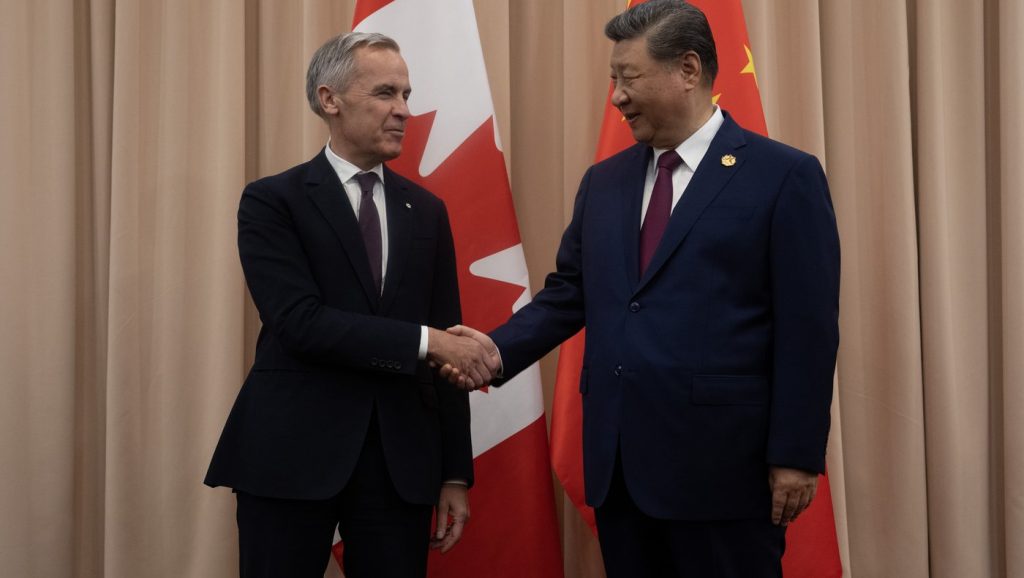
BEIJING (AP) — As Canadian Prime Minister Mark Carney arrived in China on Wednesday, Chinese officials perceived an opportunity to subtly shift ties with a nation long aligned with the United States. Chinese state media called for Canada to carve out a foreign policy that reflects “strategic autonomy,” aiming to distance itself from American influences.
Traditionally, Canada has been one of America's closest allies, both geographically and ideologically. However, Beijing hopes that the recent economic and military aggressiveness from former U.S. President Donald Trump, followed by efforts from President Joe Biden to strengthen alliances with countries like Canada and Australia to counter China, will weaken this longstanding relationship.
In light of the Biden administration’s initiatives, Beijing has seized the moment, looking for ways to loosen Canada’s ties with the U.S., although it remains cautious about how far these efforts might succeed. During his visit, Carney emphasized trade, framing his trip to China as part of a broader strategy to establish new international partnerships that would lessen Canada's economic dependency on the American market. This follows Trump’s imposition of tariffs on Canadian exports and comments that Canada could potentially become the United States' 51st state.
An Attempt at Diplomatic Resuscitation
Carney’s government is working to mend the frayed relationship with China that soured under former Prime Minister Justin Trudeau. Relations declined significantly in late 2018, following the arrest of Meng Wanzhou, a Chinese tech executive, at the request of the U.S. Further complications arose when Trudeau’s government opted to follow Biden's lead by instituting a 100% tariff on Chinese-made electric vehicles in 2024. China retaliated by imposing tariffs on Canadian exports, including canola, seafood, and pork.
A recent editorial in China’s state-owned newspaper, China Daily, urged Canada to reflect on the issues that have hampered bilateral relations in recent years. The editorial suggested that recognizing the previous government’s close alignment with U.S. policies could help Canada avoid repeating mistakes that have led to strained ties with China. The Global Times, another government-run publication, added that perhaps the heavy toll of adhering to U.S. tariffs had awakened Canada’s sense of strategic autonomy.
While Canadian officials anticipate that Carney's trip could advance discussions around trade, they are not projecting any immediate resolutions regarding tariff eliminations.
Where Could Common Ground Be?
Chinese analysts note potential areas of cooperation, particularly surrounding the U.S. military's recent intervention in Venezuela, which forced its president to face charges in New York, as well as Trump's remarks regarding Greenland's potential U.S. claim. Experts like Cui Shoujun, a foreign policy analyst at Renmin University of China, pointed out that Canada's rising unease toward the U.S. might open doors for collaborative dialogues on pressing issues.
However, China remains practical about the extent to which countries like Canada could pivot towards it, especially given Canada’s strong historical and cultural ties to the U.S. and ongoing concerns regarding China’s expanding economic and military presence. Significant differences also persist over human rights issues and China’s extensive exports, which threaten job security in Canada.
Zhu Feng, the dean of the School of International Studies at Nanjing University, cautioned against overinflating the significance of Carney’s visit. He noted that while Trump’s pressure might create openings for China to deepen relationships with traditional U.S. allies, these allies will need to carefully navigate their reliance on America’s economic and military capabilities. Although officials may reassess this dependence in the short term, a complete severance seems improbable in the foreseeable future.
Ken Moritsugu, The Associated Press