NUUK, Greenland (AP) — On October 21, President Donald Trump announced plans to impose a 10% import tax on goods from eight European nations beginning in February 2024. This measure was a response to what he perceives as their opposition to American control of Greenland, a semi-autonomous territory originally a part of Denmark.
The nations targeted by the tariff include Denmark, Norway, Sweden, France, Germany, the United Kingdom, the Netherlands, and Finland. Trump warned that if a deal for "the Complete and Total purchase of Greenland" is not reached by June 1, the tariff will increase to 25%. This proposed trade measure marks an escalation in an ongoing conflict between Trump and NATO allies, straining an alliance that has been essential for both European and North American security since its formation in 1949.
It remains ambiguous how Trump intends to legally implement these tariffs, though he might invoke economic emergency powers currently being challenged in the U.S. Supreme Court. In a post on Truth Social, Trump highlighted his concerns regarding recent visits to Greenland by representatives from several European countries, suggesting they indicated a lack of support for his administration's ambitions. Trump insists that Greenland is vital for the U.S. "Golden Dome" missile defense system and fears that Russia and China could attempt to claim the territory.
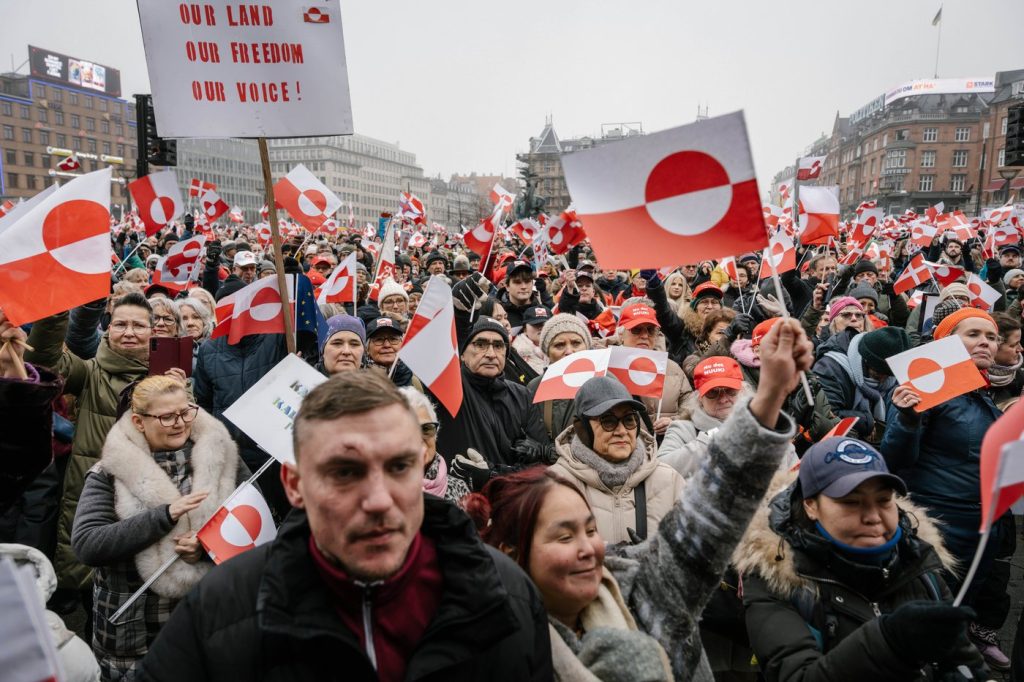
Resistance to Trump's proposal has been growing in Europe. Despite previous agreements by some European nations to Trump's tariffs to maintain economic ties with the U.S., the prevailing attitude across the continent seems to be opposition to any attempt at American territorial expansion. This sentiment was echoed earlier that same day as hundreds of Greenlanders staged a protest in their capital, Nuuk, braving adverse weather to demonstrate for their right to self-governance. Participants proudly waved their national flags and displayed signs with slogans like "We shape our future" and "Greenland is not for sale."
The protests were further amplified by a bipartisan congressional delegation that visited Copenhagen to express support for Denmark and Greenland. U.S. Senator Chris Coons emphasized that the rhetoric surrounding Greenland was causing unease within the Danish kingdom and called for de-escalation to uphold mutual trust between the allies.
In discussions about current NATO operations, Danish Major General Søren Andersen reassured the public that Denmark does not anticipate any military aggression from the U.S. or any NATO allies. He stated that recent training exercises conducted in Greenland serve to strengthen cooperation among allied forces rather than to send a political statement. Andersen noted that no Chinese or Russian military vessels have been observed near Greenland's vicinity, contradicting Trump's claims of imminent threats.
Thousands of Danes joined together in protests in Copenhagen, many carrying Greenland's flag and messages opposing Trump's stance. Danish protester Elise Riechie articulated the global significance of the issue, stating that small nations should not be viewed as commodities for sale. Echoing Trump’s stance, Coons insisted that Greenland's current security dynamics do not warrant such fears surrounding potential adversarial intentions from China or Russia.
Trump has articulated his belief that the U.S. must secure Greenland's geopolitical and resource potential, claiming that any arrangement falling short of U.S. control over the island would be "unacceptable." During events at the White House, he referenced the use of tariffs as a method to compel European allies to reconsider their positions on various issues, reiterating this approach could also apply to Greenland.
Despite this mounting tension, discussions continue between U.S. officials and their Danish counterparts, with suggestions for potential collaboration on military operations signifying ongoing diplomatic ties. Although the negotiations have yet to resolve fundamental disagreements, they manifest the delicate balance of interests at play as both nations navigate the complexities of international relations in the Arctic region.