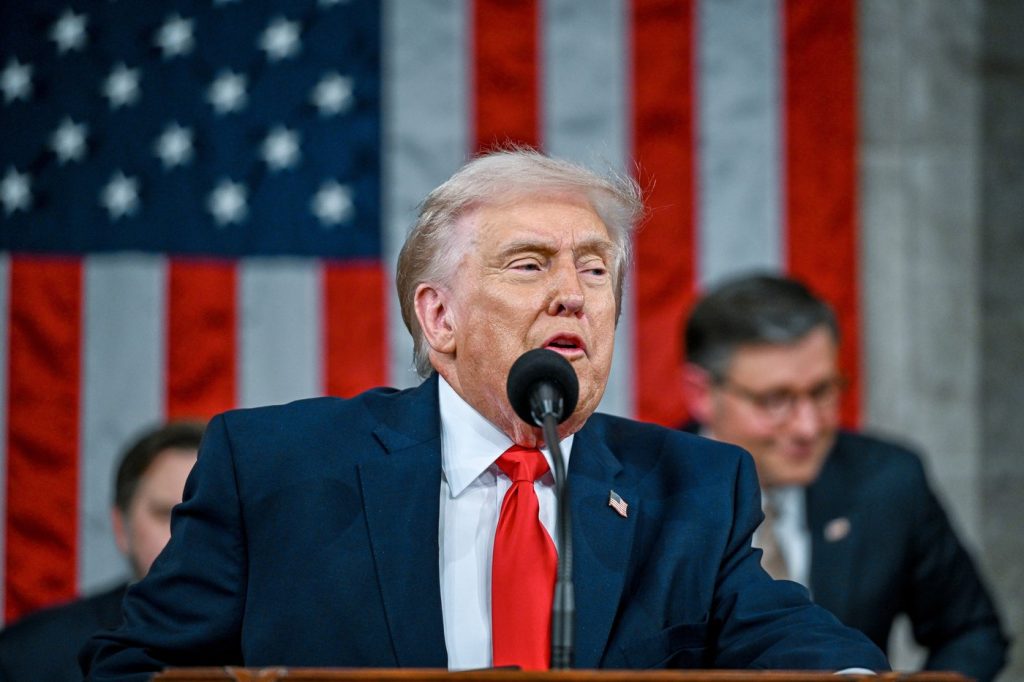
President Donald Trump adopted a commercial tone in his State of the Union address, presenting an optimistic outlook on the U.S. economy. His approach, however, diverges sharply from the prevailing public sentiment, as many Americans continue to express anxiety about their financial situations and feel disconnected from the benefits of Trump’s policies. The address commenced with a tribute to the U.S. men’s Olympic hockey team and a war hero but quickly shifted to a more confrontational tone as Trump criticized Democrats.
Despite Trump’s claim of a “roaring economy,” public approval of his economic management remains low. In February, only 39% of U.S. adults expressed approval of his handling of the economy. Trump asserted that rising costs were no longer an issue, emphasizing decreased prices in gasoline, mortgage rates, and prescription drugs, alongside a buoyant stock market. This disconnect between his assertions and the economic struggles faced by many risks portraying him as out of touch with the electorate.

In an attempt to evoke patriotic sentiments, Trump highlighted the achievements of the Olympic hockey team and recognized war heroes during his address. He aimed to infuse a sense of national pride into the speech, possibly recognizing the ability of such moments to resonate on social media in the days that follow. However, his self-reflective comment lamenting why he couldn’t award himself a congressional medal revealed a humorous yet revealing aspect of his self-presentation.
The mood of unity was short-lived as Trump shifted focus to his criticisms of Democrats, attributing various national issues to their policies. He claimed that rising health care costs were “caused by you,” and suggested Democrats were failing to protect Social Security, emphasizing that they bore responsibility for the country’s affordability crisis. His remarks grew more intense, as he declared, “These people are crazy, I’m telling you, they’re crazy. Democrats are destroying this country.” This combative approach may resonate with his MAGA base, but its broader appeal remains uncertain.
On the judicial front, Trump addressed the recent Supreme Court ruling that struck down his tariff policy. By his standards, he maintained a restrained tone, merely labeling the decision as “unfortunate.” Despite his insistence that tariff revenues were benefiting the U.S., most analyses indicate that the financial burden has largely fallen on American consumers and businesses. Trump suggested a long-term belief that the tariffs would eventually alleviate the federal income tax burden on the populace, though this view lacks grounding in constitutional authority.
In the speech, Trump reiterated his long-held claims regarding election integrity, stating, “Cheating is rampant in our elections.” With the 2022 midterm elections approaching, he indicated intentions to take action against perceived electoral fraud. Trump’s call for Congress to mandate photo IDs for voters and his allusion to an executive order reflect his ongoing narrative about election misconduct, which lacks substantiation and has been dismissed by multiple courts.
His silence on certain issues, such as immigration and notably recent enforcement actions that resulted in the deaths of U.S. citizens in Minneapolis, was conspicuous. While he has often targeted “criminal aliens,” the absence of acknowledgment regarding these incidents and broader immigration concerns might suggest a strategic choice to sidestep contentious topics that are unpopular among many voters.
Furthermore, Trump hinted at an escalation of military action regarding Iran, citing threats posed by its regime. He described Iran as the “world’s number one sponsor of terror” while advocating for a diplomatic resolution yet signaling readiness for military action if necessary. The historical context of these threats aligns with Trump’s administration’s military buildup in the Middle East, raising concerns about escalating tensions in that region.
Finally, Trump achieved a record duration for a State of the Union address—clocking in at nearly 1 hour and 48 minutes—emphasizing his continued tendency to dominate the narrative and set benchmarks during his presidency. As he moves closer to the midterms, his address reflects a blend of policy advocacy, combative rhetoric, and elements aimed at resonating with his core supporters while navigating a divided political landscape.