SEOUL, South Korea (AP) – North Korean leader Kim Jong Un has asserted that his nuclear-capable nation could "completely destroy" South Korea if its security is threatened, according to state media reports on Thursday. Kim's statements come during a ruling party congress where he emphasized his unwillingness to engage with Seoul. Nonetheless, he implied a readiness for dialogue with the United States, which he deems necessary for any potential negotiations in the future.
In recent years, Kim has intensified his hostile rhetoric toward South Korea, firmly rejecting any inter-Korean diplomacy. Analysts suggest that this aggressive stance is aimed at establishing a more assertive regional presence, supported by Kim's nuclear arsenal and alliances with countries such as Moscow and Beijing. The official Korean Central News Agency (KCNA) reported that Kim proposed developing new weapons systems to strengthen his military, including intercontinental ballistic missiles (ICBMs) that could be launched from underwater, alongside an expanded collection of tactical nuclear weapons, such as artillery and short-range missiles targeting South Korea.
Kim asserted that the accelerated advancements in North Korea's nuclear and missile programs have "permanently cemented" its status as a nuclear weapons state. He urged the U.S. to abandon what he perceives as its "hostile" policies towards North Korea if it wishes to rekindle stalled dialogues. In response, South Korea's Unification Ministry expressed regret over the North's continued definition of inter-Korean relations as hostile and reiterated its commitment to pursuing stabilization efforts patiently.
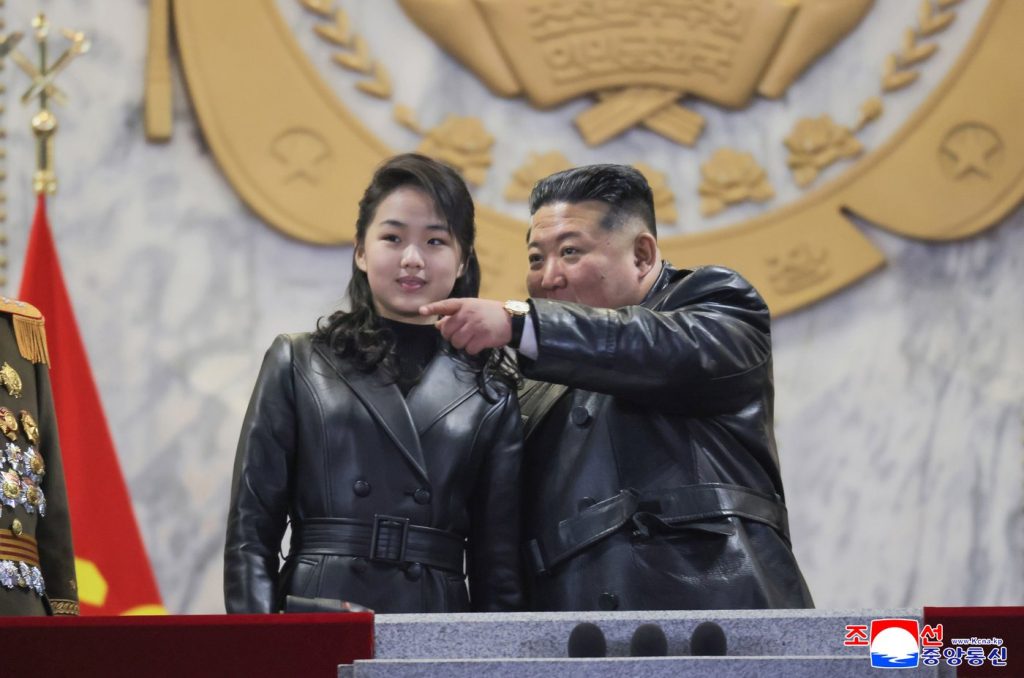
The ongoing Workers' Party congress, which commenced last Thursday in Pyongyang, is considered the North's paramount political event. KCNA noted that a military parade took place in the capital as the congress concluded, the first of its kind since 2016 and 2021. During the parade, Kim Jong Un was accompanied by his daughter, believed to be around 13 years old. In his speech, he proclaimed that the North's forces could "immediately and thoroughly retaliate" against any perceived threats, though it remains unclear whether Kim showcased the largest weapons in his arsenal during the parade.
Kim's remarks have been anticipated, particularly as he has adopted increasingly hard-line positions towards South Korea since 2024, marking an end to North Korea's earlier aspirations for peaceful reunification and designating the South as a "permanent enemy." Analysts expect a more balanced approach towards the U.S. to maintain the possibility of future discussions aimed at achieving sanctions relief and obtaining tacit recognition of North Korea as a nuclear state.
Recently, Kim has prioritized improving relations with Russia, providing troops and military equipment to bolster Moscow's efforts in Ukraine, likely in exchange for military aid and technology. However, experts warn that as the situation in Ukraine may change, North Korea's value to Russia could diminish, prompting Kim to keep diplomatic channels with the U.S. open.
In wrapping up the congress, Kim noted that while his administration is adopting the "toughest stance" against Washington, he also indicated that peaceful coexistence is possible should the U.S. rescind its "hostile policy" towards his regime. Such terms typically refer to the pressure and sanctions the U.S. maintains over North Korea's nuclear ambitions, and these remarks echoed past North Korean positions requiring the abandonment of denuclearization demands as a precondition for dialogue renewal.
Historically, North Korea has consistently dismissed calls from Washington and Seoul to reinitiate diplomacy aimed at curbing its nuclear program, which stalled after the failure of Kim's second summit with then-President Donald Trump in 2019. Kim stated that the future of U.S.-North Korea relations "depends entirely on the U.S. attitude," emphasizing that the responsibility for choosing between peaceful coexistence or continuous conflict lies not with North Korea but with the U.S.
Experts assert that Kim's negative portrayals of South Korea demonstrate his belief that the South, which facilitated initial Trump-Kim meetings, has become an obstacle rather than an intermediary in pursuing an assertive regional agenda. In addition, Kim has reacted strongly to South Korean cultural influence, launching domestic campaigns to counter South Korean soft power and reinforce his regime's control.
During the congress, Kim criticized South Korean President Lee Jae Myung's calls for engagement, branding them as deceitful, and accused previous South Korean administrations of desiring North Korea's downfall. He claimed that "there is absolutely nothing to discuss" with what he labeled an enemy state and that North Korea would "permanently exclude" South Korea from the concept of a unified nation.
As tension mounts, future prospects for escalation loom next month when South Korea will conduct its annual military exercises in conjunction with the United States. North Korea often interprets these drills as rehearsal for invasion, frequently using them as justification for showcasing its military capabilities.
Over the past years, North Korea has developed or tested many weapons from a detailed wishlist Kim provided in the 2021 congress, which includes solid-fuel ICBMs, tactical nuclear systems, and hypersonic missile technology. The country lauded the launch of its first military satellite in 2023 and claimed progress in constructing a nuclear-powered submarine. At the recent congress, Kim outlined new objectives to further enhance North Korea's nuclear capabilities over the next five years, including a focus on increasing nuclear warhead production and expanding delivery methods.
Furthermore, Kim advocated for the development of ICBMs capable of launching from submerged platforms, aligning with ongoing plans to equip a nuclear submarine currently under construction. Additionally, he called for artificial intelligence-enabled attack drones, advanced electronic warfare systems, improved reconnaissance capabilities, and provisions for neutralizing enemy satellites. Kim also announced plans for the military to incrementally deploy more nuclear-capable artillery targeting South Korea over the upcoming years while reinforcing the inter-Korean border.