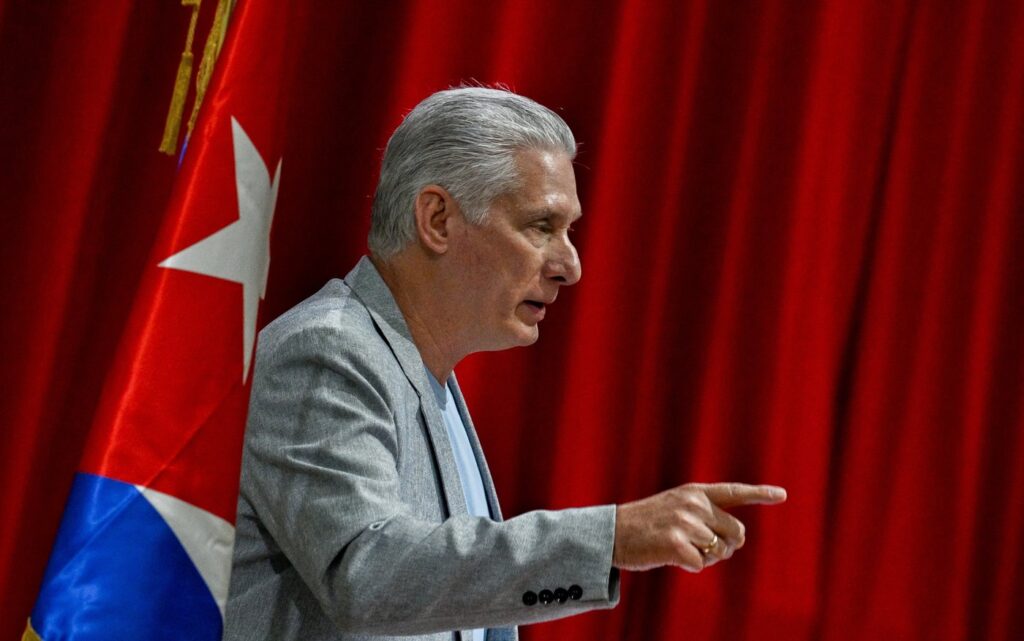
SAN JUAN, Puerto Rico (AP) – Cuban President Miguel Díaz-Canel asserted that there is no valid justification for the United States to carry out a military attack against Cuba or to attempt his ousting. In a recent interview on NBC News’ Meet the Press, he emphasized that any invasion would result in considerable costs and would threaten regional security. Should such an attack occur, Díaz-Canel proclaimed that Cubans would be prepared to defend their homeland.
“If the time comes, I don’t think there would be any justification for the United States to launch a military aggression against Cuba, nor for the U.S. to undertake a surgical operation or the kidnapping of a president,” he stated through a translator. He continued, “If that happens, there will be fighting, and there will be a struggle, and we will defend ourselves, and if we need to die, we’ll die, because as our national anthem says, ‘Dying for the homeland is to live.’”
Díaz-Canel's comments come amid heightened tensions between Cuba and the U.S., despite both sides acknowledging the existence of dialogues, though specifics remain undisclosed. The Cuban president accused the U.S. government of maintaining a “hostile policy” against Cuba, asserting that the U.S. lacks the moral authority to demand anything from his nation. He expressed Cuba’s willingness to engage in dialogue on any subject without preconditions, insisting that Cuba does not impose changes on the American system, despite harboring doubts regarding it.
The Cuban government blames a U.S. energy blockade for its escalating difficulties, contending that the blockade has severely impacted the island’s health system, public transportation, and the overall production of goods and services. Cuba currently produces only 40% of the fuel it consumes, and it ceased receiving vital oil shipments from Venezuela following a U.S. military intervention in January that resulted in the seizure of Venezuelan President Nicolás Maduro, who was taken to New York to face drug trafficking charges. Subsequently, the Trump administration began implementing a phased plan aimed at resolving Venezuela’s prolonged crisis with the cooperation of ruling party leaders.
The situation saw a slight alleviation when a Russian tanker delivered 730,000 barrels of crude oil to Cuba in March, marking the island’s first oil shipment in three months. Russia has promised an additional tanker, enhancing Cuba's crude supply amid ongoing restrictions. Despite the Trump administration threatening tariffs in January against countries supplying oil to Cuba, they permitted the tanker to proceed, underscoring the complexity of international relations in the region.
“Cuba’s finished,” President Donald Trump remarked at the time, labeling the Cuban regime as corrupt and ineffective. He asserted that despite receiving oil shipments, it would not alter the dire situation in Cuba. In response to Trump’s remarks, Díaz-Canel interpreted them as a significant warning for the Cuban leadership, emphasizing the importance of protecting their people, their political project, and their nation. “You hear that Cuba is next, that there’s a way out, that they’re going to take over Cuba,” he noted, urging a responsible approach to national security.