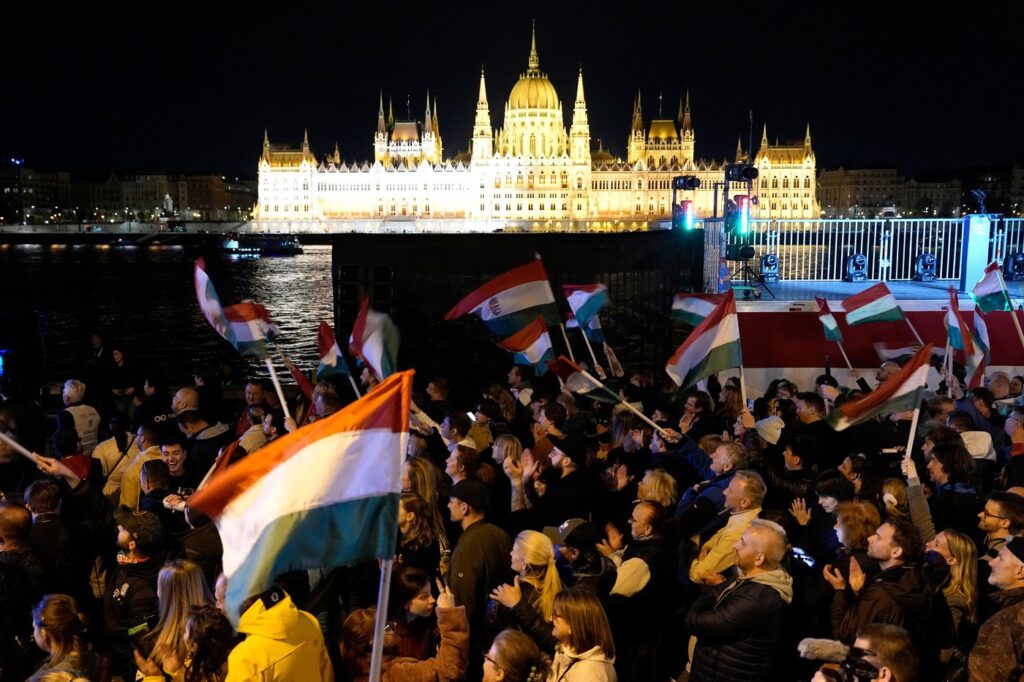
BUDAPEST, Hungary (AP) – In a significant political shift, Hungarian voters ousted long-serving Prime Minister Viktor Orbán on April 12, 2026, after 16 years in power. The election result marked a rejection of Orbán's authoritarian policies and his embodiment of the global far-right movement in favor of a pro-European challenger, Péter Magyar. This outcome is expected to have global repercussions.
Orbán, a close ally of U.S. President Donald Trump and Russian President Vladimir Putin, swiftly conceded defeat, labeling the election result as “painful.” Just days before the election, U.S. Vice President JD Vance made a visit to Hungary intended to bolster Orbán's chances of victory.
Election victor Péter Magyar, a former loyalist of Orbán who ran on a platform focused on anti-corruption and pressing social issues like health care and public transport, has vowed to restore Hungary's relationships with the European Union and NATO, which have deteriorated under Orbán. European leaders promptly congratulated Magyar on his victory, which will likely reshape political dynamics within the EU.
This election also carries implications for the far-right movements worldwide, which have often looked to Orbán as a model for leveraging nationalist populism and undermining political opponents. With 93% of the votes counted, Magyar's party, Tisza, garnered over 53% support compared to 37% for Orbán’s ruling Fidesz party, appearing set to secure 94 of Hungary's 106 voting districts. However, it remains uncertain if Tisza will achieve the two-thirds parliamentary majority necessary for significant legislative changes.
In a speech to thousands of jubilant supporters along the Danube River, Magyar proclaimed, “Tonight, truth prevailed over lies,” emphasizing the civic commitment of Hungarians to their homeland. People celebrated in the streets of Budapest, chanting slogans like “Ruszkik haza!” or “Russians go home!” which gained traction during Hungary's 1956 anti-Soviet revolution amid concerns over Orbán's increasing proximity to Moscow. Voter turnout reached nearly 80%, the highest in Hungary's post-Communist electoral history.
Over his long-term tenure, Orbán transitioned from a liberal anti-Soviet youth to a pro-Russia nationalist and one of the EU's most prominent adversaries. His government faced accusations of undermining EU unity through frequent vetoes and blocking critical decisions, including a recent 90-billion euro ($104 billion) aid loan to Ukraine.
Magyar emerged as a formidable opponent to Orbán, breaking away from the Fidesz party in 2024 to form Tisza. Throughout his campaign, he traveled extensively across Hungary, indicating that the election would be a referendum on the country's future alignment with the EU and its drift towards Russia under Orbán. Tisza, part of the European People’s Party, represents the center-right elements within the EU, where it is expected to influence Hungary's approach to European and NATO collaborations.
Despite facing significant hurdles, such as media control by Orbán’s administration and a gerrymandered electoral system, Magyar's campaign rallied considerable support. Reports indicated that Russian secret services had plans to meddle in the election to ensure Orbán’s victory; however, Orbán allegedly accused neighboring Ukraine and other EU allies of attempting to influence the vote in favor of a "pro-Ukraine" government. The aftermath of this election suggests a pivotal moment for Hungarian politics and its relations with both the EU and Russia.