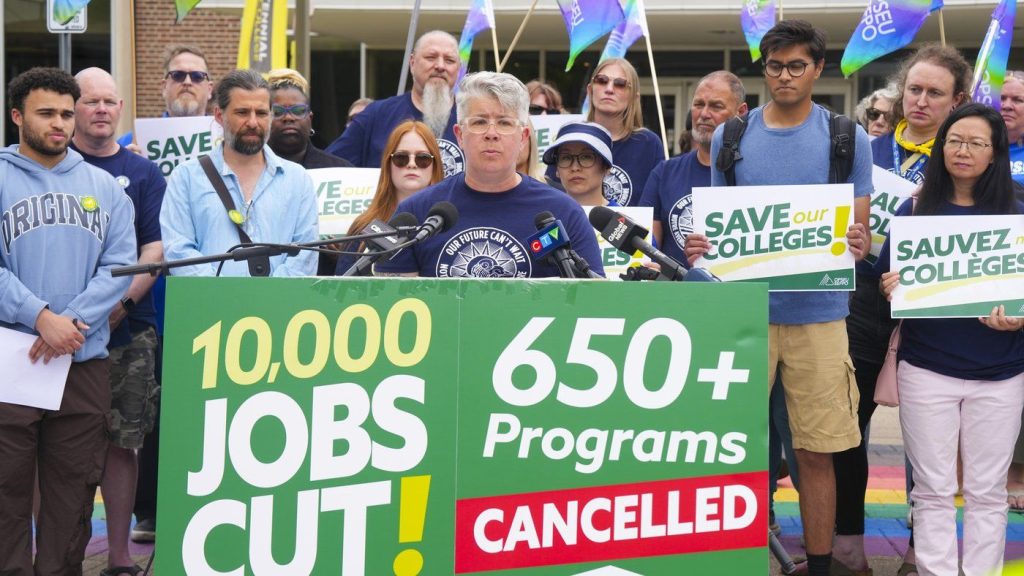
The unions representing faculty and support staff at Fleming College and St. Lawrence College expressed their discontent regarding the recent announcement of a merger between the two institutions. They claim that the decision came as a surprise to workers and is indicative of the provincial government's failure to adequately invest in post-secondary education.
Marcia Steeves, the president of OPSEU Local 351—which represents the support staff at Fleming College—stated that unions at both colleges were not informed beforehand about the merger. She accused government officials and college presidents of neglecting inquiries concerning the future of these institutions. According to Steeves, this lack of communication has left many stakeholders in the dark.
On the other hand, Dayna Smockum, a spokesperson for the Ministry of Colleges and Universities, described the position of OPSEU as “misguided.” She asserted that the decision to merge the two colleges was made independently, aiming to better fulfill the educational mandates of the institutions involved.
Fleming College and St. Lawrence College officially confirmed their merger on a Friday, announcing that the consolidation aims to expand access to education, align programs with regional labor market needs more effectively, and enhance long-term financial sustainability. The combined institution will be managed by a single management team, and both colleges have reassured that there will be no immediate changes to programs, campuses, services, student supports, or local branding.
Fleming College has multiple campuses located in Peterborough, Lindsay, Cobourg, and Haliburton, while St. Lawrence College operates campuses in Kingston, Brockville, and Cornwall. The merger represents a significant shift in the landscape of Ontario’s post-secondary education system.
Newly elected OPSEU president JP Hornick emphasized that the union has previously warned of potential college closures and mergers resulting from years of underfunding. Hornick noted the disparity in public funding, stating that while billions are allocated for corporate bailouts and other private interests, Premier Doug Ford consistently underfunds public college systems that benefit the community at large.
In response to the concerns raised, Smockum highlighted the government’s recent initiatives to increase funding for colleges and universities, claiming that government support for post-secondary institutions is at an all-time high. In February, Ontario announced a substantial funding boost of $6.4 billion over four years intended to alleviate severe financial pressures on these institutions. Additionally, the government lifted a seven-year freeze on tuition fees to address the budgetary challenges faced by colleges and universities.
Despite these measures, Ontario colleges and universities have been grappling with low levels of government funding for many years, coupled with stagnant tuition rates since 2019. The reduction of international students, who contribute significantly higher tuition fees, has further exacerbated financial strains, with estimates suggesting that federal government policies may lead to a revenue loss of up to $4.2 billion by 2027-28.
To mitigate these financial challenges, colleges have already implemented substantial cost-cutting measures, totaling $1.4 billion. These measures have included suspending over 600 programs and eliminating more than 8,000 staff positions in an effort to balance the budget and maintain operational viability.