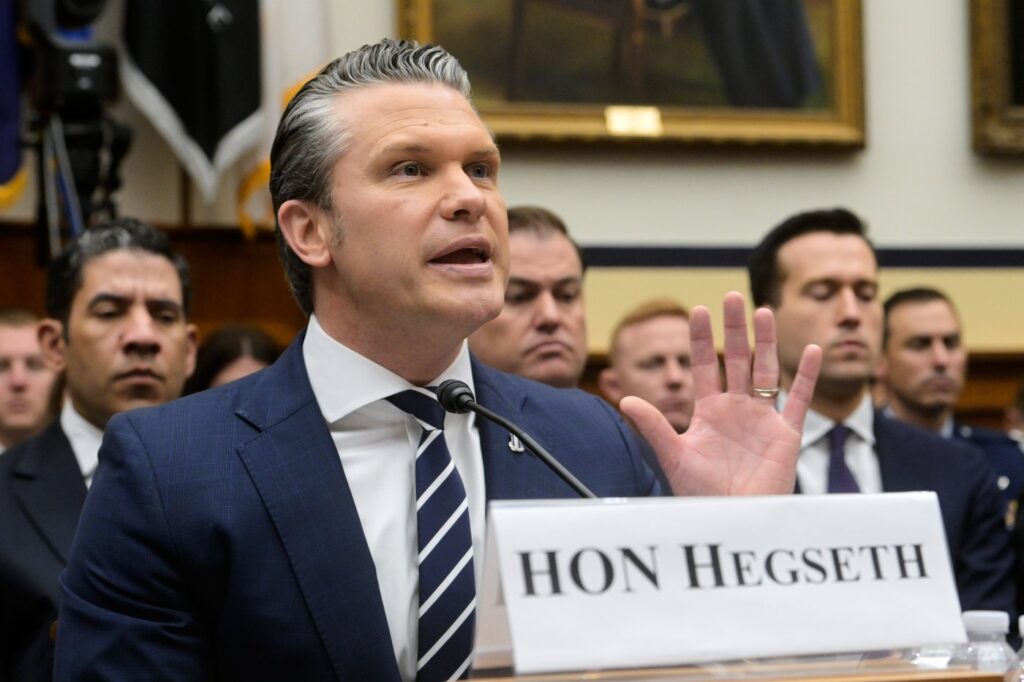
WASHINGTON (AP) – In a contentious hearing before Congress, Defense Secretary Pete Hegseth faced intense scrutiny from skeptical Democrats regarding the administration's costly war against Iran, which has incurred expenses of $25 billion to date. This marked Hegseth's first appearance before Congress since the onset of the conflict, which began without congressional approval and was a key focus of the session held by the House Armed Services Committee.
The hearing, which lasted nearly six hours, also addressed the administration's proposed military budget for 2027 that seeks to increase defense spending to a historic $1.5 trillion. While Hegseth and Gen. Dan Caine, the Chairman of the Joint Chiefs of Staff, received support from Republican committee members who emphasized military budgeting specifics, they were met with pointed inquiries from Democrats regarding the war's escalating costs, the depletion of critical U.S. munitions, and the humanitarian impact, including incidents that resulted in civilian casualties.
Democrats were particularly critical of the administration’s shifting justifications for the conflict and accused Hegseth of misleading the public regarding the war's purpose. Representative Adam Smith, the ranking Democrat on the committee, challenged Hegseth's assertion that Iran's nuclear facilities had been destroyed in prior U.S. strikes but contended that the threat had evidently persisted since the war was initiated.
“We had to start this war...because the nuclear weapon was an imminent threat,” Smith stated, questioning the rationale behind the conflict that began less than a year after the alleged destruction of these facilities. In response, Hegseth argued that Iran continued to pose a threat with its ongoing missile capabilities.
Gas prices skyrocketed due to Iran’s closure of the Strait of Hormuz, a major shipping route, which further complicated the political landscape for Republicans ahead of the midterm elections. Each party’s perspectives on the war diverged sharply, with many Democrats accusing the administration of not only mismanagement but also negligence towards American citizens burdened by rising gas prices. Representative John Garamendi described the war as a “geopolitical calamity” and a strategic error, and he indicated that Hegseth and President Trump had consistently misrepresented the situation to the American public.
In an assertive retort, Hegseth questioned Garamendi's loyalties, suggesting that the lawmaker’s disdain for Trump overshadowed the perceived successes of the military engagement. Tensions escalated when Representative Chrissy Houlahan pressed Hegseth on the dismissal of several top military officers, including Gen. Randy George, whom she described as respected within military circles. Hegseth's justification of needing “new leadership” did not suffice to quell the questions surrounding his firings.
The management of personnel within the military has become a point of contention, with some lawmakers expressing bipartisan concerns over Hegseth's decisions. Republican Rep. Don Bacon conveyed that while Hegseth is within his rights to make personnel changes, the recent firings of high-ranking officials raised substantial questions about their wisdom.
In the midst of this discourse, Hegseth outlined the administration's strategy to bolster military compensation and upgrade munitions. He also confirmed that the Pentagon had previously released $400 million in military aid for Ukraine in its resistance against Russian advances, indicating a focus on global military dynamics amid ongoing conflicts.
Despite a fragile ceasefire status, the Iran war loomed high on the agenda with no immediate resolution evident. The United States and Israel initiated the conflict on February 28, 2026, through coordinated military action without congressional oversight, a decision that has faced ongoing bipartisan criticism. As tough questions persist about the war's economic implications and the heightened fuel costs faced by Americans, the conflict has the potential to impact political stances and legislative outcomes ahead of the approaching elections.