PEREIRA, Colombia (AP) – Rescue crews and civilians in Colombia tirelessly searched through the debris on Tuesday for survivors trapped beneath the rubble following a devastating 7.4 magnitude earthquake that struck western Colombia on Monday. The disaster left a significant number of people missing across various cities and towns, leading to urgent rescue operations.
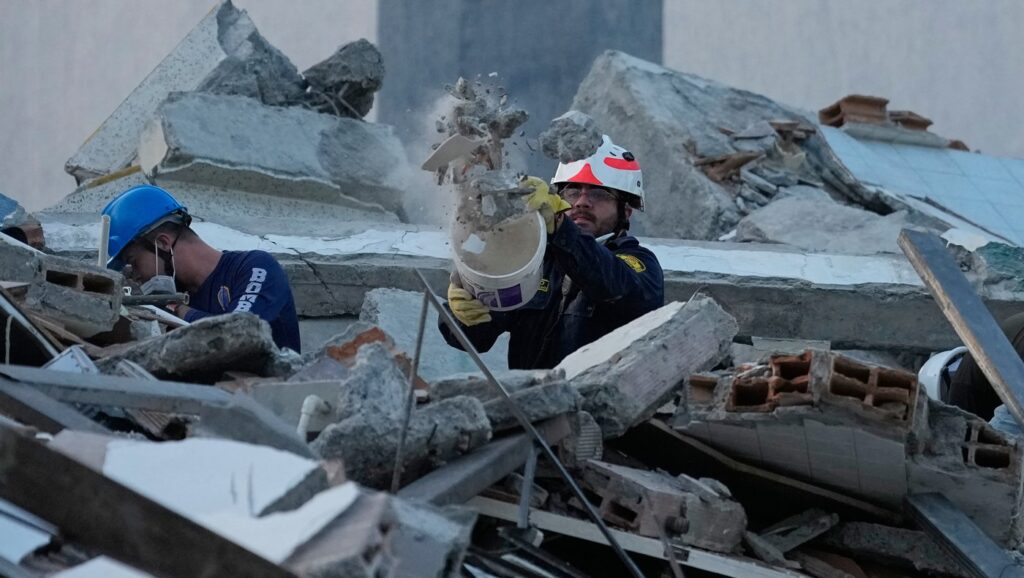
The earthquake caused widespread destruction, collapsing buildings, buckling roads, and crushing vehicles. As residents gathered amongst the wreckage of their homes, heavy machinery was deployed to clear large chunks of concrete, while volunteers passed buckets of rubble hand-to-hand in hopes of finding those who may still be alive beneath the debris.
Colombian President Abelardo de la Espriella reported that at least 181 people had lost their lives, with 2,595 more injured. He indicated that at least 195 individuals remained missing, although civilian-led databases suggested that the true number could be closer to 4,000. The hardest-hit areas included the cities of Cali, Pereira, Manizales, and Quibdo, with significant concerns about casualties and structural damage in rural regions where information has been scarce.
As rescue efforts intensified, volunteers and rescue crews scoured the flattened buildings for any signs of life. When potential sounds of survivors were detected, teams would call for silence, hoping to hear any response. Remarkably, rescuers managed to retrieve at least one woman alive from the rubble, offering a glimmer of hope amidst the chaos.
The recent quake poses a significant challenge for President de la Espriella, who assumed office only days before the disaster. The earthquake has presented the first major test of his leadership as he seeks to unify the country in its response to the crisis. The epicenter, Choco, is one of Colombia's most impoverished regions, often neglected and affected by violence from warring armed groups. Many towns in Choco are inaccessible except by boat, complicating rescue and recovery operations.
Sterling Palacios, a local leader, reported that communities along the Atrato River suffered extensive damage, with many homes reduced to rubble. Aftershocks continue to shake the region, heightening the distress of residents forced to sleep in the streets. The Colombian Geological Service noted over 100 aftershocks of lesser magnitude following the initial earthquake, further alarming the impacted population.
President de la Espriella expressed commitment to mobilizing the military and police forces, alongside delivering engineers, rescue personnel, and search dogs to the affected areas. He vowed that Choco would no longer be regarded as "the land of the forgotten." However, critics pointed out that current aid efforts appear to be primarily concentrated in urban centers, raising concerns about adequate assistance for remote communities that are difficult to reach.
In the aftermath of the earthquake, desperate residents sought news about missing family members through citizen-operated websites. Dana Carolina Zamora shared her worries about her uncle, who vanished from the rural area of El Cairo, noting that the town had suffered considerable damage. Similarly, Mónica Sánchez, a local resident in Pereira, recounted the collapse of a wall inside her clothing factory just in time for her and her employees to escape.
In response to the disaster, Pereira and Cali enforced a curfew on Monday night to deter looting, and private vehicles were barred from roads to ensure clearance for emergency vehicles. The U.S. State Department announced an initial assistance package of $15.5 million to provide emergency shelter, food, and other critical supplies to those affected. Governments from across Latin America also pledged their support to the relief efforts.
Mayor Mauricio Salazar of Pereira lamented the tragedy that befell countless families and expressed hope for a united community response to the disaster's aftermath.