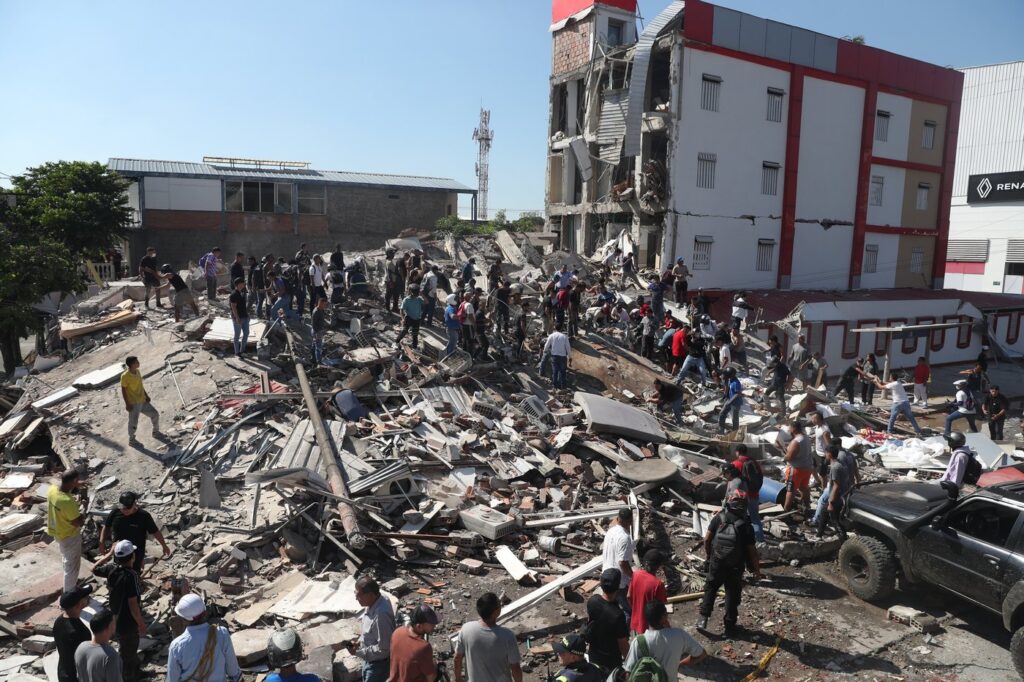
CALI, Colombia (AP) – A powerful 7.4 magnitude earthquake struck western Colombia on Monday, resulting in at least 111 fatalities, damaging hundreds of buildings, and leaving many individuals trapped beneath rubble. Rescue teams and civilians actively searched through the debris in the country's third-largest city, Cali, passing large pieces of concrete and rubble down a line of volunteers. Álvaro López, a resident, recounted the devastation, stating, “Our building has basically been left in ruins, and the building next to ours? Completely collapsed.” This sentiment echoed the search efforts still ongoing in neighboring Venezuela, which had recently experienced two significant earthquakes.
The quake affected numerous cities across western Colombia, including Pereira, Quibdo, and Manizales, and was felt as far away as neighboring Ecuador and Panama. The earthquake's epicenter was located in San Jose del Palmar, a small community with a population of around 4,800 in the Chocó region, approximately 250 miles (400 kilometers) west of Bogotá, according to the U.S. Geological Survey.
President Abelardo de la Espriella reported that at least 87 individuals were injured, and approximately 1,600 buildings sustained damage, including at least 61 that completely collapsed. He declared a state of emergency to facilitate funding for recovery efforts. “We aren’t going to leave people alone. They are in our hearts, and we are going to tend to people with our full determination,” he stated.
This earthquake marked the most powerful seismic activity recorded in Colombia in the 21st century, with several aftershocks reported following the initial quake. The Pacific region around the epicenter is situated along the “Ring of Fire,” an area prone to seismic activity where much of the world’s earthquakes occur. Chocó is one of Colombia’s poorest regions, characterized by dense jungle terrain, making it challenging to assess the extent of the damage and casualties.
Local authorities noted that the death toll included at least 40 individuals from the Risaralda region, where Pereira is located, and 27 from the Valle del Cauca region, where Cali is situated. Among the deceased were three children. Additionally, nine fatalities were confirmed in Chocó, two in the Caldas region, and one elderly individual in Antioquia. The locations of 32 other fatalities remain unclear.
The earthquake left the nation of Colombia in a state of anxiety, following two recent devastating quakes in Venezuela that destroyed hundreds of buildings and resulted in over 6,300 deaths. By Monday afternoon, reports of missing individuals began to emerge, with databases indicating over 2,000 people unaccounted for, primarily in Cali and Pereira. The photographs shared of the missing included a young mother with her infant and an elderly woman desperately sought after the collapse of her building.
In Cali, residents and rescue teams were observed searching through ruins where dust and debris plumed into the air as buildings collapsed. Jorge Moncayo, a 64-year-old taxi driver, described his experience, stating, “My entire house shook. I’ve never lived through such a powerful earthquake. We’re thanking God we’re alive.” The extent of the damage in Chocó remained largely unknown due to communication disruptions and the remote nature of the area.
In Pereira, images circulated on local media depicted chaos at the airport, with pieces of the ceiling falling on travelers seeking shelter. Mayor Mauricio Salazar reported that at least 15 buildings had collapsed, leading to fears that individuals remained trapped within. Nearby, in Manizales, a portion of the neo-Gothic cathedral was reported to have collapsed. Authorities suspended flights at various airports, including those in Manizales, Quibdó, Armenia, Cartago, Buenaventura, and Pereira, as they commenced damage assessments.
Despite frequent smaller earthquakes known as “temblores” in central and western Colombia, occurrences exceeding a 6.0 magnitude are rare. The last major earthquake in the region, a magnitude 6.2 event near Armenia in 1999, resulted in over 1,100 deaths. The recent earthquake presents a substantial challenge for President de la Espriella, who took office just over the weekend and expressed commitment to managing the government’s emergency response.
On the same day, the U.S. State Department announced a contribution of $15.5 million for emergency relief, including food and shelter. Offers of assistance poured in from across Latin America, with El Salvador's President Nayib Bukele and Mexican President Claudia Sheinbaum expressing readiness to provide resources, personnel, and support. Chile's President José Antonio Kast also pledged assistance, emphasizing their experience with earthquake recovery.