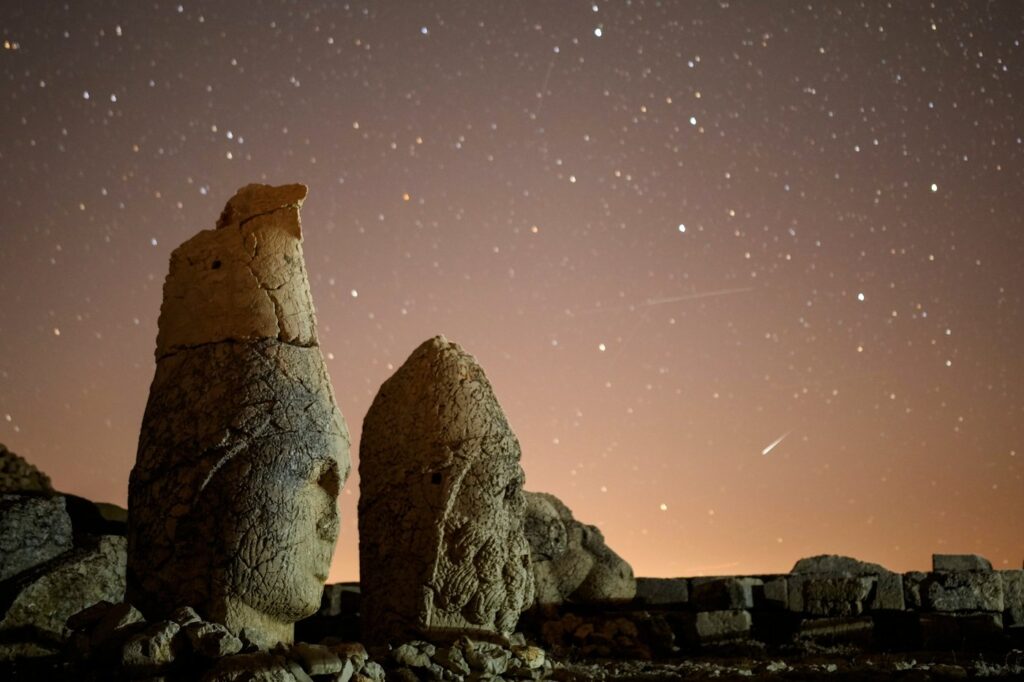
NEW YORK (AP) — The popular Perseid meteor shower is set to illuminate the skies once again, with particularly favorable viewing conditions anticipated for the Northern Hemisphere. This year's peak occurs from Wednesday night into Thursday morning, coinciding with a spectacular total solar eclipse visible in regions such as Spain, Iceland, and Greenland, along with a unique alignment that will see six planets in a parade across the night sky. However, the best opportunity to witness the meteors will come after the eclipse reaches its totality.
Under ideal conditions, astronomers estimate that viewers may catch sight of as many as 50 to 100 meteors per hour, according to NASA. The American Meteor Society provides a more conservative estimate for rural areas, suggesting that observers could see around 30 to 50 meteors per hour. While random meteors can be observed on any dark night, meteor showers, such as the Perseids, are known for delivering impressive displays at scheduled intervals each year. These events occur when Earth passes through the debris trails left by comets and sometimes asteroids, resulting in particles striking the atmosphere at incredible speeds and producing the characteristic streaks of light known as shooting stars.
Astrophysicist Neil DeGrasse Tyson elaborated on the phenomena, explaining that comets possess orbits that intersect with Earth's path. As a comet approaches the sun, the heat causes the ice within it to evaporate, releasing accumulated dirt and debris, which then follows a similar orbital path around the sun. The Perseids specifically originate from comet 109P/Swift-Tuttle, of which the next expected return will not occur until 2125. The history of observations of this meteor shower spans over two millennia, making it a long-standing favorite among stargazers.
The Perseid meteor shower is particularly cherished because it often produces brilliant fireballs, and its timing during the summer months means that enthusiasts can enjoy the spectacle without needing to endure the frigid temperatures of winter nights. Astronomer Zach Vanderbosch from the McDonald Observatory in Texas noted, "We don’t have to suffer through a cold winter night to get a good view of meteors."
This year, conditions for viewing the Perseids will be further enhanced, as the moon will be in its new moon phase during the peak. Astronomer Aparna Venkatesan from the University of San Francisco remarked on the benefits of this lunar phase, stating, "New moon means we don’t have moonlight flooding the sky, and you tend to see way more meteors as a result." This allows for optimal visibility of the meteors without interference from lunar brightness.
For those wishing to observe the meteor shower, the best strategy is to find a location away from city lights and clouds. Venkatesan plans to head to the Sierra Nevada for a clearer view. The prime time for witnessing the meteors will be between midnight and dawn when the constellation Perseus will be positioned high in the northern sky. Observers should look for shooting stars radiating from this constellation.
To adequately adjust to the darkness, it is advised that viewers spend about half an hour allowing their eyes to acclimate. Vanderbosch suggests focusing on a section of the sky until meteors appear, even catching them in peripheral vision while avoiding distractions such as phone screens. Vanderbosch captures the essence of the experience, highlighting the magic of witnessing such celestial events.