UNITED NATIONS (AP) — For many years, Canada maintained a relatively low profile on the international stage, contributing effectively to global affairs without frequently attracting attention. However, this year, the nation of 41 million has adopted a more assertive stance, particularly at the United Nations, as Prime Minister Mark Carney has emerged as a prominent advocate for what he refers to as "middle powers."
Since delivering a significant speech at the World Economic Forum in January, Carney has called for middle powers to collaborate in updating and safeguarding the international order amidst the actions of the United States and other dominant nations. He has demonstrated his willingness to confront U.S. President Donald Trump, rejecting what he deemed unacceptable trade demands and even walking away from negotiations last month, reflecting a shift away from Canada's long-standing reliance on U.S. trade and partnerships.
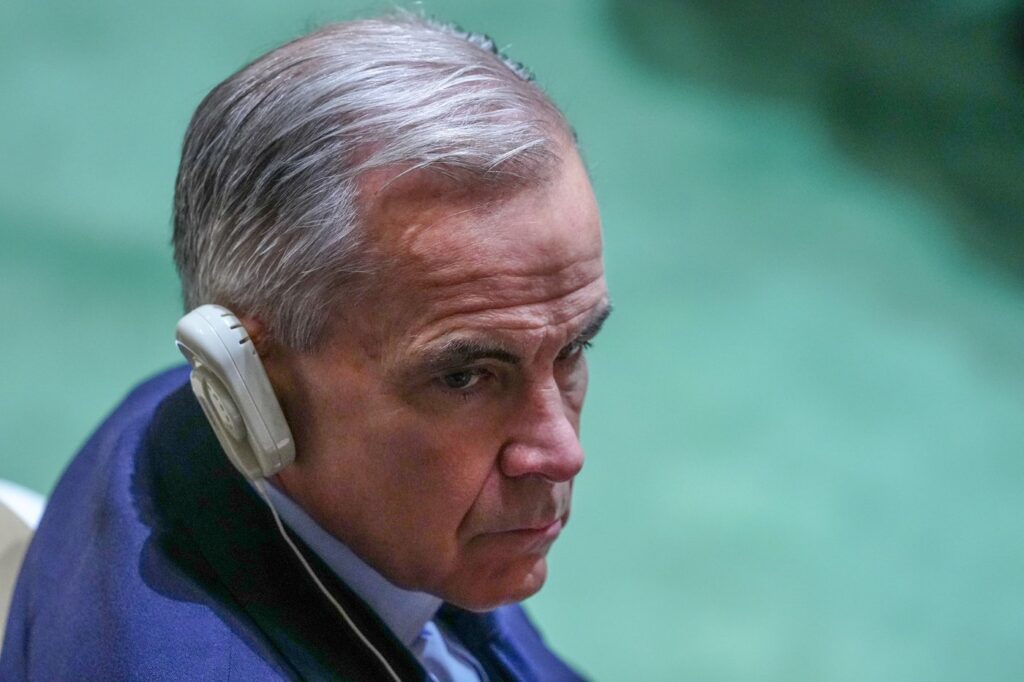
In his remarks, Carney highlighted Canada's reliability and principled approach as valuable assets in a world characterized by unpredictability. Speaking at a news conference at the U.N. during its annual General Assembly meeting, he stressed that Canada’s diplomatic approach balances a commitment to values such as human rights and sustainability with practical alliances that may not conform completely to every value.
As part of this diplomatic strategy, Canada, alongside six other countries, recently established a new coalition aimed at promoting economic cooperation and reinforcing the spirit of international collaboration synonymous with the U.N. Despite experiencing logistical challenges due to a traffic control issue, Carney met personally with various leaders, including King Abdullah II of Jordan and the presidents of Chile and Angola. He also co-hosted a meeting on pursuing a two-state solution to the Israeli-Palestinian conflict, pledging 100 million Canadian dollars (approximately $71 million) in humanitarian and security assistance for Palestinians, reaffirming Canada’s recognition of a Palestinian state.
In the backdrop of these efforts, Carney observed Trump’s address at the assembly, where the U.S. President notably omitted mentions of Canada, amid a backdrop of escalating trade tensions. Following the assembly, Trump took to social media to criticize Canada, calling immigration in the country “destructive.” To counter this narrative, Carney highlighted that immigration levels have decreased in Canada during his tenure.
Carney, who became Prime Minister in March 2025, aims to double Canada’s trade with non-U.S. countries within the next decade. Recently, he convened international investment executives at a summit and aims to secure trade agreements, potentially with India, by the end of this year. His government has celebrated various security and economic agreements with multiple countries, looking to position Canada as a potential economic connector between the European Union and Pacific Rim nations.
His international outreach efforts have sparked some controversy, especially following his historic visit to Saudi Arabia—the first by a Canadian prime minister in over 25 years. This visit marked a reconciliation between the two nations after Canada’s previous government criticized Saudi Arabia's human rights record. Carney emphasized that his approach is guided by the need to engage rather than lecture, promoting an active rather than passive participation in global affairs.
In summary, Prime Minister Carney described his approach to international diplomacy as one that “actively takes on the world as it is, not passively waiting for a world we wish to be,” asserting that his government’s strategy is already demonstrating strength for Canada while suggesting that this is only the beginning of its global engagement efforts.