OTTAWA – Prime Minister Mark Carney revealed in a recent interview with the New York Times that he has explored the possibility of U.S.-led military action in Canada. Although he did not delve into specific details about this examination, Carney emphasized the importance of considering what he calls “extreme tail risk,” suggesting that it would be irresponsible not to prepare for such scenarios.
During the interview, Carney stated, “I think you have a responsibility in these roles to look at extreme tail risk. That’s just risk management. That’s not a base case, but it would be irresponsible not to (prepare).” His comments come in the context of ongoing tensions between Canada and the United States, particularly under the leadership of U.S. President Donald Trump.
Trump has previously expressed interest in the notion of making Canada the 51st state. Although he ruled out military action for annexation in January 2025, he indicated a willingness to employ “economic force” to convince Canada to join the United States. These remarks have raised concerns about potential conflicts and policy implications affecting bilateral relations.
In the same interview, Carney addressed Canada’s strategy to reduce its dependence on Elon Musk's Starlink satellite internet service. He also discussed the country’s consideration of alternative options for acquiring American F-35 fighter jets. Currently, the procurement of a complete fleet of F-35 stealth fighters is under political review by Carney’s administration, a process that has been ongoing for over a year in response to the trade war initiated by Trump.
The trade war has intensified following failed negotiations for a trade deal in mid-August. Just a day after the talks collapsed, Trump enforced 50 percent tariffs on $28 billion worth of Canadian goods. Canada retaliated with its own tariffs in early September, further escalating the financial confrontation between the two countries. Additionally, Trump signed an order to identify Canadian products to be removed from U.S. government procurement systems.
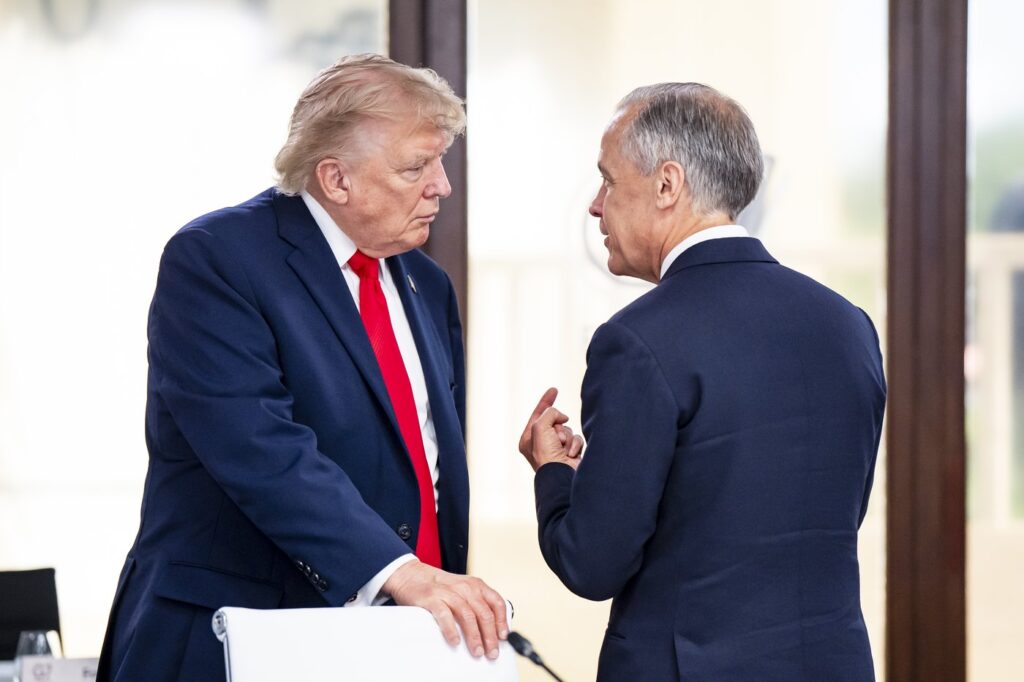
Notably, Carney mentioned that he maintains regular communication with Trump, even after trade discussions ceased. This information highlights Carney's approach to diplomacy, as he noted during a recent news conference with Ukrainian President Volodymyr Zelenskyy that they can "compartmentalize" their discussions. He emphasized the necessity of cooperating to tackle global issues such as the ongoing war in Ukraine.
On social media earlier Wednesday, Trump made claims that Canada is “destroying itself” by allowing a significant influx of people into the country “essentially unchecked and unvetted.” Trump provided no substantiating evidence for his statements, alleging that this situation is indicative of a “Liberal takeover that will end very badly.”
During the recent 81st session of the United Nations General Assembly, both Carney and Trump were present, although they did not meet. This marked Carney’s first visit to the United States since trade negotiations faltered last month, underscoring the complexity of the diplomatic landscape between the neighboring countries.