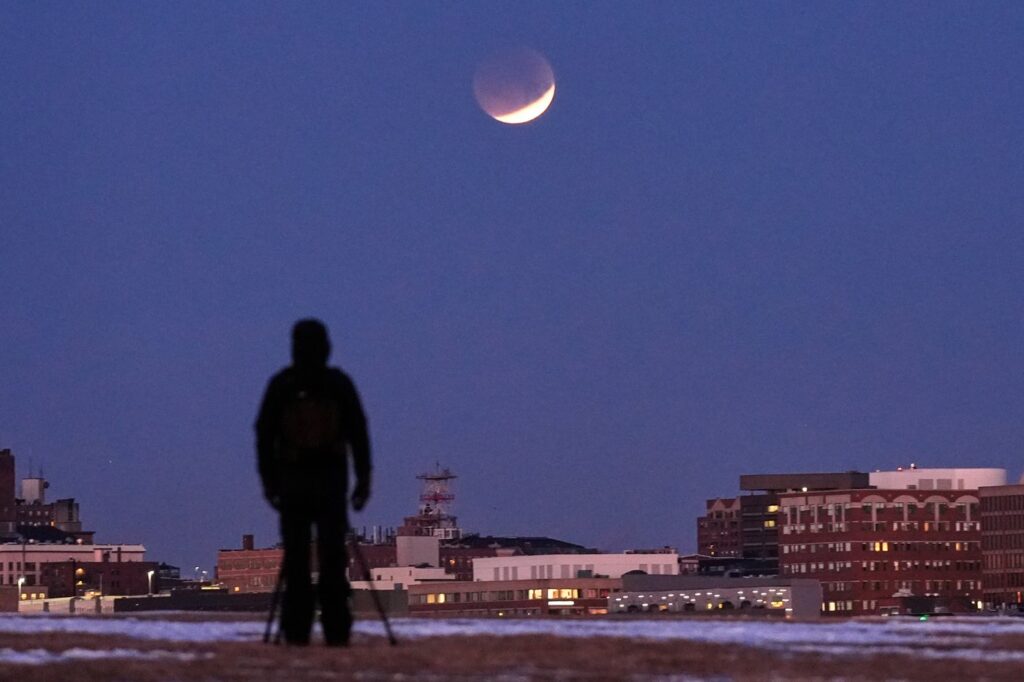
CAPE CANAVERAL, Fla. (AP) - The moon is set to take center stage with a partial lunar eclipse occurring Thursday night into Friday, where a significant 96% of its surface will be covered by Earth's shadow. This lunar event follows the total solar eclipse that recently made its way across Greenland, Iceland, and Spain, showing that eclipses tend to occur in pairs as the sun, moon, and Earth align in a precise manner.
The upcoming lunar eclipse will provide a spectacular view for billions of people across North and South America, Europe, Africa, and the Middle East, assuming clear skies. NASA's Artemis II astronauts, who conducted a historic lunar flyby in April, add to the excitement surrounding space exploration. The flyby is a precursor to future lunar missions aimed at establishing a base on the moon inhabited by both humans and robots.
NASA astronaut Jack Hathaway, currently aboard the International Space Station (ISS), expressed enthusiasm about this period in space exploration, stating, "This is a great time to be part of the space program. We’re not slowing down." The second act of this celestial series offers a much larger audience compared to the recent solar eclipse due to its broader visibility.
During the eclipse, Earth's shadow will cast a reddish-orange hue onto the moon. Though the moon will not enter the full shadow, creating a traditional blood moon, the partial eclipse's duration will exceed three hours, with the entire event lasting approximately 5.5 hours. The peak of the eclipse is expected to occur just after midnight Eastern Daylight Time (EDT).
Nearly 1 billion people in the United States, Canada, and parts of Central and South America will have a prime view of this cosmic spectacle. In total, over 3 billion people, or about 44% of the global population, will be positioned to see at least a portion of the eclipse. However, the view will vary across different regions; the eclipsed moon will appear to be setting in Europe, Africa, and the Middle East, while it will be rising in Hawaii, marking a late start for the eastern Pacific, as well as northwestern sections of the U.S. and Canada.
This lunar eclipse marks the second of the year and the fourth of all types of eclipses. A total lunar eclipse previously illuminated the skies over the Americas, Australia, and eastern Asia in March. Looking ahead, the next total lunar blackout won't occur until New Year's Eve 2028, with Asia and Australia as the focal points. Stargazers in North and South America will not see another full lunar eclipse until 2029.
The anticipation surrounding the lunar eclipse underscores not only the intrinsic beauty of celestial events but also highlights the current advancements in space exploration. With astronauts like Hathaway continually orbiting above, they will have the opportunity to witness this celestial marvel from a unique vantage point.