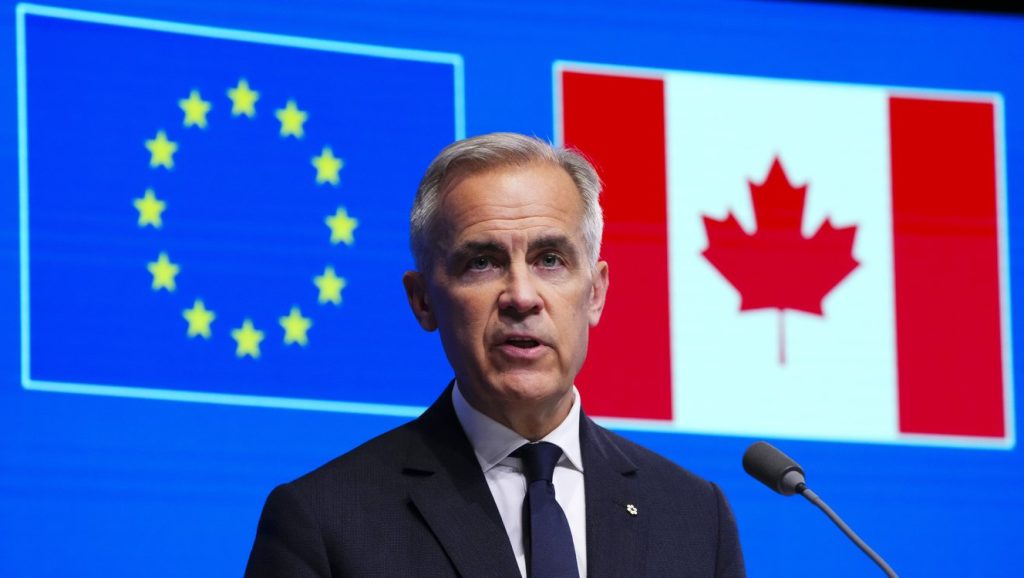
OTTAWA — The European Union's ambassador to Canada, Geneviève Tuts, has announced that the EU is in the process of developing a unique partnership with Ottawa that differs significantly from its existing relationships with other nations. This initiative is designed to foster a stronger collaboration between Canada and the EU, aiming to create a bond that is not replicated in its agreements with countries like Switzerland, Norway, or the United Kingdom.
Prime Minister Mark Carney indicated last month that he is working towards establishing deeper ties with Europe following the signing of a defence-industrial pact alongside the current strategic partnership agreement and free-trade deal. "This fall, we will begin discussions with the European Union — the world’s second-largest economy — to build a much stronger and deeper security and economic partnership," Carney stated on August 22.
Tuts emphasized that the specifics of the proposed partnership are still being formulated but assured that it would not mirror any existing arrangements with other nations. The importance of the upcoming discussions between Carney and EU officials, scheduled for the European Parliament in Strasbourg, France, next week, has been underscored, marking a rare invitation for a non-European leader to participate in such discussions.
While there are media speculations suggesting that a potential deal could be announced at this meeting, Tuts clarified that the focus would be on exploratory discussions rather than formal agreements. Following these discussions, Brussels intends to consult with EU member states while Canada will engage with its provinces to prepare for a possible announcement during a summit scheduled for late October in Canada.
"It’s more than filling gaps," Tuts explained. "The idea is to go further in the integration, on substance and on the way we are working together." The emphasis will be on identifying collaborative goals and determining how to achieve them within a structured format.
Achim Hurrelmann, co-director of the Centre for European Studies at Carleton University, expressed concern regarding the hurried nature of the negotiations, suggesting that there may not be substantial details available at this moment. "I wouldn’t expect much detail at this stage, because my understanding is that they are really a little bit scrambling for ideas of what to include in this new package," he remarked.
Hurrelmann mentioned potential areas for collaboration could include initiatives such as creating a European stockpile of critical minerals, enhancing university student exchanges through programs like Erasmus, and establishing a digital trade agreement. However, he articulated uncertainty about whether these initiatives would coalesce into a truly systematic advancement in the EU-Canada relationship.
Furthermore, he highlighted potential challenges that could affect deeper ties, including Canada's ongoing adjustment to its trade access with the U.S. market and Europe's encounter with rising far-right movements that exhibit skepticism towards the EU.
Canada has already been recognized as the first non-European ally to participate in the EU's Security Action for Europe (SAFE) program, aimed at joint defence projects, albeit only one project has materialized for Canada under this initiative thus far. In December, the EU assessed a significantly lower fee for Canada compared to the U.K. for partner contributions based on anticipated economic benefits.
Hurrelmann pointed out the historical trend in Canada-EU relations, noting, "As always in the Canada-EU relationship, it’s easier to come up with big pronouncements of new initiatives than to actually follow through on these announcements." Next week in Strasbourg, European Commission President Ursula von der Leyen is slated to deliver her annual address outlining the EU's priorities for the upcoming year, after which Carney will present his insights to the members of the European Parliament on the following morning.
The forthcoming EU-Canada summit is set to take place from October 29 to 30, with the location yet to be confirmed. Tuts revealed that the Canadian government has allocated various personnel to manage the intricate collaborations envisioned with the EU, addressing a wide range of topics from critical minerals to countering disinformation. "We are living in a very fascinating moment in the relationship. We are closer than ever — and we will be even closer," she stated, indicating a forward-looking perspective on the evolving partnership.