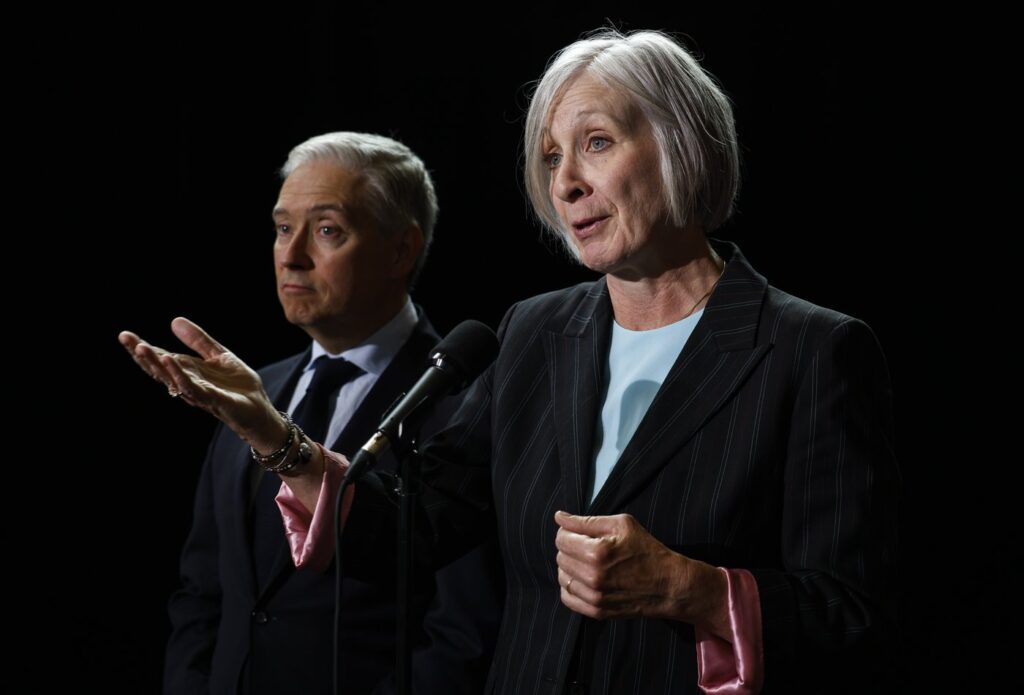
OTTAWA — Jobs Minister Patty Hajdu announced plans for upcoming legislation aimed at reducing the federal government's frequency of intervention in strikes. Speaking to reporters on Parliament Hill, Hajdu mentioned that the forthcoming amendments to the Canada Labour Code are intended to empower parties to resolve their issues at the negotiating table, rather than relying on government intervention. She emphasized that while the government currently possesses the power to intervene, the objective is to minimize the instances where it is required to step in to mediate between employers and unions.
Employers and unions have expressed divergent views regarding the use of Section 107 of the labour code, which has increasingly been employed to mitigate work stoppages in critical industries by directing disputes to the Canada Industrial Relations Board. A recent report from Employment and Social Development Canada highlighted the ongoing division on the extent of intervention powers that Ottawa should maintain in labour disputes.
Transport Minister Steven MacKinnon clarified that the pending legislation, expected to be introduced in the House of Commons as early as next week, is not aimed at infringing on the right to strike. He stated, “What we want to do is make achieving collective agreements easier,” indicating a focus on facilitation rather than restriction.
In response to the proposed changes, Bea Bruske, president of the Canadian Labour Congress, expressed concerns about the potential impact on the right to strike. She maintained that such a right is crucial to Canada's economic security, as it allows workers to negotiate for improved wages, working conditions, and job security. Any expanded government power to prevent or shut down legal strikes, according to Bruske, would diminish workers' bargaining power.
Derrick Hynes, CEO of Federally Regulated Employers—Transportation and Communications, advocated for changes in the Canada Labour Code that could incorporate mechanisms to avert “catastrophic” labour disruptions. He suggested the inclusion of a neutral, third-party special mediator equipped to provide public reports on bargaining processes, which could subsequently inform government actions. Additionally, Hynes argued that in rare situations where labour disruptions pose significant threats to the national interest, the cabinet should possess the authority to impose binding arbitration before irreversible damage occurs.
Prime Minister Mark Carney held discussions with his Liberal caucus in Ottawa as MPs prepare for the upcoming fall session of Parliament. During these meetings, Carney indicated that the session is set to be dynamic, with plans to introduce major legislation that he believes will be consequential not just for the government but for Canada overall. He outlined that the government is focused on initiatives to reduce costs for Canadians and to fortify national sovereignty while preparing to introduce a new budget in the fall sitting.
As part of their legislative agenda, Carney announced the forthcoming “Building Canada Strong Act,” aimed at streamlining project reviews. He emphasized a simplified process: “one project, one review, one year,” advocating for efficient decision-making regarding project approvals.
This legislative push occurs amid ongoing trade tensions with the United States, particularly under President Donald Trump's administration, which has posed challenges to Canada’s economy and sovereignty. Following stalled negotiations with the U.S. in August, Carney's government has faced increased tariffs from the Trump administration, prompting countermeasures from Canada.
Industry Minister Melanie Joly recently engaged in talks with U.S. Democratic politicians, including discussions with Illinois Governor J.B. Pritzker aimed at working collaboratively to eliminate tariffs. Joly echoed sentiments from Carney, acknowledging that the trade relationship with the U.S. has fundamentally changed and emphasized the importance of diversifying Canada’s trade partnerships and reducing dependence on the U.S. market.
Carney is scheduled to attend the United Nations General Assembly next week, where interactions with President Trump could occur, although there are no meetings currently planned with U.S. officials. When questioned about the possibility of meeting Trump in New York, Carney provided no definitive answer.