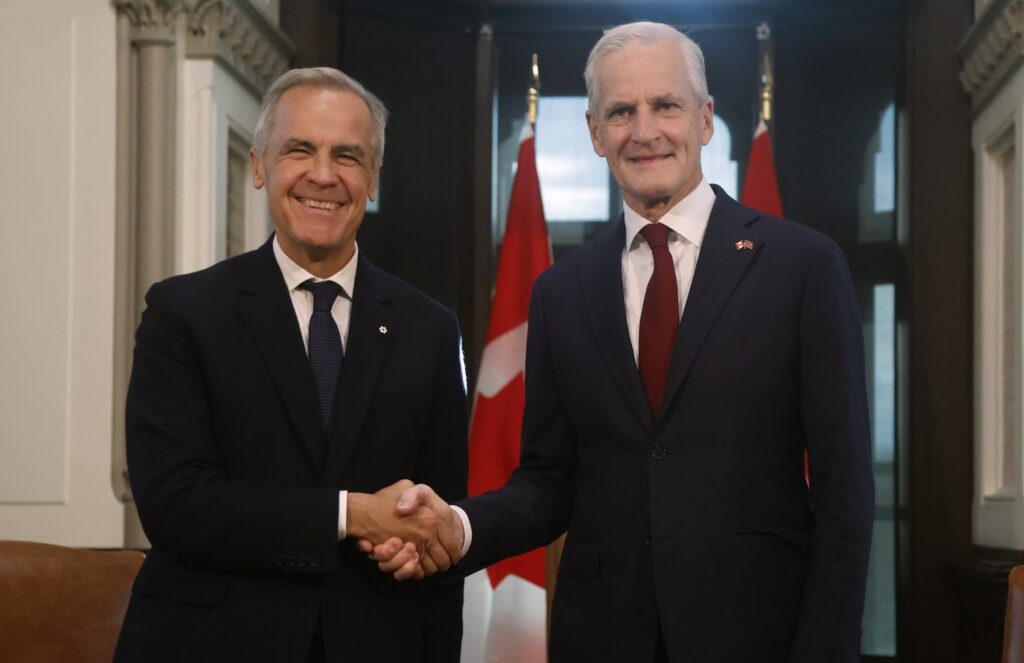
OTTAWA – Prime Minister Mark Carney emphasized the importance of building international relationships, particularly with Norway, as a strategic response to the ongoing threats posed by Russia. This statement came during a news conference held in Ottawa with Norwegian Prime Minister Jonas Gahr Store, where both leaders addressed escalating warnings from Poland regarding potential hybrid attacks by Russia on European nations supporting Ukraine.
During the conference, Store underscored the seriousness of these warnings, mentioning that Norway's intelligence assessments indicate "real threats coming from hybrid activity, ranging all the way to potential sabotage." While Carney did not assess the credibility of the threats directly, he expressed agreement with Store's alarming observations.
Carney highlighted the advantages of enhancing relationships, which include improved intelligence sharing, broader perspectives, and collaborative capabilities among Arctic nations. "One of the advantages of this relationship and deepening across a broad range of relationships is, yes, greater intelligence sharing, greater perspective, greater capacities that are built together," he stated. He also emphasized the need for submarine and space capabilities as well as the necessity of having "the right partners" in the Arctic region.
In July, Carney made headlines by selecting a European shipbuilder for the purchase of a dozen submarines over a Korean competitor, which followed a competitive bidding process. This partnership includes collaboration with a German company alongside Norway, aimed at joint production and maintenance of the submarines.
Before the meeting with Store, Carney visited Saint-Pierre and Miquelon to engage with French President Emmanuel Macron. This meeting, along with discussions in Norway and with Store, reflects Carney’s larger strategy to fortify relationships within Europe. Carney stated, "the time spent whether it’s in the high north in Norway, a meeting with the French president who’s directly implicated in a number of these decisions, our meeting today and beyond, it’s all connected."
Later that day, the Prime Minister's Office announced the signing of several agreements between Canada and Norway, encompassing Arctic and Antarctic scientific research, development of space-based capabilities, and joint mapping of critical minerals. Both nations also expressed intentions to advance an enhanced Defence Cooperation Agreement in the upcoming year.
In a joint statement, Norway and Canada confirmed their commitment to strengthen deterrence and defense in the Arctic, highlighting Arctic security as a matter of national security for both countries. The meeting comes at a time when Carney is actively seeking to strengthen ties with Europe, including exploring the possibility of "associate membership" in the European Union.
Norway is not an EU member but has maintained an agreement with the EU for over thirty years that allows unrestricted access to each other’s markets, thus benefiting from most EU programs. Carney aims to cultivate deeper defense ties with Norway and attract investments from its substantial petroleum-based sovereign wealth fund.
Carney became the first sitting Canadian prime minister to visit Norway in over four decades during a trip in March. The collaboration established during that visit covered various sectors, from Arctic security to space, critical minerals, and energy, with both leaders advocating for their nations’ statuses as low-risk global oil producers amidst global supply disruptions related to conflicts, such as the tensions deriving from policies related to Iran.
Officials from both nations have consistently recognized Canada as a counterpart, as both countries seek to balance a significant oil industry while advancing green energy initiatives and honoring Indigenous rights. They share a commitment to employing multilateral institutions for conflict resolution and show unwavering support for NATO, maintaining strong connections with the EU without being members.
With both nations positioning support for Ukraine as central to their foreign policies in light of Russia's invasions in 2014 and 2022, the impending Arctic foreign policy introduced by Canada in late 2024 calls for enhanced ties with Nordic countries regarding defense, strategic sectors, and environmental issues.