

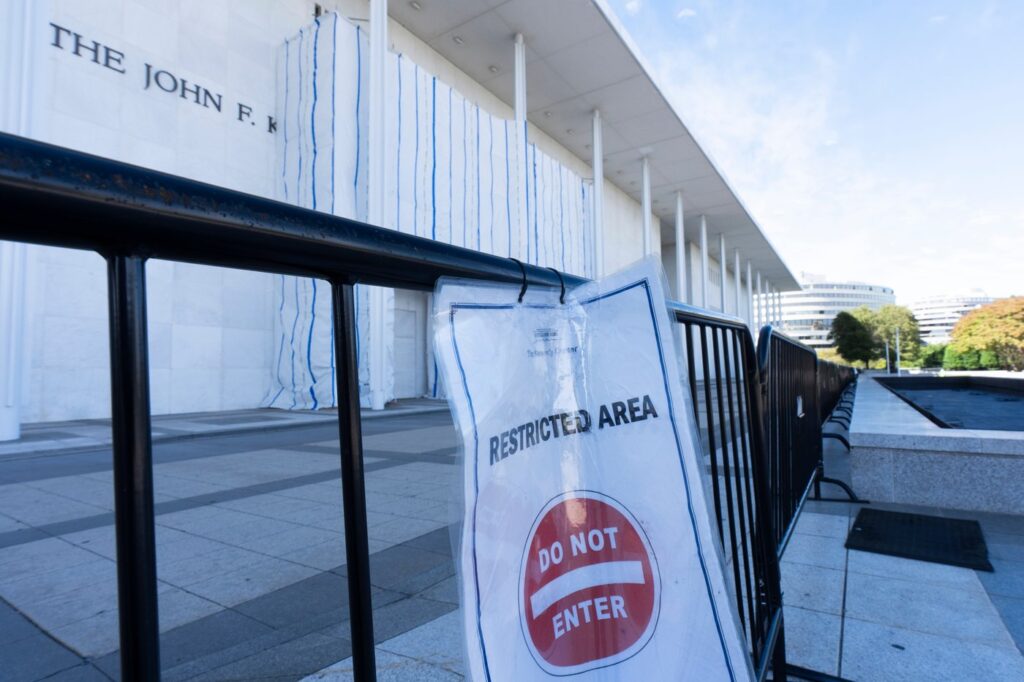
The Kennedy Center has come under fire following allegations from a group of former employees that officials were aware of critical structural issues well before the recent decision to close the performing arts venue. These former employees detail their claims in a letter to Congress, asserting that the center's executive director and chief operating officer, Matt Floca, neglected pressing roofing concerns and halted a funded plan to address these issues in April. David Seide, a lawyer representing the whistleblowers, signed the letter that accuses Floca of not prioritizing these safety problems.
Floca has responded to the allegations by asserting that an inspection revealed new hazards at the facility, thus prompting a temporary closure. In a declaration made in September, Floca mentioned there were “acute risks to public safety” due to a deteriorating roof terrace canopy and a partial ceiling collapse. However, the whistleblowers contest that these hazards had been known to Floca prior to the building's abrupt closure. They point out that more than a year before the issues came to light, Floca had successfully requested funds to remediate these "new problems," which reference actions authorized under legislation signed by President Donald Trump in 2025, allocating $257 million for the Kennedy Center.
The letter detailing these claims garnered attention in the media, with the New York Times being among the first to report on this saga, which has been marked by escalating tensions surrounding the renowned Potomac River waterfront venue. These tensions have escalated during Trump's second term, wherein he appointed individuals aligned with his agenda to the governing board of the center. Furthermore, Trump’s name was controversially placed on the building before a judge intervened, deeming the new signage was added unlawfully and ordering its removal.
Recently, the Trump-appointed board voted to close the Kennedy Center indefinitely for repairs, shortly after U.S. District Judge Christopher Cooper impeded plans to restore Trump’s name on the building. Cooper also mandated that the center must provide a 30-day notice prior to enacting any significant physical changes, including its potential demolition, an action Trump has reportedly threatened. Additionally, Kennedy Center leadership has been instructed to file a status report regarding the temporary closure and necessary emergency repairs.
When approached regarding the whistleblowers' accusations, a spokesperson for the Kennedy Center provided a statement from Floca, who reiterated that the safety of everyone associated with the center remains his top priority. Floca acknowledged that the center was aware of leaks in the roof overhang for years, yet stated that the extent of the internal damage was only revealed during a summer inspection.
Floca defended himself against claims that he had stalled design plans by asserting his decision to reallocate efforts towards a more comprehensive repair strategy. He clarified that the contractor's estimate for the original plans was nearly three times higher than expected, necessitating a shift in approach rather than a postponement of essential repair work.
Rhode Island Senator Sheldon Whitehouse, who is the leading Democrat on the Senate Committee on Environment and Public Works, wrote to Floca after his office received the whistleblower letter. Whitehouse’s correspondence articulated concerns that the Kennedy Center had been “hoarding” congressionally allocated funds for repairs while placing blame for the current state of disrepair on past leadership. He remarked that his preliminary investigation into misconduct at the center had initially centered on cronyism and financial impropriety under Trump’s chairmanship, but that new documents now suggest deeper financial mismanagement.
The Kennedy Center's ongoing issues represent a complex intersection of politics, administration, and the pursuit of public safety, casting a long shadow over the future of the esteemed cultural institution.








